
Already running Amazon Ads? How the engine works alongside your campaigns
What happens to the campaigns you already run when you start the ad engine, how to hand products over gradually, how Autron AI and Autron Strategic differ, and how to hand a campaign to the engine.
TL;DR: The engine builds and runs its own campaigns in an Autron AI portfolio and never edits campaigns you created. Campaigns the agent builds outside the engine sit in Autron Strategic at fixed bids; move one into Autron AI and the engine takes it over. Start on a few products, then pause your own campaigns on them or accept that the two compete for the same clicks.

Starting the ad engine does not touch what you already run. It creates its own campaigns — one per keyword or target, plus one automatic-targeting campaign per product — grouped in a portfolio named Autron AI in your Amazon Ads console, and bids only on what sits in that portfolio. Campaigns you or your agency built are left exactly as they are.
Hand over one product at a time
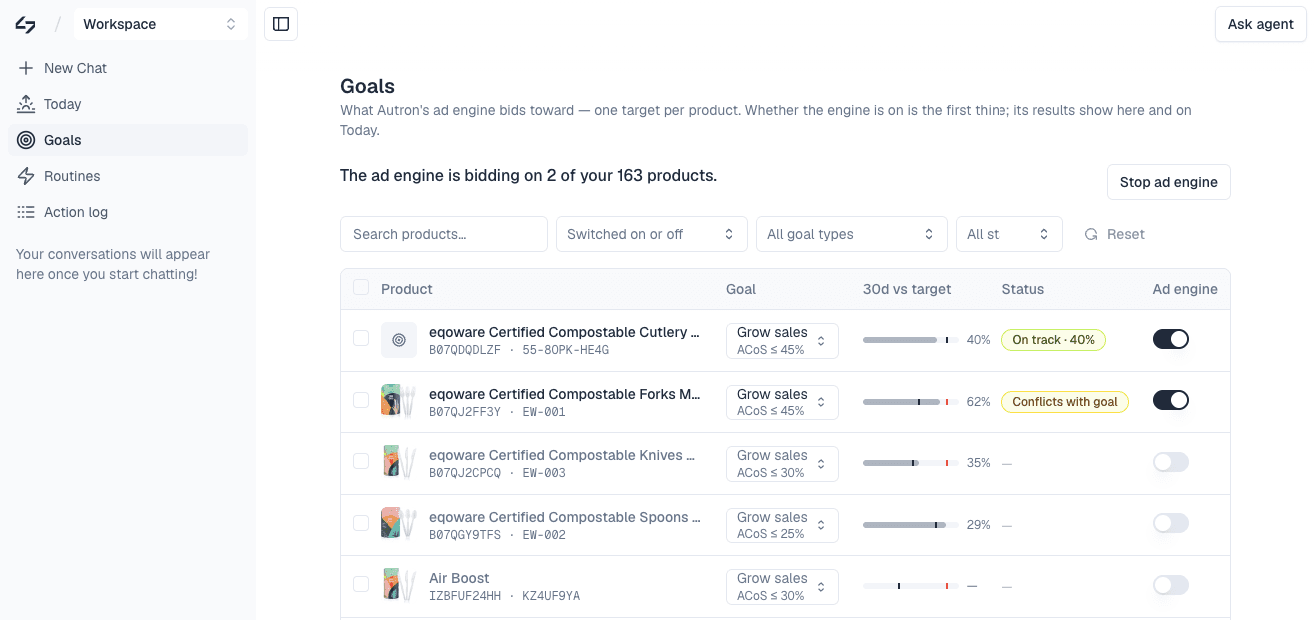
Open Goals. Every product has its own switch, so you decide what the engine takes over and what you keep running yourself. Start it on a handful of products, leave your own campaigns running alongside, and add more once you can see how it is doing against each target.
Two sets of campaigns on one product compete
Amazon runs one auction per search. If your own exact-match campaign and the engine's campaign both bid on the same keyword for the same product, they bid against each other: you pay more than you needed to for the click, and the engine's campaigns lose the impressions they need to learn from. It never wins that argument, because the other side is you.
So for each product you switch on, pick one:
- Pause your own campaigns for that product — in Amazon Ads, or ask the agent to. Cleanest. The engine takes over the keywords and learns from a clean slate.
- Keep specific campaigns running deliberately — a launch you are running your own way, say. Leave them where they are: the engine never touches a campaign outside the Autron AI portfolio.
What you should not do is leave everything running and compare the two after a week. Neither will look good.
Autron AI or Autron Strategic?
Autron's campaigns sit in two portfolios, and the difference is who sets the bids.
| Autron AI | Autron Strategic | |
|---|---|---|
| Who builds it | The engine, from your search terms and the keywords you give it | The agent, when you ask for a campaign outside the engine |
| Bids | Tuned every day toward the product's goal | Stay where they were set until you change them |
| New targets and negatives | Added by the engine from your search terms | Only what you add through the agent |
For most products, Autron AI is the one to use: it works toward your goal without you, and it is where the agent sends your keywords for a product the engine runs (see Suggest keywords and targets). Autron Strategic suits a term you want held at a bid you choose, such as a test, and then keeping an eye on its ACoS is up to you. Ask for it in so many words — "a campaign outside the engine" — or the agent hands the keyword to the engine instead.
"Outside the engine" means any campaign the engine doesn't bid on: those in Autron Strategic, and those you or your agency built.
Campaigns the agent builds land in Autron Strategic unless you ask for another portfolio, and two things set them apart from your own campaigns. Switching a product off on Goals pauses its Strategic campaigns along with the engine's, except any you've stepped in on, and switching it back on does not restart them. And they count as Autron-managed work, so on Pro their ad sales count toward the Autron-attributed sales its share is charged on. See Autron plans.
Handing a campaign to the engine
A campaign the agent built can be handed to the engine whenever you like: ask the agent to move it into the Autron AI portfolio. It keeps its bids until the engine's next daily run, and from then on the engine manages it like one it built — bids, placements and negatives — toward the product's goal. The product's switch on Goals must be on. This is the way to give the engine a keyword that already has a Strategic campaign, and the way to bring an auto campaign the agent created under the engine.
Your own campaigns don't move over this way: they are named your way, so the engine can't tell which product each one is for. To hand those over, pause them and give their keywords to the engine.
Archive a campaign only when you want it gone. The engine won't build a keyword for a product while a Strategic campaign for that product has it, even paused, so archiving does free the keyword — but the archived campaign's name stays unavailable to the engine for about three months, and nothing runs that keyword until the engine builds its own. Archiving an auto campaign that way can leave the product without one. Moving the campaign instead keeps it running throughout.
What the engine reads from your history
Your existing campaigns are not wasted. Their search-term history is what the engine studies on day one: which terms have converted, which have spent without selling, and where your brand terms sit. That history shortens its learning phase, which is why an account with a year of campaigns settles faster than a new launch.