
Amazon Is Retiring Sponsored Brands Product Collection Ads: Your Migration Plan Before January 2027
Amazon shuts off the Sponsored Brands product collection format in January 2027, and new campaigns already convert automatically. Here is what changes and how to migrate.
TL;DR: Amazon shuts off the legacy Sponsored Brands product collection format in January 2027, and since September 2026 any new product collection campaign converts to a Manual Collection instead. Existing campaigns keep serving until then. The replacement, Sponsored Brands collections, needs 3 to 10 ASINs and drops custom headlines and lifestyle images, so migrate on your schedule, not Amazon's.

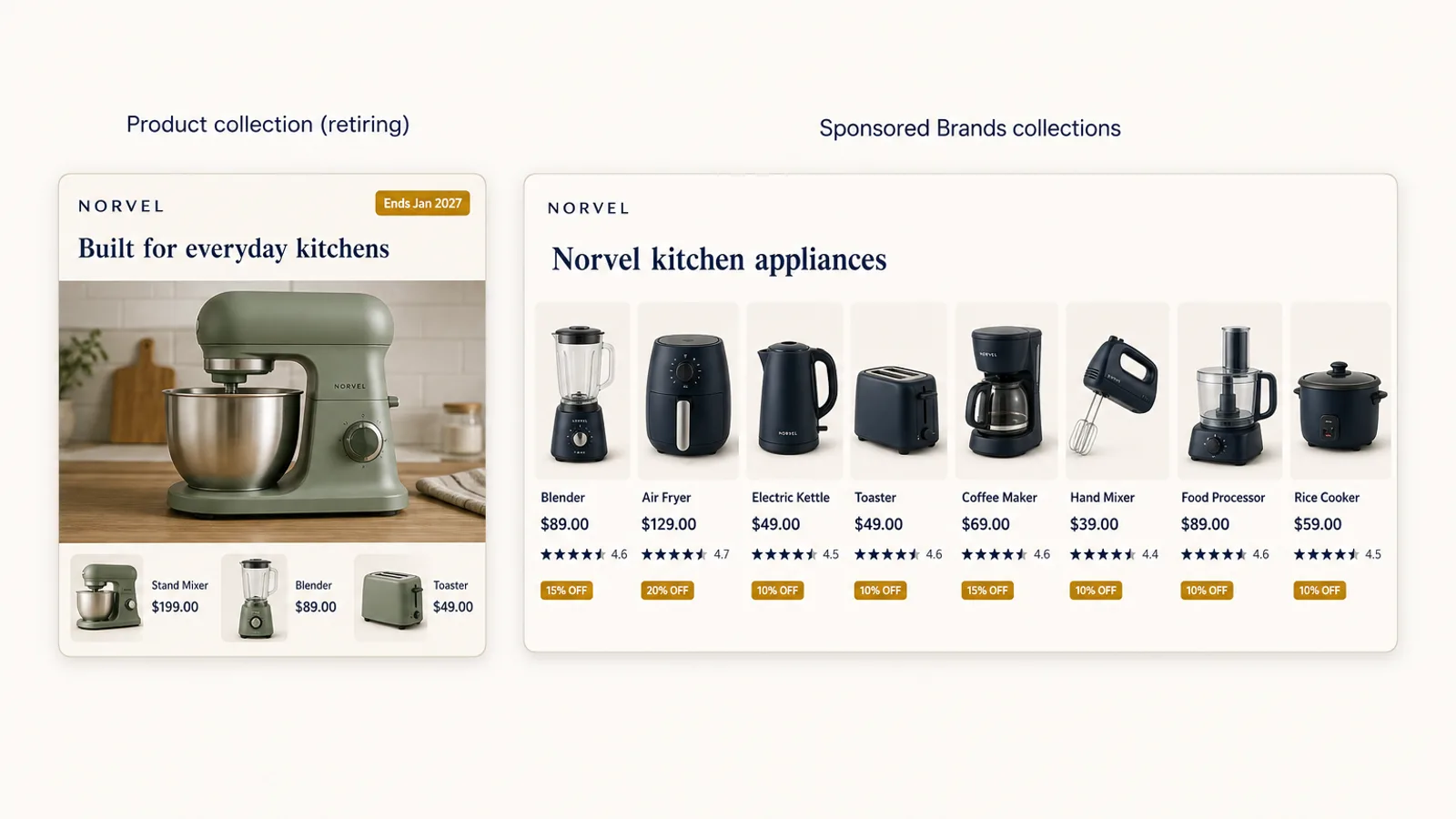
If you run Sponsored Brands, the ad unit you have been building campaigns in for years now has an expiry date. Amazon has confirmed that the legacy Sponsored Brands product collection format shuts off entirely in January 2027, and the transition is already underway. Since September 2026, any newly created product collection campaign is converted into a Manual Collection instead, and Ad Optimizer has stopped supporting new product collection creation.
Nothing breaks this week. Existing campaigns keep serving and stay manageable until the deadline. But the interesting part of this change is not the shutdown date, it is what the replacement format takes away, and what that does to campaigns you have been reading performance from for years.
The timeline, in the order it actually happened
This has been a staged retirement, not a single announcement, which is why a lot of sellers only noticed the last step.
- January 28, 2026. Product collections were overhauled in place. The ASIN requirement moved from one product to a minimum of three and a maximum of ten. Custom headlines and lifestyle images were removed. Ad groups with one or two ASINs kept serving but could no longer be expanded.
- May 27, 2026. Amazon launched Sponsored Brands collections as the successor format, across North America, Brazil, much of Europe, the Middle East, Australia and Japan.
- September 2026. New product collection campaigns began auto-converting to Manual Collections. Custom images submitted during this window are still accepted on upload but do not render in the live ad, which is a quiet way to waste an afternoon.
- January 2027. Full shutdown. No creation through the console, none through the API.
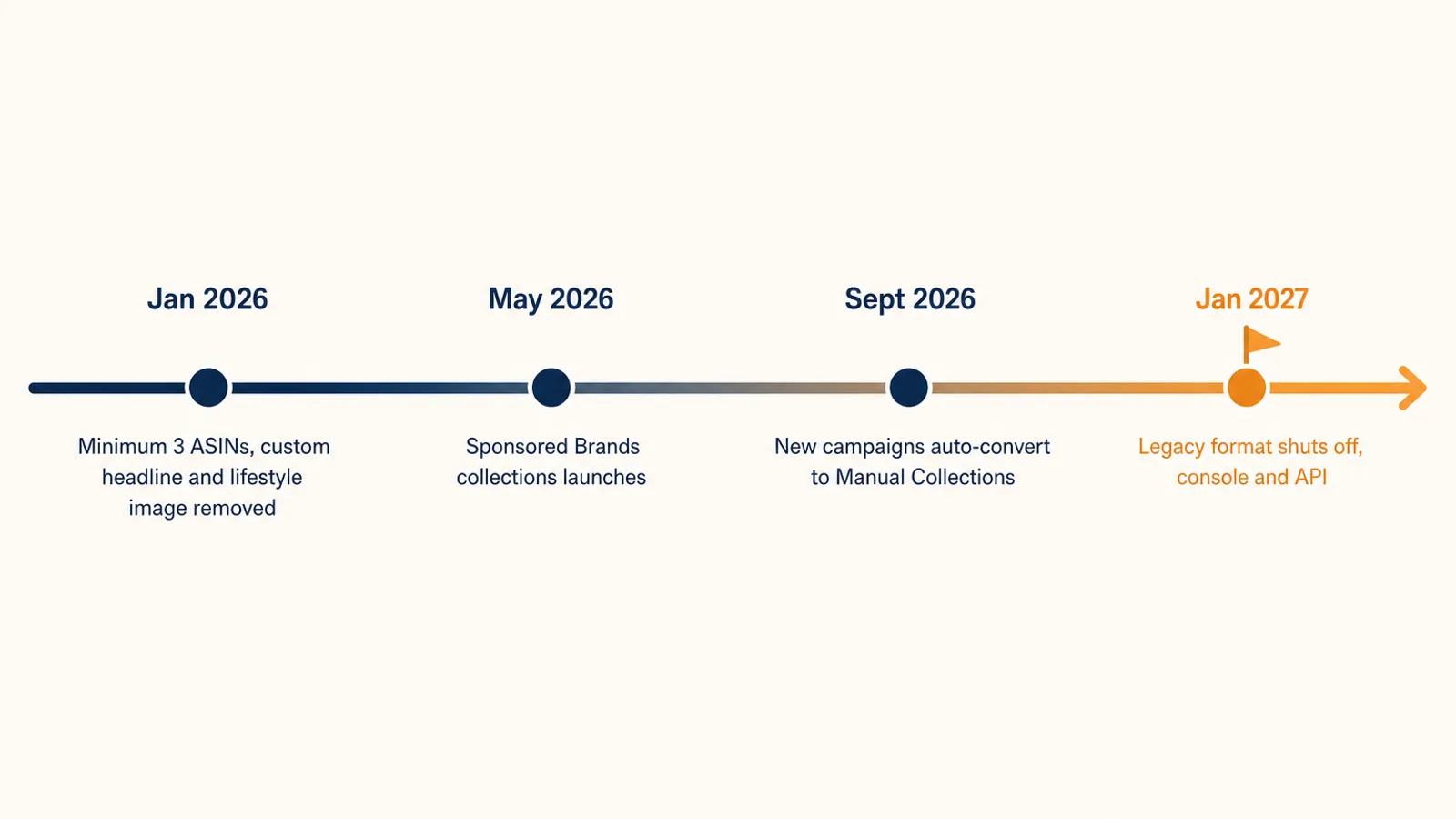
The practical reading: you have roughly one Q4 and a few weeks either side. Migrating during peak season is a bad idea, so your real window is either the next few weeks or late January, and late January means Amazon picks the moment, not you.
Manual or automatic: the choice you are actually making
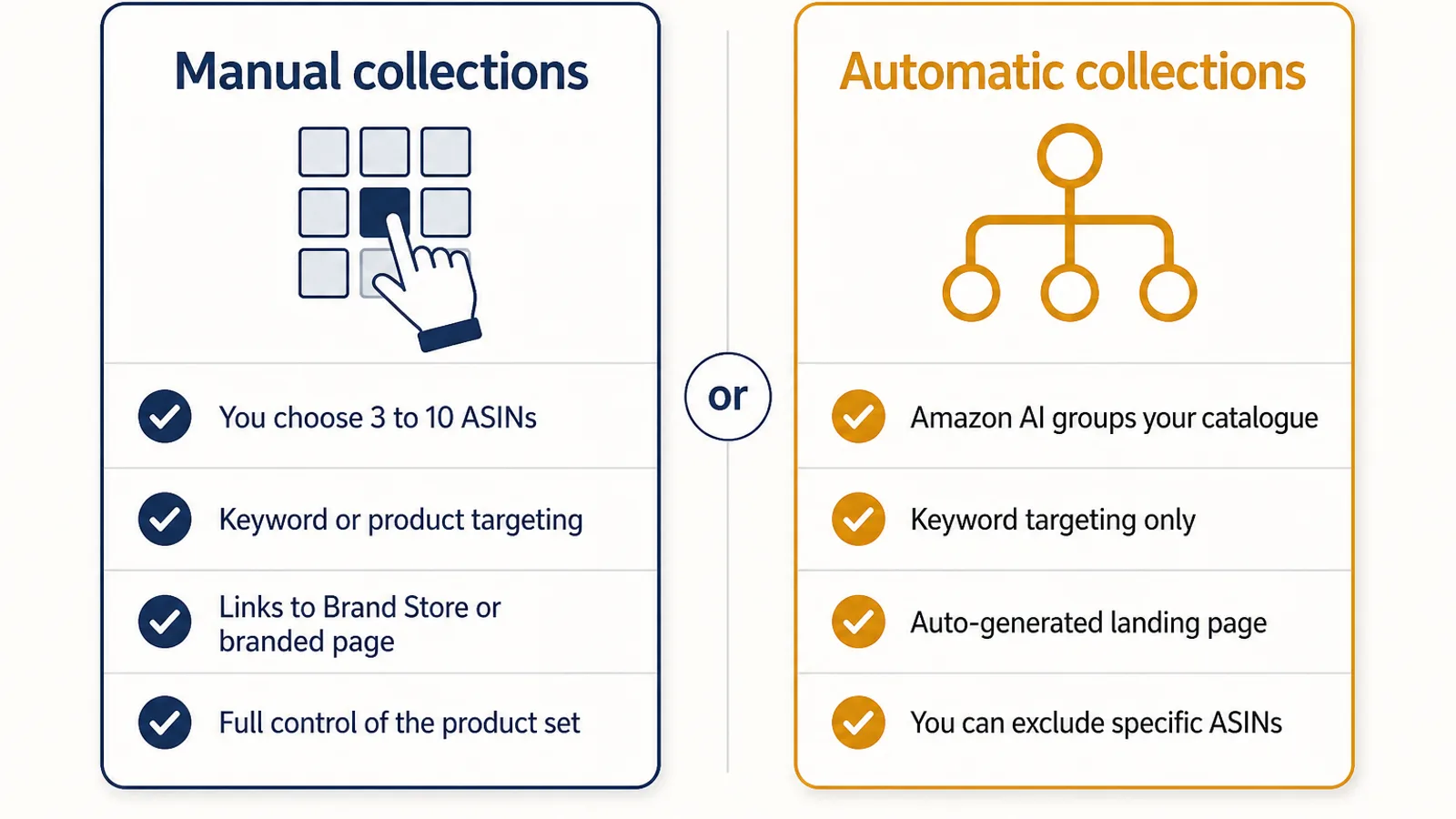
Sponsored Brands collections ship in two shapes, and the difference matters more than the naming suggests.
Manual collections. You select between 3 and 10 related ASINs yourself. You can use keyword targeting or product targeting. You can send traffic to a branded experience featuring your products or to a Brand Store page. This is the closest thing to what you had, minus the creative control.
Automatic collections. Amazon's AI groups the most relevant products from your catalog into collections based on your keyword targets and shopper search queries. Targeting is keyword only. The landing page is auto-generated. You can exclude specific ASINs from being featured, which is the main steering wheel you retain.
Amazon's own numbers on the format, from its collections guide, are worth reading precisely rather than as a headline. Early US beta results showed a 19% increase in clicks and a 44% increase in conversions compared to the prior top-of-search ad experience. Separately, automatic collections reached 3x more unique search queries per campaign and drove 2.5x more unique products purchased than manually curated collections. Both figures come from Amazon internal testing in 2025.
Those are real and they are also exactly the numbers you would expect from a format that broadens reach. More unique queries per campaign is a statement about coverage, not about efficiency. It tells you the automatic version will find traffic your manual keyword list would not have, and it tells you nothing about what that traffic converts at on your margin.
What you lose, stated plainly
Three things go away, and it is worth being honest about each.
The headline. Custom copy was the main reason Sponsored Brands felt different from Sponsored Products. A collections ad renders with an auto-generated title instead. If a handwritten line was doing real work for your brand, Sponsored Brands video is now where that lever lives.
The lifestyle image. Gone too. Collections are product-centric by design: product images, price, ratings, deals, logo, call to action. The unit has moved from a brand banner toward a merchandising shelf.
Product targeting, if you go automatic. This one catches people out. Automatic collections support keyword targeting only. If you run Sponsored Brands ASIN defense or competitor conquesting through product targeting, that budget has to stay on manual collections or move to Sponsored Products. There is no automatic path for it.
And for brands with one or two ASINs, the format is simply over. The three-product minimum from the January 2026 overhaul is not negotiable, and it is not coming back.
The part that quietly breaks your reporting
Here is the operational issue that outlasts the migration itself.
A legacy product collection ad showed a fixed set of products with fixed copy. When its ACoS moved, the cause was bids, competition or demand. An automatic collection can show a different product mix from one week to the next, assembled against shifting shopper queries. The campaign identifier stays the same. What it is selling does not.
That makes a year-over-year or month-over-month campaign ACoS comparison a comparison of two different things. It is not that the data is wrong, it is that the unit of analysis moved underneath it. If you manage Sponsored Brands by looking at campaign-level ACoS trends, you will be reading noise as signal for at least a quarter after cutover.
The second-order effect is on your search term work. Three times the unique queries per campaign means three times the surface area for irrelevant traffic, arriving without you adding a single keyword. Sponsored Brands search term reports move from a monthly skim to something that needs real attention in the first weeks after migration. Our negative keywords guide covers the harvesting workflow if you want the long version.
The migration plan
Run this in order. It takes an afternoon for the audit and a few weeks for the test.
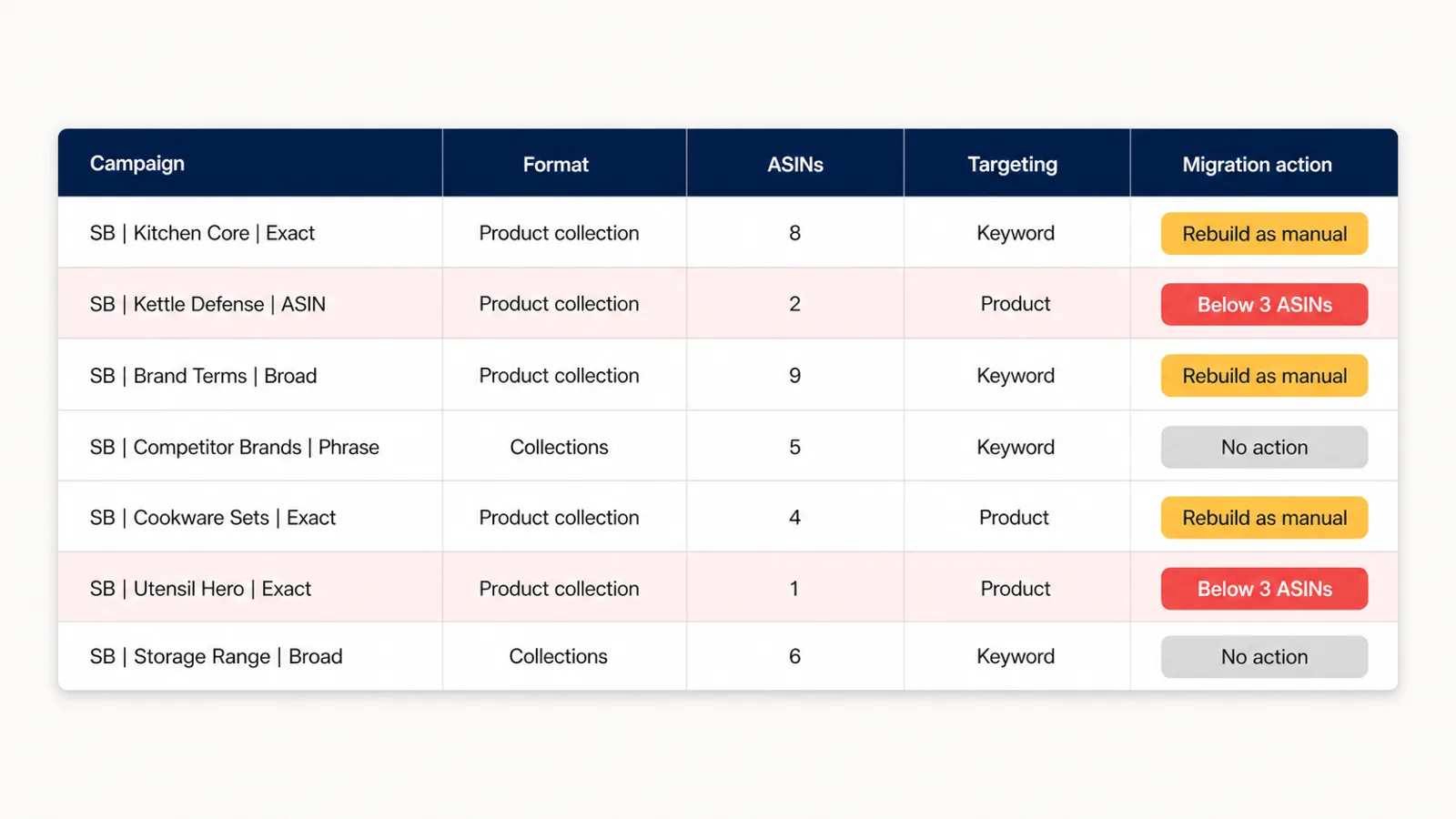
- Inventory what you have. Pull every Sponsored Brands campaign with its ad format and ASIN count. Flag every ad group sitting at one or two ASINs, because those are already dead ends, and flag every campaign using product targeting, because those cannot go automatic.
- Export a 60-day baseline before you touch anything. Clicks, CPC, orders, sales, ACoS per campaign, plus the Sponsored Brands search term report. After cutover you will want the pre-migration numbers, and you will not be able to reconstruct them from a converted campaign.
- Rebuild your single best product collection campaign as a manual collection. Same keywords, same bids, same ASINs, topped up to three if needed. Run it alongside the legacy campaign for two to three weeks. This isolates the creative change from everything else.
- Test automatic on a catalog that suits it. Broad, genuinely related product lines benefit from AI grouping. A catalog of three loosely connected SKUs does not. Before you launch, exclude ASINs you do not want shown: low stock, thin margin, weak review counts.
- Re-baseline your negatives weekly for the first month. New query surface, new waste. Pull the search term report every week rather than every month until the query mix settles.
- Move product-targeting budget deliberately. Manual collections or Sponsored Products. Decide where it goes rather than letting a forced conversion decide for you.
- Do not wait for January. A forced conversion happens on Amazon's schedule, in whatever state your account is in that week. Everything in this list is easier done voluntarily.
If you want the Campaign Manager mechanics for any of these steps, our Amazon Ads Campaign Manager guide walks the console surfaces.
Where automation actually helps here
Be clear about what a tool can and cannot do for this. No platform migrates your creative strategy for you. Choosing manual or automatic, and which ASINs belong in a collection, is a merchandising decision that needs your catalog knowledge.
What automation handles is the part that comes after: a campaign whose reach just widened, whose query mix is unstable, and whose bids were tuned for a narrower surface. Autron reads Sponsored Brands campaign, keyword and target data alongside Sponsored Products and your Seller Central sales and traffic reports, and prices bids against your target ACoS or TACoS on a daily loop. When a migrated collection starts pulling queries that convert below your goal, bids come down that week rather than after your next monthly review, and the new search terms surface for negation on the same cadence.
That is the honest version of the pitch. The migration is yours. The drift afterwards is the thing a daily loop is good at, and the thing a monthly review reliably misses. It is the same pattern we wrote about when the unified Campaign Manager changed how budget flows: Amazon broadens where your money can go, and the accounts that stay efficient are the ones repricing continuously instead of quarterly.
FAQ
When exactly do Sponsored Brands product collection ads stop working? The legacy product collection format shuts off entirely in January 2027, through both Campaign Manager and the Amazon Ads API. The squeeze started earlier: since September 2026, any newly created product collection campaign is automatically converted into a Manual Collection, and Ad Optimizer no longer supports creating new product collection ads. Existing campaigns keep serving impressions and remain manageable until the January deadline, so nothing breaks overnight.
What is the difference between manual and automatic Sponsored Brands collections? With a manual collection you pick the specific ASINs, between 3 and 10 related products, and you can use either keyword targeting or product targeting. With an automatic collection Amazon's AI groups products from your catalog based on your keyword targets and shopper search queries, and only keyword targeting is available. Automatic collections generate their own landing page, while manual collections can point at a branded experience or a Brand Store page. You can exclude specific ASINs from automatic collections.
Can I still run Sponsored Brands if I only have one or two products? Not in this format. Since the January 2026 overhaul, collections require a minimum of three related ASINs, up from one under the old product collection rules. Brands with one or two products lose access to the collections format entirely and should move that budget to Sponsored Brands video, which has no three-product requirement, or to Sponsored Products.
Do I lose my custom headline and lifestyle image? Yes. The new collections format drops custom headlines and lifestyle images. Ads render with product images, key product details such as price, ratings and deals, your brand logo, an auto-generated title and a call to action. If handwritten copy was doing real work for your brand, Sponsored Brands video is now the format that still carries it.
Does migrating break my Sponsored Brands performance history? It breaks comparability, not the data. A migrated campaign serves a different creative, and an automatic collection can show a different product mix week to week, so ACoS before and after the switch is not a like-for-like comparison. Export a 60-day baseline of clicks, CPC, orders, ACoS and the Sponsored Brands search term report before you cut over, so you have the pre-migration numbers when you need to judge the result.
The takeaway
This is a format retirement with a real deadline and a staged on-ramp, which is the polite version of a forced migration. The creative control that made Sponsored Brands distinctive is going away, the reach is going up, and the campaigns you have been trending for years will stop being comparable to themselves. None of that is catastrophic. All of it is easier to handle on your schedule than on Amazon's.
Audit your Sponsored Brands campaigns this month, export the baseline, run one manual rebuild in parallel, and decide where product-targeting budget lives before January.
If you would rather not add another weekly search-term review to the list once your collections go live, start with Autron and let the bid loop price the new query surface against your goal. If you just want to see how much of your current Sponsored Brands spend is going to queries you would never have targeted, the free PPC audit will show you.