
Amazon Sponsored Brands Video in 2026: The Creative and Bidding Playbook That's Driving 2.6x More Clicks
SBV now drives 2.6x more clicks than static SB ads and accounts for 58% of total SB spend in 2026. Here's the creative and bidding playbook to win with it.
TL;DR: Sponsored Brands Video now drives 2.6x the CTR of static SB ads and ~58% of total SB spend in 2026 — but 71% of plays are muted, so your visual layer must carry the message in the first five seconds. Keep videos 15-20 seconds, refresh creative every 45-75 days before decay, and split branded defense from category exploration so their ACoS targets don't blur.

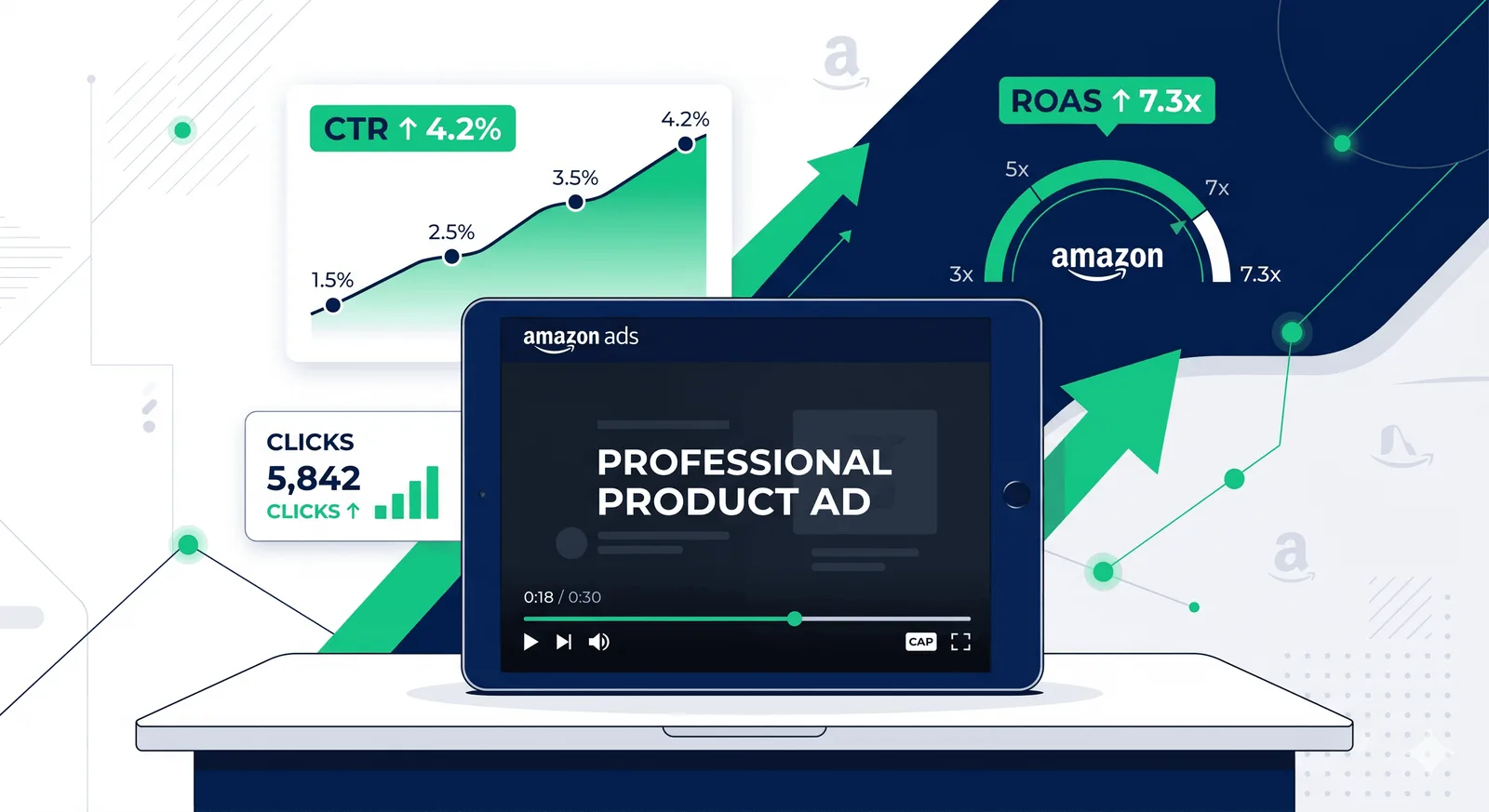
Sponsored Brands Video is no longer the experimental format you test when your static ads are already performing well. In 2026, SBV is the default Sponsored Brands format for most categories, accounting for approximately 58% of total Sponsored Brands spend across advertisers as of Q1 2026. It delivers 2.6 times the click-through rate of static headline ads, a conversion rate that exceeds image-based ads by around 13%, and 10% higher year-over-year sales growth for brands that run it alongside static formats.
The competitive picture has shifted just as fast. Branded search CPCs are up 22-31% in the past 12 months as competitors use SBV to intercept searches for brand-name keywords that sellers used to own unopposed. If you set up your Sponsored Brands Video campaigns in 2024 and have not revisited the creative, structure, or bids since, you are now running yesterday's strategy in today's auction environment.
This guide covers what is driving SBV's performance advantage, the creative framework that converts in 2026, and the campaign structure and bidding approach that separates profitable SBV programs from expensive ones.
Why Sponsored Brands Video Has Become the Default Format
The Performance Gap Between SBV and Static Is Now Definitive
The performance data that kept SBV as a secondary format for most sellers — limited creative resources, unclear ROI, steeper setup requirements — no longer holds up against the numbers. SBV delivers an average CTR of 0.89 to 1.0%, compared to 0.3 to 0.4% for static Sponsored Brands headline ads. That gap has widened as Amazon has expanded SBV placements across search results pages, product detail pages, and mobile search. Static headlines are competing in fewer positions and losing impression share to a format that consistently earns more clicks per impression.
The conversion rate advantage compounds the CTR gap. SBV buyers tend to arrive at the listing with more product context — they have already seen the item demonstrated or showcased in motion — which compresses the consideration phase and increases purchase intent at the point of click. For sellers in categories with high visual differentiation (supplements, kitchen, fitness, home, pet), the advantage is even more pronounced.
For brands spending $3,000 or more per month on Sponsored Brands, running without SBV in 2026 is the equivalent of opting out of your strongest available conversion lever.
71% of Plays Are Muted — And That Changes Everything About Creative
The single most important creative insight for SBV in 2026 is this: 71% of Sponsored Brands Video plays are muted, up from 64% in 2024. The majority of shoppers who see your video will never hear your audio. They will see moving imagery, on-screen text, and the visual flow of your creative — and they will make a click decision based on that alone.
Most SBV creative is still built around audio-led storytelling: a voiceover explaining the product, background music driving energy, a call-to-action spoken at the end. When 71% of your audience is watching in silence, that structure fails. The information that matters is locked in an audio track nobody is hearing.
The implication is not that audio is irrelevant — the 29% who do have sound on still matter, particularly on desktop. The implication is that your visual layer must carry the full message independently. Every key benefit, every differentiating feature, every call-to-action needs to be legible without sound.

The SBV Creative Framework That Converts in 2026
Build Your First Five Seconds for a Muted Viewer
The first five seconds of your SBV creative is the decision window. Amazon's algorithm uses early engagement signals — did the viewer continue watching, or scroll past? — as a quality signal that influences subsequent impression weighting. Shoppers make a click-or-scroll decision faster on video than on static images because motion immediately signals relevance or irrelevance.
Structure your first five seconds around three elements: product visibility (your hero SKU on screen within the first two seconds), a primary benefit statement as legible text (not voiceover), and enough visual motion to hold attention without overwhelming. Avoid cold opens that prioritize brand storytelling over product context. Shoppers on Amazon are in purchase mode, not entertainment mode. Every second spent on brand imagery that does not directly communicate product value is a second that increases the probability of a scroll.
The practical test: mute your own video and watch the first five seconds. If a stranger would not know what the product does and why they should consider it, the creative needs rework before it goes into an active campaign.
Optimal Length: Why 15 to 20 Seconds Outperforms Everything Else
Amazon's SBV format supports videos up to 45 seconds, but the data is consistent across multiple 2026 benchmark analyses: the highest CTR and completion rates cluster in the 15 to 20 second range. Shorter than 15 seconds often does not leave enough time to establish product context and a credible benefit case. Longer than 20 seconds loses the majority of viewers before the call-to-action, and in a search environment where the next result is one scroll away, that drop-off is irreversible.
For most products, the optimal 15 to 20 second SBV structure follows this pattern: hero product shot (seconds 1-3), primary differentiator with on-screen text (seconds 4-9), secondary benefit or use case (seconds 10-14), product name and call-to-action on screen (seconds 15-20). This is not a formula — it is a framework. Products with complex features or high price points may warrant pushing toward the 20 second upper end to provide enough context for a confident click decision.
Managing Creative Decay: The 45 to 75 Day Refresh Cycle
CTR on SBV creatives typically begins declining around day 45 of continuous serving, with the decay accelerating by day 75. Audience overlap — the same shoppers seeing the same video repeatedly — reduces novelty and click response. This is a structural feature of the format, not a reflection of creative quality. Even strong-performing SBV creatives need to be refreshed on a 60 to 90 day cycle for hero SKU campaigns and approximately 120 days for evergreen category exploration campaigns where audience rotation is wider.
The practical implication for 2026: with Prime Day landing approximately six weeks away (week of June 15-22), any SBV creative that has been running since March or earlier is approaching or past its peak performance window. Refreshing creative now, before Prime Day bid competition peaks, positions your campaigns to enter the highest-spend period of H1 with maximum creative effectiveness.
SBV Campaign Structure and Bidding for Maximum ROAS
Separate SBV by Intent Layer
The most common structural mistake in SBV is running branded defense, category exploration, and competitor conquest inside the same campaign. Mixing intent layers produces averaged performance data that makes it impossible to optimize any of them accurately. Branded defense SBV — protecting your own brand-name searches — operates at very different CPCs, CTRs, and conversion rates than category exploration SBV targeting shoppers who do not yet know your brand.
Build at minimum two distinct SBV campaign types. Branded defense campaigns use your brand name as a keyword target, operate at high bids relative to your branded CPC, and are evaluated on branded ROAS (typically 8x or above). Category exploration campaigns target non-branded category terms, operate at more conservative CPCs, and are evaluated primarily on new-to-brand rate and new-to-brand revenue rather than direct ROAS alone. Combining these into one campaign produces an ACoS average that undersells branded defense performance and overcounts category exploration returns simultaneously.
Branded Search Defense: Why You Are Losing Revenue You Cannot See
Branded search CPCs have risen 22 to 31% in the past 12 months as more advertisers use SBV to intercept competitor brand-name searches. A shopper who types your brand name into Amazon is demonstrably aware of your product and has already expressed intent — these are among the highest-conversion impressions on the platform. Brands without an active branded defense SBV campaign are surrendering those impressions to competitors at exactly the moment purchase intent is highest.
The revenue leakage from inadequate branded search defense is typically 8 to 14% of branded search revenue, flowing silently to competitors who are running SBV on your brand terms. Because this loss shows up as a reduction in organic branded conversion rather than as an ad spend line item, it often escapes detection in standard PPC reporting reviews. The fix is straightforward: run a dedicated Sponsored Brands Video campaign on exact match branded keywords, bid aggressively enough to dominate the top placement, and evaluate it monthly against branded search impression share rather than against ACoS alone.

SBV Needs Different Bid Targets Than Static SB
Static Sponsored Brands and Sponsored Brands Video compete in separate auctions and have different click value economics. SBV tends to attract higher-intent clicks because the viewer has already engaged with motion content before clicking — but the higher CPCs that SBV commands in competitive categories mean your ACoS target should be set based on SBV's actual conversion rate, not carried over from your static SB benchmarks.
For most categories, SBV brand defense campaigns warrant an ACoS target of 8 to 15%, reflecting the high purchase intent of branded searchers. SBV category exploration campaigns typically run at 20 to 35% ACoS with a new-to-brand rate target of 50% or higher, evaluated on a 28-day attribution window to capture the full consideration cycle. Setting SBV bids without format-specific targets produces either systematic overbidding on category exploration (dragging down portfolio profitability) or systematic underbidding on branded defense (surrendering your highest-intent impressions).
How AI-Powered Optimization Keeps SBV Profitable as Competition Grows
Even with correct creative and campaign structure in place, managing SBV bids manually across multiple intent layers at the speed Amazon's auction environment requires is not sustainable at scale. Branded keyword CPCs fluctuate by day of week, by competitor activity, and by proximity to peak shopping events like Prime Day. Category exploration SBV bids need to respond to shifts in conversion rate as inventory levels change and as organic rank fluctuates. The compounding of these variables across multiple campaigns produces bid drift that manual weekly reviews cannot catch in real time.
Amazon's native SBV bidding supports ACoS goal-based automation, which is a useful baseline. The limitation is that it optimizes against Amazon's internal cost signals without accounting for the broader picture: your organic sales velocity, your total TACoS position, how SBV spend is interacting with your Sponsored Products and Sponsored Display campaigns, and what each format's contribution looks like at the account level rather than the campaign level.
AI-powered platforms like Autron manage SBV bids continuously alongside your full ad stack — adjusting bids in real time as market CPCs shift, as your conversion rate changes, and as Prime Day approaches and bid competition intensifies. Rather than setting an SBV ACoS target once and trusting it to remain accurate through May, June, and into Prime Day season, Autron's bidding engine recalibrates continuously against actual performance signals. The result is branded defense campaigns that never lose position on high-intent branded terms due to underbidding, and category exploration campaigns that do not overbid into unprofitability as auction pressure rises.
For sellers refreshing SBV creative ahead of Prime Day, pairing a strong creative refresh with automated bid management removes the two biggest variables that erode SBV performance over time: creative decay and bid drift.
Conclusion
Amazon Sponsored Brands Video in 2026 is not optional for brands serious about search visibility. It is the format that wins on CTR, wins on conversion, and now accounts for the majority of total Sponsored Brands investment across the platform. The sellers extracting the most value from it are not necessarily running the highest budgets — they are running muted-first creative that communicates value in the first five seconds, refreshing that creative before the 45 to 75 day decay window, defending their branded search position with dedicated SBV campaigns, and letting automation manage the bid precision that manual reviews cannot provide at auction speed.
With Prime Day approximately six weeks away, there is still time to refresh creative, restructure campaigns by intent layer, and enter the platform's highest-spend period with SBV that is genuinely optimized — not just running.
If you want to see what AI-powered SBV bid management looks like alongside your full Sponsored Products and Sponsored Display stack, try Autron free at https://autron.ai/. No long-term contracts, no manual bid management — just continuous optimization built for how Amazon advertising actually works in 2026.