
Amazon Replaces Rufus with Alexa for Shopping: What the PPC Implications Actually Are
Amazon retired Rufus on May 13 and launched Alexa for Shopping — an AI agent now inside the search bar itself. Here's what changed for your Sponsored Products campaigns.
TL;DR: On May 13, 2026 Amazon retired Rufus and launched Alexa for Shopping — an agentic AI in the search bar across five surfaces. Active Sponsored Products and Sponsored Brands campaigns are auto-eligible in its results, so listing content is now a direct ad-performance input. Expect a 30-60 day attribution wobble as voice, chat and click conversions merge into one window — don't cut bids on the noise.

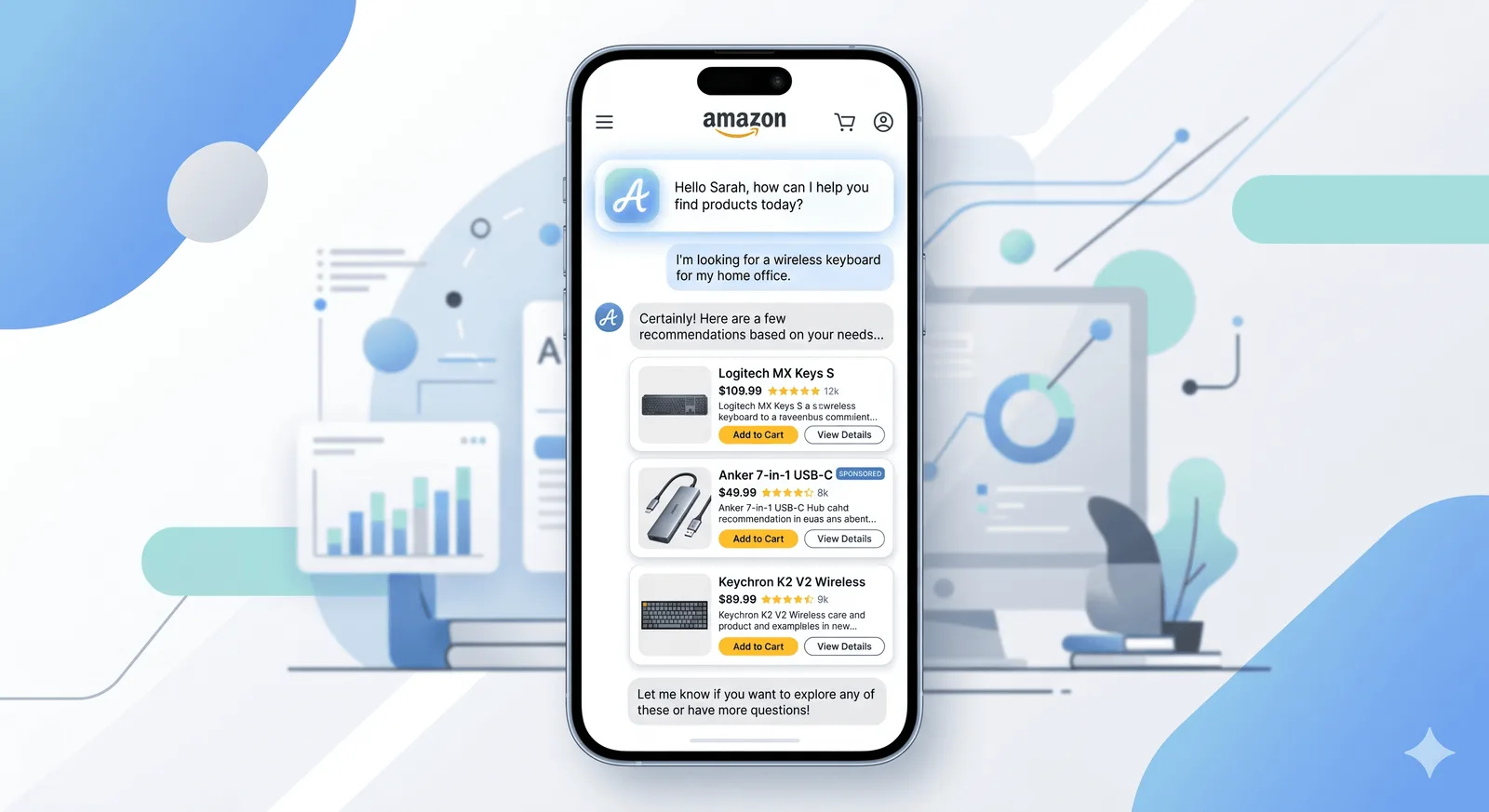
On May 13, 2026, Amazon retired Rufus and replaced it with Alexa for Shopping, an agentic AI assistant now embedded directly inside the Amazon search bar. If you had just started adjusting your PPC keyword strategy around Rufus's conversational queries — building long-tail keyword lists, auditing your A+ content, restructuring campaigns to capture the 15 to 20 percent of searches Rufus was mediating — your work was not wasted. But the environment has changed again, and this time the shift is structural rather than incremental. Alexa for Shopping is not a new chatbot. It is a different model for how Amazon connects AI to advertising, and the implications for your Sponsored Products campaigns, your attribution data, and your listing content strategy are playing out right now.
What Is Alexa for Shopping and How Is It Different from Rufus?
Rufus was a chatbot that lived in a discrete panel. Shoppers had to deliberately open it, ask a question, and interpret the response before navigating back to the traditional search results page. The handoff from AI-assisted discovery to a sponsored placement was a separate step. Alexa for Shopping removes that handoff.
When a U.S. customer opens the Amazon Shopping app or visits Amazon.com today, they interact with Alexa for Shopping the moment they begin typing in the search bar. The output is not a flat list of products with sponsored placements ranked by bid. It is a hybrid response: a conversational answer, AI-generated product comparison cards, up to 12 months of price history for the product they're considering, personalized recommendations, and traditional product listings, all on one screen.
New Features That Reshape the Purchase Decision
The capabilities Alexa for Shopping introduces go well beyond Rufus. On-demand comparison tables let shoppers benchmark multiple products side by side within seconds. Twelve months of visible price history means a shopper can immediately evaluate whether your current price represents value or an inflated anchor before clicking. Auto-Buy handles replenishment purchases automatically, removing the active purchase step entirely for consumable products. And Buy for Me, which grew from 65,000 products at launch to over 500,000 in less than a year, allows Alexa to complete purchases from non-Amazon retailers entirely on the shopper's behalf using their saved address and payment method.
The same unified shopper profile runs across Amazon.com, the Amazon Shopping app, Alexa.com, the Alexa app, and Echo devices. A shopper who researched products via voice on an Echo Show and later opens the app sees a continuous experience, with Alexa already aware of their prior search context. This is a fundamentally different environment from the one Rufus created, and sellers need to plan accordingly.
How Alexa for Shopping Changes Your Sponsored Products Visibility
Amazon has confirmed that active Sponsored Products campaigns are automatically eligible to surface inside Alexa for Shopping results. No separate opt-in is required. Your ads are already in play. Amazon describes the placements as appearing "when they enhance the shopping experience" — which, in practice, means the AI is making a semantic relevance judgment about your product's fit for the shopper's stated intent, alongside the bid and performance signals that have always driven auction outcomes.
Auto-Eligibility Is Not Auto-Performance
Being eligible to appear in Alexa for Shopping placements is not the same as appearing with meaningful frequency. The AI is reading your product's full content model: structured attribute fields, A+ content, reviews, Q&A, and listing copy. A product with aggressive bids but thin A+ content, incomplete attributes, or review language that does not match the shopper's stated use case will lose Alexa for Shopping placements to better-matched competitors who may be bidding less. Your listing content is now a direct input to ad performance, not just organic ranking.
This is the most important structural change for sellers to understand. Listing quality has always influenced conversion rate. Now it determines whether you surface at all inside the platform's highest-converting AI-mediated placements.

The Attribution Gap You Need to Track Now
Here is the near-term risk that most PPC dashboards are not yet surfacing. When a shopper discovers your product through Alexa for Shopping, whether via a voice query on Echo, a chat response in the app, or a conversational result on Amazon.com, and then clicks your sponsored placement in the traditional SERP, Amazon records it as a single session. Voice, chat, and click conversions collapse into one attribution window. Amazon has not yet shipped placement-level breakdowns that separate Alexa for Shopping-assisted conversions from traditional keyword-triggered conversions.
The practical result is that your ACOS and TACOS figures may look erratic over the next 30 to 60 days, not because your campaigns are underperforming, but because the attribution model is still stabilizing. New-to-brand rates are also expected to shift as Alexa for Shopping surfaces products to shoppers who would not have found them through a traditional keyword search. Sellers who cut bids aggressively in response to apparent ACOS deterioration during this window risk giving up Alexa for Shopping placements they are winning at low cost.
A Practical Playbook for the Alexa for Shopping Era
The sellers who adapt most effectively to platform shifts are not the ones who rebuild everything at once. They identify the two or three highest-leverage adjustments and execute them while campaigns continue running.
Treat Your Listing Content as Ad Creative
In the Alexa for Shopping environment, your listing is the primary signal the AI uses to match your product to a shopper's intent. Complete every structured attribute field accurately. Rewrite bullet points to lead with specific use cases rather than keyword chains. Update A+ content to include comparison language, since the comparison module format performs well in AI-mediated sessions because it directly answers the "how does this compare to X" question Alexa shoppers are asking. Respond to open Q&A questions with specific, direct answers that address real purchase objections.
Titles deserve particular attention. Alexa for Shopping operates across voice surfaces as well as screen, and titles written for spoken queries outperform those written purely for keyword indexing. Leading with use case — "Protein Powder for Women Over 40, Low Sugar" — works better in conversational AI environments than leading with brand name or generic category terms.
Restructure Campaigns for Multi-Surface Coverage
Your Sponsored Products campaigns are now working across the traditional SERP, Alexa for Shopping conversational results, and Echo voice placements simultaneously. The campaign structure that handles this well is built in layers. Broad and phrase match campaigns function as discovery layers, capturing the range of natural-language query variations that Alexa for Shopping generates. Exact match campaigns built from your converting query data handle the highest-intent, highest-confidence placements. Sponsored Brands campaigns are also eligible for Alexa for Shopping placement, giving brand-registered sellers a second ad format inside the same AI-mediated results.
The core discipline is regular search term report analysis. Alexa for Shopping is surfacing new query patterns that your existing keyword lists may not include. Mining those reports for converting long-tail queries and building exact match campaigns around them is the fastest way to capture the Alexa for Shopping traffic that your broad and phrase match campaigns have already validated.

Adjust Bids Based on Query Data, Not Headline Metrics
During the 30 to 60 day attribution stabilization period, resist the temptation to make aggressive bid changes based on headline ACOS numbers. Instead, work from the query level. If a specific long-tail query is converting at strong rates, increase the exact match bid for that term. If a broad match term is generating impressions with no conversions after sufficient data, pause it. These decisions, grounded in converting query data rather than aggregate campaign metrics, are more reliable guidance during a transition period than top-line ACOS trends.
Long-tail queries aligned with Alexa for Shopping's conversational output continue to offer compelling economics: CPCs roughly 45 percent lower than equivalent head terms, with higher conversion rates because the shopper has been pre-qualified by the AI before clicking. The transition from Rufus to Alexa for Shopping has not changed this dynamic; if anything, it has strengthened it as Alexa surfaces shoppers across more surfaces and with more specific intent.
Why AI-Powered PPC Management Matters More Right Now
Every time Amazon's AI layer becomes more sophisticated, the management complexity for sellers increases. Rufus added one layer. Alexa for Shopping, operating across five surfaces with a unified shopper profile, agentic purchase features, price history signals, and auto-eligible ad placements inside conversational results, has added several more.
Manual PPC management struggles to keep pace with this complexity because the signals that determine performance now span listing content quality, multi-surface attribution, historical conversion data, and real-time bid decisions across an expanded and rapidly evolving set of query variations. A human manager working in Seller Central is adjusting bids every few days. Alexa for Shopping is making matching decisions millions of times per hour.
Autron's AI-powered bid optimization processes real-time performance signals continuously across every campaign, identifying which queries are generating Alexa for Shopping-assisted conversions, adjusting bids to protect high-performing placements, and reallocating budget away from underperforming terms faster than any manual workflow allows. As attribution normalizes over the next 30 to 60 days, sellers running automated optimization will capture the efficiency gains from the new environment earlier than those adjusting bids manually.
The Bottom Line
Amazon's replacement of Rufus with Alexa for Shopping is a platform-level change that makes AI the primary intermediary between shoppers and search results, expands ad-eligible surfaces to include voice and conversational placements across five channels, introduces new purchase-decision signals (price history, comparison tables, agentic purchasing) into the shopper journey, and creates a short-term attribution transition that will affect how your metrics read over the coming weeks.
The practical response: treat listing content as your primary ad creative, build campaign structure that covers the full range of conversational query variations, and let automated bidding handle the real-time optimization that this environment demands.
Try Autron free at autron.ai and see how AI-powered PPC management handles the complexity of the Alexa for Shopping era for your campaigns.