
Amazon's Featured Offer Eligibility Gate Is Gone: What It Does to Your Sponsored Products
Amazon is removing the Featured Offer eligibility gate through 2026. Here's why your Sponsored Products ads can stop serving while campaigns still show Delivering.
TL;DR: In July 2026 Amazon began removing the standalone seller-performance gate for the Featured Offer, folding order defect rate, chargeback rate and service complaints into one ranked score. Since Sponsored Products only serves on ASINs holding the Featured Offer, ad eligibility is now a contested position you can lose while Campaign Manager still reads Delivering. Watch Featured Offer share per ASIN.

Amazon is quietly rewriting the rule that decides whether your ads run at all. In July 2026 it began removing the Featured Offer eligibility gate, the standalone seller-performance check an offer had to pass before it could even compete for the Buy Box. In Amazon's own words, posted to the Seller Forums, "the first seller eligibility step is no longer delivering additional value to customers, so we're removing it." No seller action is required, existing offers are included automatically, and the change rolls out across all Amazon stores by the end of 2026.
Read as a Buy Box story, that sounds like good news, and for a lot of sellers it is. Read as a PPC story it is something else. Sponsored Products only serves on ASINs that hold the Featured Offer. Change how the Featured Offer is decided and you have changed, underneath every campaign in the account, the thing that determines whether an ad enters the auction in the first place.
What Amazon Actually Changed About Featured Offer Eligibility
The old system had two stages. First a gate: your account had to clear a set of performance thresholds before your offer was allowed into the pool at all. Only offers that cleared it were then ranked against each other on the things shoppers care about, mainly competitive pricing, delivery speed and offer performance.
The new system has one stage. Every offer goes straight into the ranking, and the performance signals that used to run the gate become weighted inputs inside the score. Trade press covering the announcement identifies those signals as chargeback rate, order defect data and Voice of the Customer complaints. Amazon has not published the weighting, and its forum replies did not enumerate exactly which requirements were removed, which is why the thread filled up with sellers asking the same question in different words.
The selection criteria themselves are unchanged. Amazon still ranks on price, delivery and offer performance, and being considered for the Featured Offer has never guaranteed winning it.
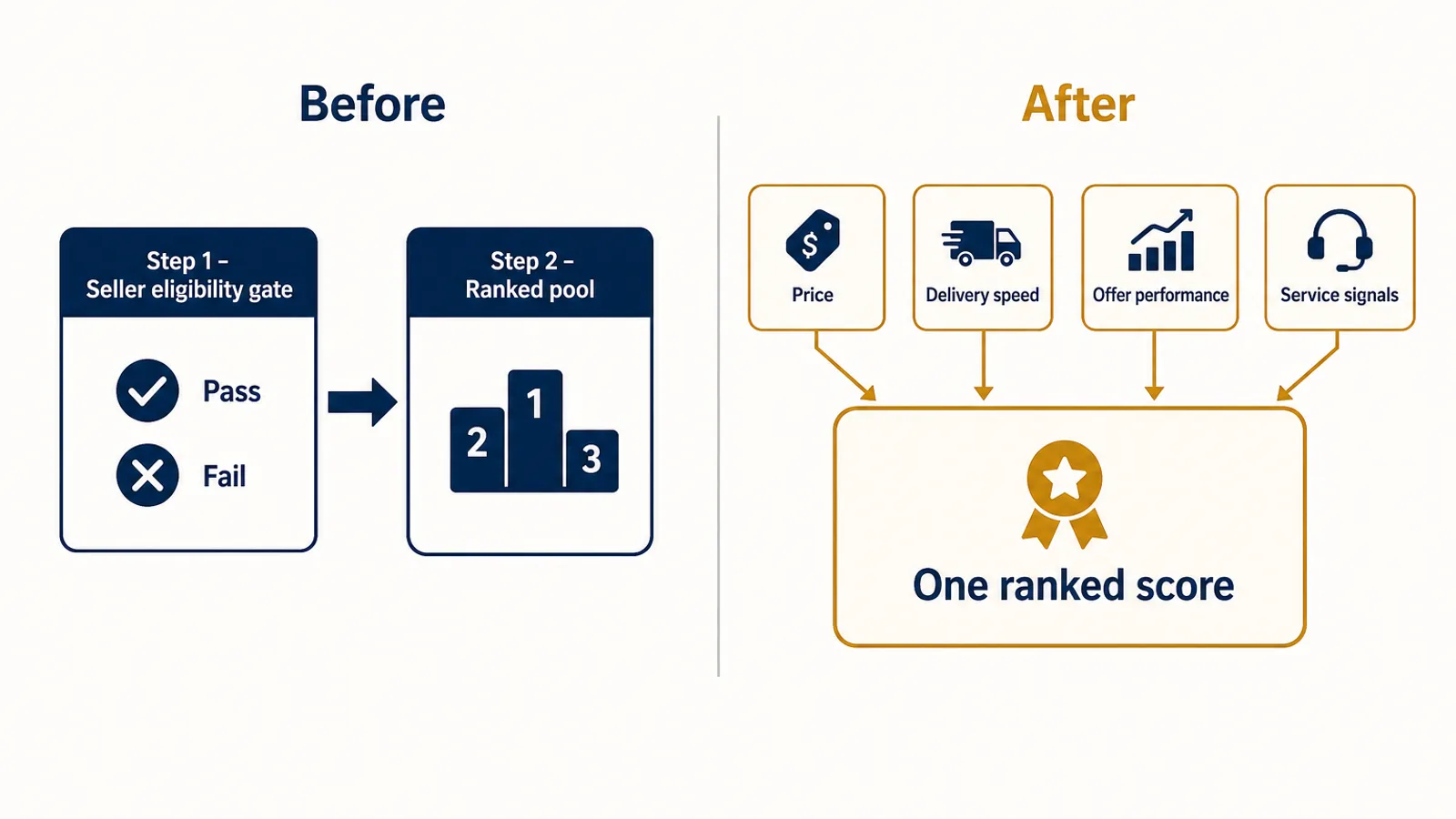
What is different is the shape of the outcome. A gate produces a binary: you are in the pool or you are not, and if you are in it your position is contested only against other sellers who also cleared it. A single weighted score produces a gradient. Offers that would previously have been filtered out now sit in the ranking, a few places down, close enough that a price move or a delivery-speed change can lift them past you. Marginal sellers who were invisible to you last quarter are now competitors for the slot.
Why This Is an Advertising Problem, Not Just a Buy Box Problem
Here is the connection most Buy Box coverage skips. Amazon requires a product to be eligible for the Featured Offer in order to advertise it with Sponsored Products, and an ad created for a listing that is not eligible will not display to shoppers. It is not a bid disadvantage or a ranking penalty. The ad does not enter the auction.
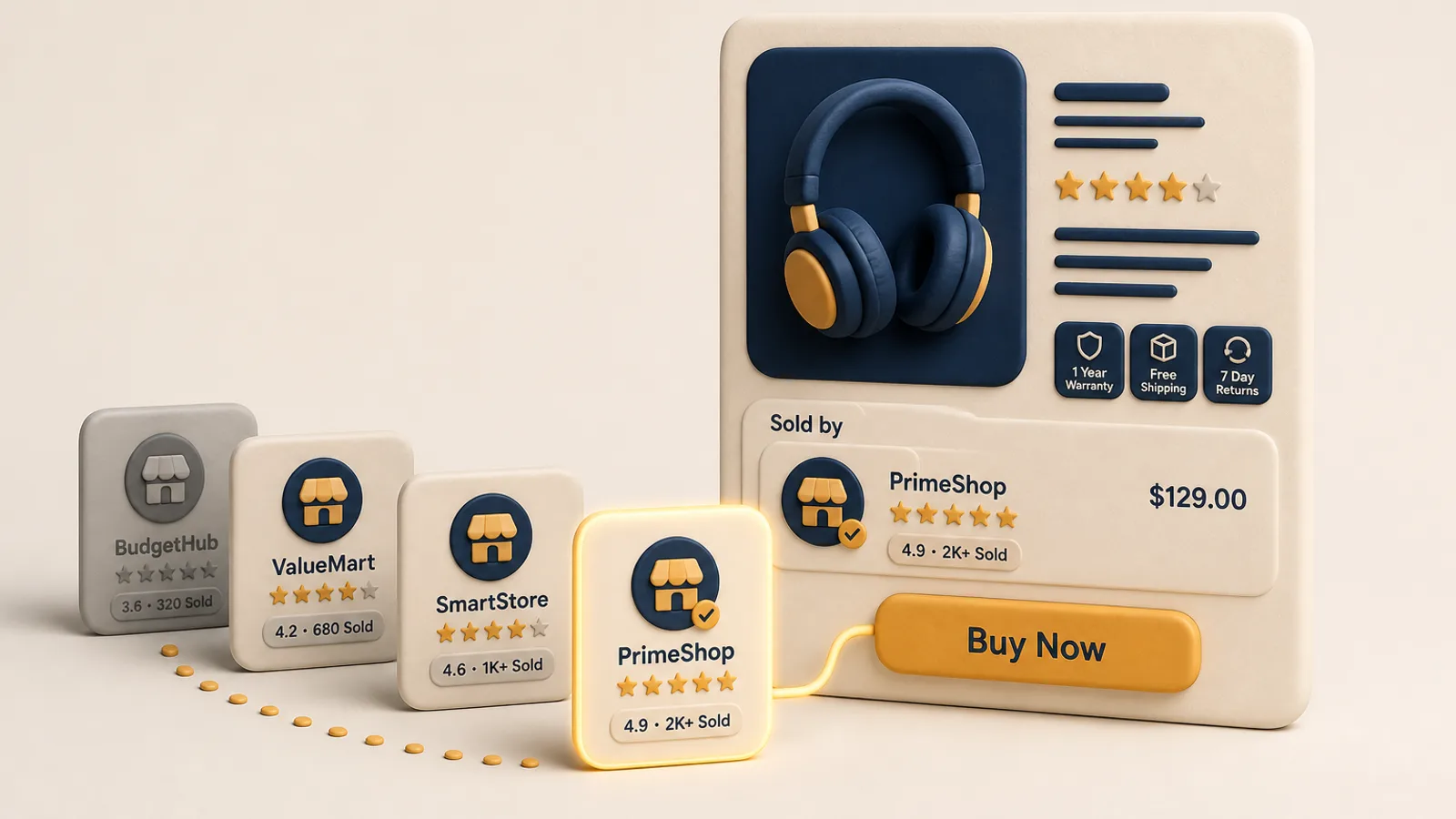
So the Featured Offer has always been the on-off switch for Sponsored Products. What the 2026 change does is take a switch that used to flip rarely, because the gate was slow-moving and account-level, and wire it to a continuously recalculated score that reacts to every competitor's price change, every delivery-promise shift and every service metric that moves. Ad eligibility used to be a state your account was in. Now it is a position you hold, and positions get lost intermittently.
For a private-label brand that is the sole seller on its own ASINs, this is close to a non-event. For anyone on a shared listing, a reseller, a wholesaler, or a brand with unauthorised sellers on its catalogue, the switch just got a lot twitchier.
The Symptom You Will Actually See
Nobody gets an email that says you lost the Featured Offer, so your ads have stopped. What you get is a chart that stops making sense.
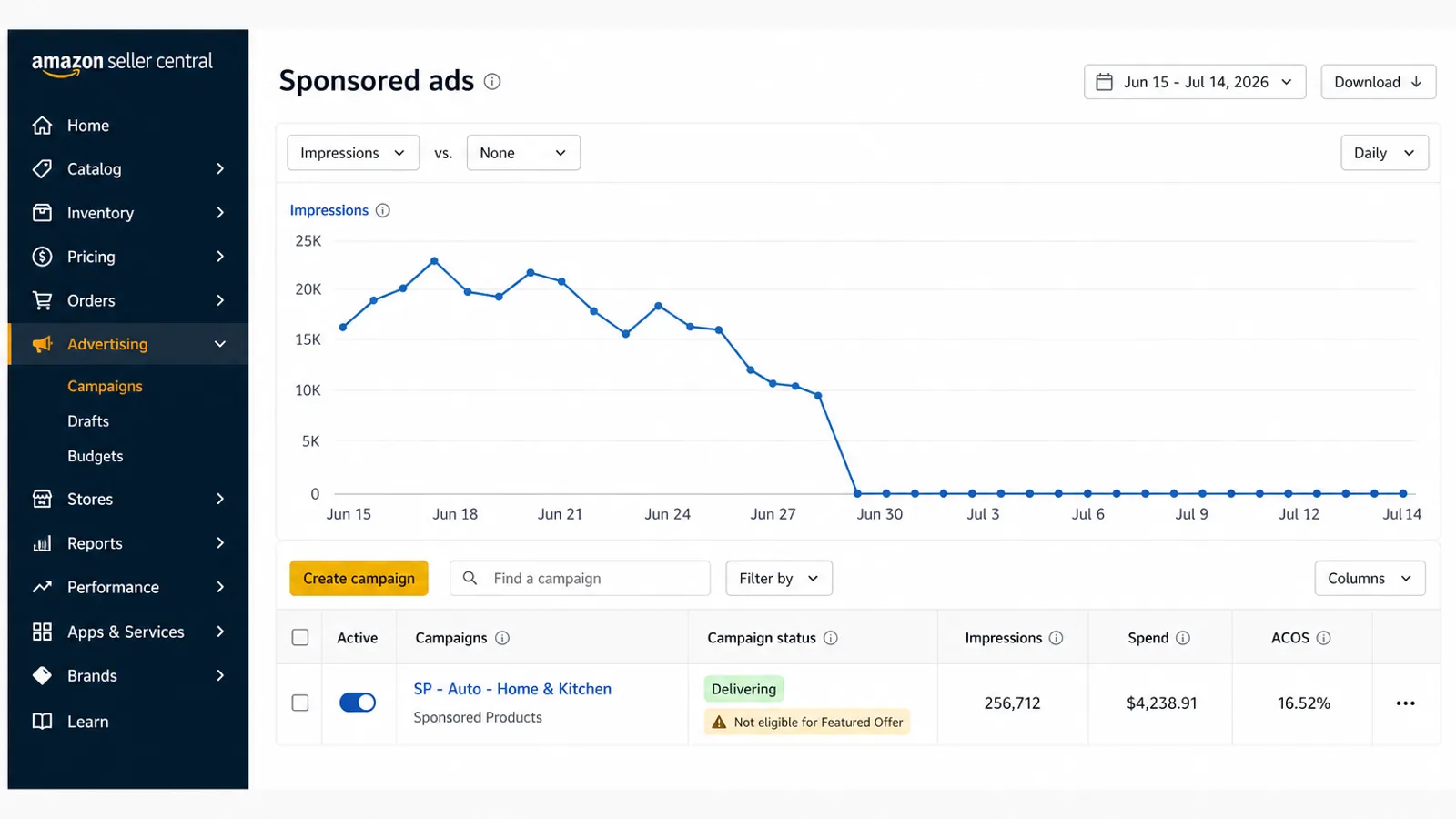
Impressions on a handful of ASINs collapse toward zero while the rest of the account carries on normally. The campaign status pill still reads Delivering, because the campaign is delivering: it is enabled, it is funded, it has targets. It simply has nothing eligible to show. Amazon does flag ineligible ads in Campaign Manager, but the flag lives at the ad level, several clicks below the campaign view most operators actually scan, and it tells you the current state rather than the three hours yesterday when you were out.
The knock-on effects are worse than the lost impressions:
- Spend gets lumpy. Budget that would have paced evenly across the day now compresses into the hours you hold the offer, which pushes you into higher-cost auction moments and inflates your effective cost per click.
- Metrics lie in both directions. If you drop out during your weakest converting hours, ACoS improves and looks like a win. If you drop out during your strongest, it craters. Neither number is telling you anything about your advertising.
- Budget drains elsewhere. In a shared budget or portfolio, the spend that cannot go to the ineligible ASIN does not sit idle. It flows to whatever else is eligible, which is usually your less profitable inventory.
- Organic rank follows. Lost ad-driven sales velocity feeds back into lower organic placement, which costs more than the impressions did.
None of this is visible if you are looking at account-level ACoS, which is exactly where most weekly reviews start.
The Reflex That Makes It Worse
Impressions fall, so you raise bids. It is the single most expensive wrong move available here.
Bids do nothing for an ad that is not entering the auction. You will not buy your way back into the Featured Offer, because the Featured Offer is not an ad auction, it is an offer ranking on price, delivery and service. So the higher bid sits inert for as long as you are out. Then you win the offer back, often for reasons entirely unrelated to what you did, and the inflated bid activates against live traffic at a cost per click you never intended to pay. Against a 2026 Sponsored Products baseline of roughly $1.13 average CPC at 34% ACoS, a panic bid raise applied to a recovery window does real damage before anyone notices it.
The same logic applies to the other reflexes. Adding budget does not help an ineligible ASIN. Nor does broadening match types, adding keywords or duplicating the campaign, which is how accounts end up with the sprawl that consolidated campaign structures are meant to prevent. Every one of those aims a fix at the auction when the problem sits upstream of it.
How to Diagnose It in Your Own Data
The diagnosis takes about twenty minutes and needs two data sources you already have.
One: pull Featured Offer share per ASIN. Amazon reports it as buy box percentage, at both ASIN and SKU level, in the Sales and Traffic business report in Seller Central. Take the last 60 days.
Two: pull ad impressions for the same ASINs and the same dates. Advertised-product report, daily granularity.
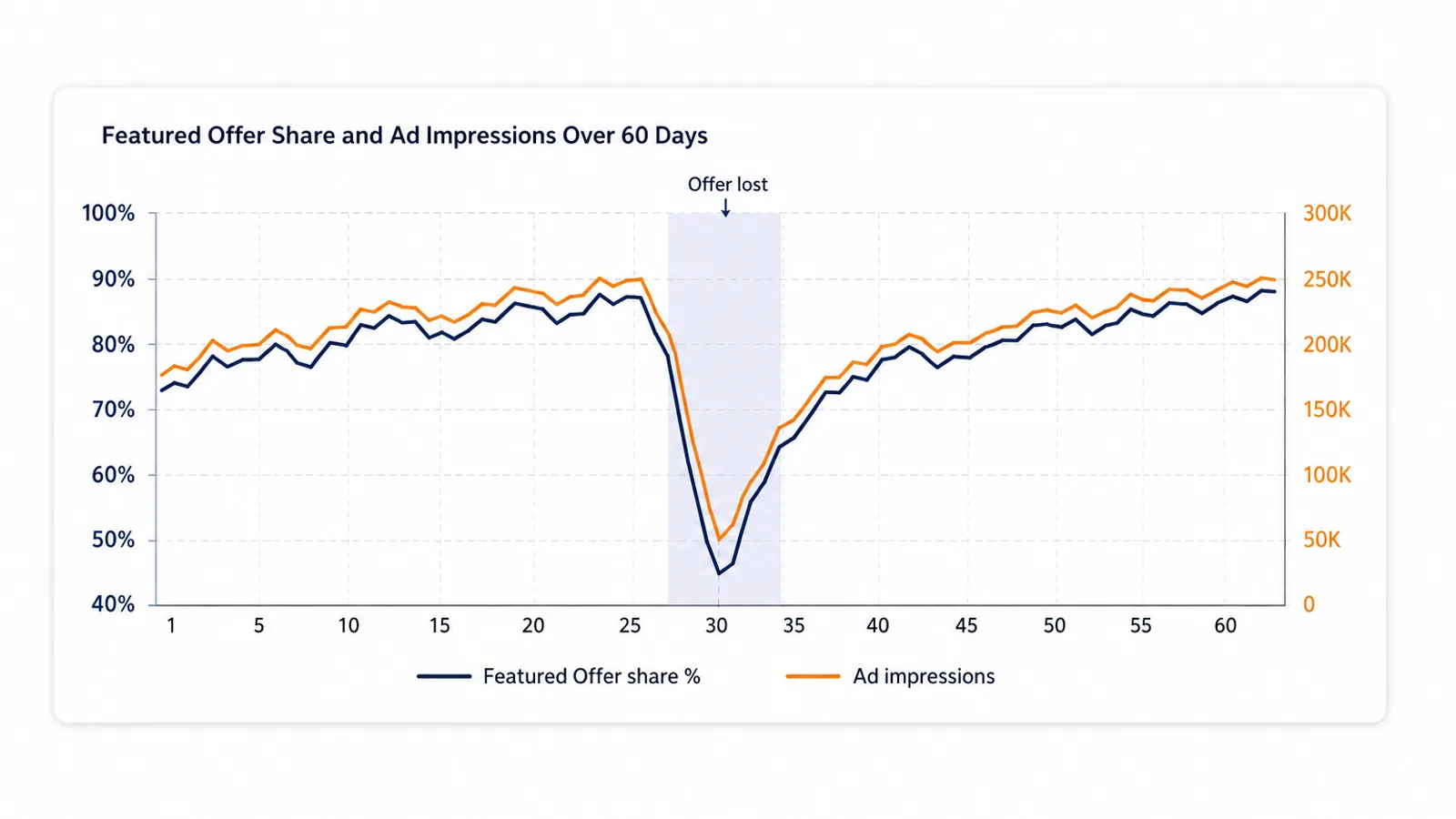
Line them up. The pattern is unmistakable once you look for it: impressions track Featured Offer share, then fall off a cliff at the point share drops, and recover when it does. If the two lines move together, you have an offer-ranking problem wearing an advertising costume, and no amount of campaign work will fix it.
Three things worth checking while you are in there. Sort ASINs by ad spend against Featured Offer share, because a 70% share on your top spender costs far more than a 40% share on a long-tail SKU. Look at whether dips cluster by time of day, which usually points at a repricer, yours or a competitor's. And check stock cover, because running thin degrades your ranking position and takes ads down with it, which makes this partly an inventory operations problem.
What to Actually Fix
Once you know Featured Offer share is the constraint, the work is on the offer, not the campaign.
Price competitiveness is the heaviest lever and the fastest to move. You do not need to be cheapest, you need to be inside the band where the rest of your score carries you.
Delivery speed is the one most sellers underweight. Fulfilment method, regional inventory placement and handling time all feed the promise shown to the shopper, and a slower promise loses to a faster one at equal price.
The service signals now folded into the score used to be a threshold you cleared and forgot. They are continuous inputs now, so the difference between a good order defect rate and an excellent one is worth something it was not worth before.
Stock cover protects the whole thing. An out-of-stock offer is not ranked at all.
Wasted spend on ASINs that are only intermittently eligible is one of the least visible budget leaks in an account, and it compounds with the ordinary kind that search-term waste creates.
What This Means for Automated Bid Management
This change is a good illustration of why Ads-API-only tooling struggles. A bidder that sees campaigns, targets and clicks but not Featured Offer share reads an eligibility dropout as weak performance. The rational-looking response is to cut bids on the ASIN, which is precisely wrong, then raise them again when impressions return. That oscillation is expensive and entirely avoidable, and it happens because the signal that explains the behaviour lives in the SP-API sales and traffic data rather than the advertising data.
Autron ingests both into a per-seller database, including buy_box_percentage at ASIN and SKU level from the Sales and Traffic report, alongside the full Sponsored Products, Sponsored Brands and Sponsored Display surface. Featured Offer share sits in the same store as the ad data, so it reads as a driver of an ASIN's performance rather than something you infer from a hole in the impression curve. That is the durable answer to a platform change like this one. Not a new dashboard to check every morning, but a system that already reads the signal the change made important.
FAQ
What changed with Amazon Featured Offer eligibility in 2026? Amazon began removing the standalone seller eligibility step that offers had to pass before competing for the Featured Offer. The signals behind that gate, including order defect rate, chargeback rate and Voice of the Customer complaints, became weighted inputs in a single ranking score. No seller action is required and the rollout completes by the end of 2026.
Does losing the Featured Offer stop my Amazon ads from running? Yes. Amazon requires a listing to be eligible for the Featured Offer in order to advertise it with Sponsored Products, and an ad on an ineligible listing will not display. The campaign stays enabled and can still read Delivering, which is why it presents as an unexplained impression collapse rather than an error.
Why did my Sponsored Products impressions drop to zero without a bid change? Usually because you lost the Featured Offer on that ASIN, not because you lost the auction. Losing the offer removes the ad from the auction entirely, so impressions hit zero on those ASINs while the rest of the account looks normal.
How do I track Featured Offer share for my ads? Amazon reports buy box percentage per ASIN and per SKU in the Sales and Traffic business report. Pull it for the same dates as your ad impressions. If impressions fall when share dips, the problem is offer ranking, not advertising.
Should I raise bids when impressions drop after losing the Featured Offer? No. Bids do nothing for an ad that is not entering the auction, and the raised bid then overspends the moment you win the offer back. Fix price, delivery speed, stock cover and the service metrics first.
The Takeaway
Amazon removed a gate, and gates are easy to reason about. What replaced it is a continuously recalculated ranking, which turns your ad eligibility from a setting into a position you have to keep winning. For sole sellers on their own ASINs, very little changes. For anyone sharing a listing, the switch that controls whether Sponsored Products runs at all just became something that can flip several times a week without telling you.
Add Featured Offer share to whatever you review alongside ACoS, at ASIN level, and check it before you touch a bid. If you would rather not add another manual check to the list, sign up for Autron Pro and let the bid loop run against your offer data and your ad data at once, or run a free PPC audit to see where spend is going on ASINs that are not always eligible to receive it.