
Amazon PPC Campaign Structure in 2026: Why Fewer Campaigns Now Beat More
The old Amazon PPC campaign structure is costing you conversions. Learn the 2026 blueprint for intent-first campaign architecture that works with Amazon's AI, not against it.
TL;DR: In 2026, fewer Amazon campaigns beat more: splitting one keyword across six match-type campaigns starves each of the conversion data Amazon's AI needs to bid well. Consolidate into three intent buckets — Discovery, Harvest, and Defence & Conquest. Any campaign under ~30 clicks/week is below the AI's learning threshold; consolidating can cut ACOS 20-35% without cutting spend.

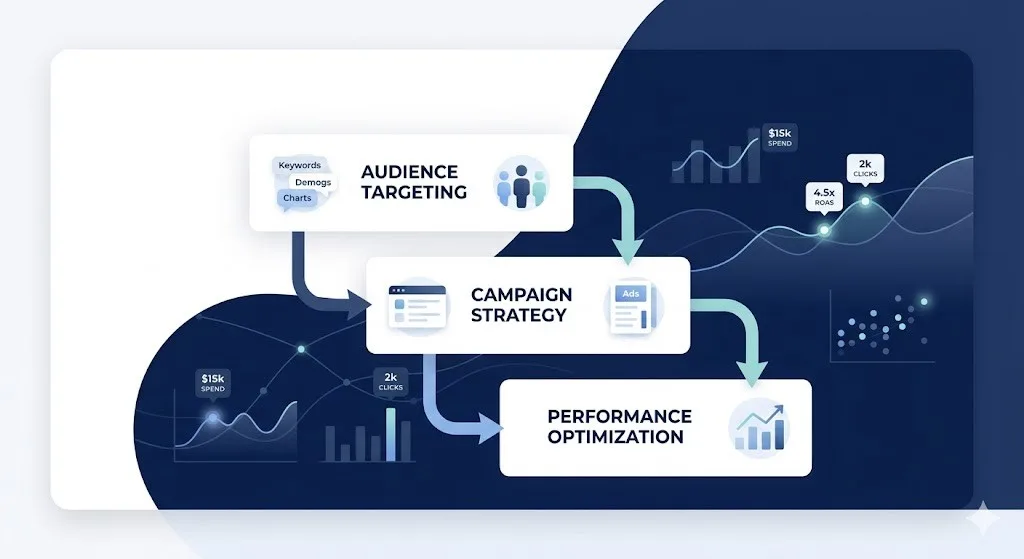
If your Amazon advertising account has grown to resemble a city planning map — dozens of ad groups, hundreds of campaigns, match types siloed within an inch of their lives — you are not alone. For years, the received wisdom was that tighter control meant better results. Separate every keyword by match type. Break campaigns down to the ASIN level. Never let an auto campaign touch a manual one.
That logic made sense when human analysts were the primary optimization engine. In 2026, Amazon's AI is doing most of the work — and it needs something very different from your campaign structure than you've been giving it. The sellers restructuring their accounts around data density and buyer intent are consistently outperforming those clinging to legacy architectures, often cutting ACOS by 20-35% without reducing spend. Here is what the shift looks like, why it is happening, and how to make the transition without losing ground.
Why Your Current Amazon PPC Campaign Structure May Be Working Against You
The SKAG model — single keyword ad groups, each tightly controlled — was borrowed from Google Ads best practices circa 2015. On Amazon, it became the default for serious advertisers because it offered granular control: you could see exactly which keyword was spending, bid it up or down, and isolate underperformers quickly.
The problem is that Amazon's advertising algorithm is not Google's. Amazon's machine learning models improve bid decisions by learning from conversion signals within each campaign. The more conversions a campaign accumulates over time, the better the algorithm predicts when to bid aggressively and when to hold back. When you split a category keyword across six different campaigns by match type and product variation, you are also splitting its conversion data six ways. Each campaign ends up data-starved, never reaching the signal threshold the algorithm needs to perform at its best.
This problem has compounded in 2026 as Amazon's AI has become far more sophisticated. Rufus, Amazon's AI shopping assistant, now mediates an estimated 15-20% of all mobile search queries and is growing. The Ads Agent, launched in open beta earlier this year, can adjust bids based on conversion probability, organic rank position, inventory levels, and signals that no human analyst checks simultaneously. These systems are designed to operate at scale, processing inputs that a fragmented campaign structure cannot provide in sufficient volume.
A practical indicator: if any of your campaigns is generating fewer than 30 clicks per week, it is operating below the threshold where Amazon's algorithm can meaningfully learn from it. In a typical over-segmented account, the majority of campaigns fall into this category. The result is a portfolio of orphaned micro-campaigns that spend inconsistently, learn nothing, and require constant manual intervention to remain stable.

What Amazon's AI Actually Needs to Deliver Better Results
Understanding why consolidation works requires understanding what Amazon's algorithm is optimising toward. It is not optimising for keyword-level control. It is optimising for conversion probability at the impression level, factoring in the shopper's browsing history, the product's historical conversion rate, current inventory status, and the competitive landscape for that placement at that moment in time.
When you give Amazon's AI a single large campaign with strong conversion volume, it develops a rich model of which impressions are worth bidding up and which are not. When you give it ten thin campaigns with the same aggregate conversion volume distributed across them, each model is weaker and the collective output suffers.
The persona-based campaign architecture emerging as the 2026 standard reflects this shift. Rather than organizing campaigns around match type mechanics, the new approach organizes them around buyer intent stages. Amazon Growth Lab formalized this with their persona-driven PPC framework, which has been widely discussed in the community this spring. Industry data published in late April showed that accounts running three to five intent-based campaigns consistently outperform accounts with twenty or more fragmented campaigns across equivalent spend levels.
The underlying logic: Amazon is getting better at matching your product to the right shopper regardless of the specific keyword they typed. Rufus-mediated discovery already works this way — the AI identifies intent from conversational queries and surfaces products it predicts will satisfy that intent. Campaign structure that mirrors this intent-based logic trains Amazon's algorithm more effectively than structure built around match type hygiene.
The 2026 Campaign Structure Blueprint
The Three-Bucket Framework
The most practical version of the consolidated approach groups all sponsored products activity into three buckets, each serving a distinct function.
Bucket 1: Discovery. One auto campaign and one broad match manual campaign per product group. This is your exploration layer — finding new converting search terms, testing new audiences, and generating the raw data that feeds your harvesting process. Bids here should be moderate and budgets should be protected. Discovery campaigns should run continuously, not just during launches.
Bucket 2: Harvest. Proven exact match and phrase match keywords that have demonstrated conversion history, organized by intent cluster rather than by individual product. This is where you allocate the majority of your budget because these terms have the highest conversion predictability. Within this bucket, group keywords by shopper intent — problem-aware queries together, solution-aware queries together, comparison queries together — rather than by product SKU. This grouping gives Amazon's algorithm cleaner signals about which buyer intent stage your ads are winning.
Bucket 3: Defence and Conquest. ASIN targeting for competitor products, branded keyword protection, and category-level targeting campaigns. This bucket serves a strategic function separate from pure conversion efficiency and should be budgeted accordingly.
Portfolio Organisation by Product Line, Not by Match Type
Above the campaign level, organise your Sponsored Products portfolio by product line or category, not by campaign tactic. Put all three buckets for a single product family inside one portfolio. This allows Amazon's pacing algorithms to shift budget intelligently across discovery and harvest phases as performance fluctuates, rather than having budget locked into siloed campaign types that cannot borrow from each other.
Negative Keywords: The Connective Tissue
Consolidation only works if you build a rigorous negative keyword layer between buckets. Every converting term from your Discovery campaigns should be harvested into Bucket 2 as an exact match and immediately added as a negative exact in your Discovery campaigns. This prevents cannibalization across buckets and ensures conversion data concentrates where it generates the most learning. Run this harvest review weekly at minimum.

How to Migrate Without Losing Ground
The biggest concern sellers have about restructuring is the transition risk. A consolidation handled poorly can spike ACOS for several weeks as the new campaigns rebuild conversion history. Done methodically, the risk is manageable.
Start with an audit. Pull a campaign performance report for the last 90 days and sort by clicks. Any campaign generating fewer than 30 clicks per week is a candidate for consolidation. Group those thin campaigns by product line and match type intent, then merge them into the appropriate bucket within your new structure.
Do not pause old campaigns immediately. Run the new structure in parallel for two to four weeks, allowing the consolidated campaigns to accumulate enough conversion data before you reduce budgets on legacy campaigns. Watch your total portfolio impressions, overall conversion rate, and account-level ACOS during the transition — not individual campaign ACOS, which will fluctuate as algorithms relearn.
The 60-day mark is typically when the benefits become clear. Consolidated campaigns with adequate conversion volume show more consistent performance, require fewer manual bid adjustments, and respond more predictably to budget changes. The time you were spending on campaign-level triage gets redirected to higher-leverage decisions: product expansion, creative testing, and funnel strategy.
For sellers managing large catalogues, this kind of ongoing structural maintenance is where AI-powered platforms earn their keep. Autron's bidding engine continuously monitors conversion signals across your entire portfolio, adjusting bids in response to the same multi-variable inputs that Amazon's algorithm uses internally. It also automates the keyword harvest process between buckets — identifying converting terms, promoting them to exact match, and adding negatives — without requiring a weekly manual review. The result is a campaign structure that does not decay between human check-ins.
Conclusion
Amazon PPC campaign structure in 2026 is not about who has the most granular control. It is about who gives Amazon's AI the cleanest, richest data to work with. Consolidating around buyer intent rather than match type mechanics, letting data concentrate within fewer campaigns, and automating the connective tissue between discovery and harvest — these changes consistently outperform the legacy SKAG approach in accounts with comparable spend.
The sellers winning on Amazon right now are not running bigger accounts. They are running smarter ones.
If you want to see what intent-first campaign structure looks like when combined with AI-powered bid optimization, try Autron free at https://autron.ai/. No long-term contracts, no manual setup — just smarter Amazon advertising from day one.