
Amazon Rufus Is Now Mediating 20% of Searches: How to Realign Your PPC Keyword Strategy
Rufus mediated 20% of Amazon searches before Alexa for Shopping replaced it on May 13, 2026, and those conversational shoppers convert at 2.74x. Here's how to restructure your PPC keywords to capture them.
TL;DR: Amazon Rufus reshaped PPC by mediating 15-20% of mobile searches, with shoppers converting at 2.74x the rate of traditional search — and Alexa for Shopping, which replaced Rufus on May 13, 2026, deepens that shift. Long-tail keywords (6+ words) hit ~13.5% conversion at ~$0.64 CPC vs $1.18 head terms at ~9%. Capture them with a three-tier structure: auto discovery, broad research, exact-match.

Update — May 2026: Amazon retired Rufus on May 13, 2026 and replaced it with Alexa for Shopping, an agentic AI built directly into the search bar. The conversational-search keyword strategy below applies directly — and more urgently — to the Alexa era, because Alexa deepens the same shift Rufus began. See that breakdown for exactly what changed.
If you optimised your Amazon PPC campaigns last year and haven't touched your keyword strategy since, you may be bidding on the wrong queries entirely.
Amazon Rufus, the AI shopping assistant embedded directly into the Amazon search experience, mediated between 15% and 20% of all mobile search queries before its May 13, 2026 retirement. More than 250 million shoppers used it, with interactions up over 210% year-over-year. The shoppers it filtered and delivered converted at 2.74 times the rate of traditional search traffic, and the queries they typed were 2.4 times longer than the head terms most accounts bid on. Alexa for Shopping, its replacement, inherits and extends that conversational behaviour, so the strategy implications below carry straight over.
This is not a listing optimisation problem. It's a keyword and bidding strategy problem, and most Amazon PPC guides in 2026 are still treating it like the former. This post addresses the latter: specifically, how to restructure your keyword targeting, match types, and bid logic to perform in the era of conversational search.
Why Rufus Changes the Keywords That Actually Matter
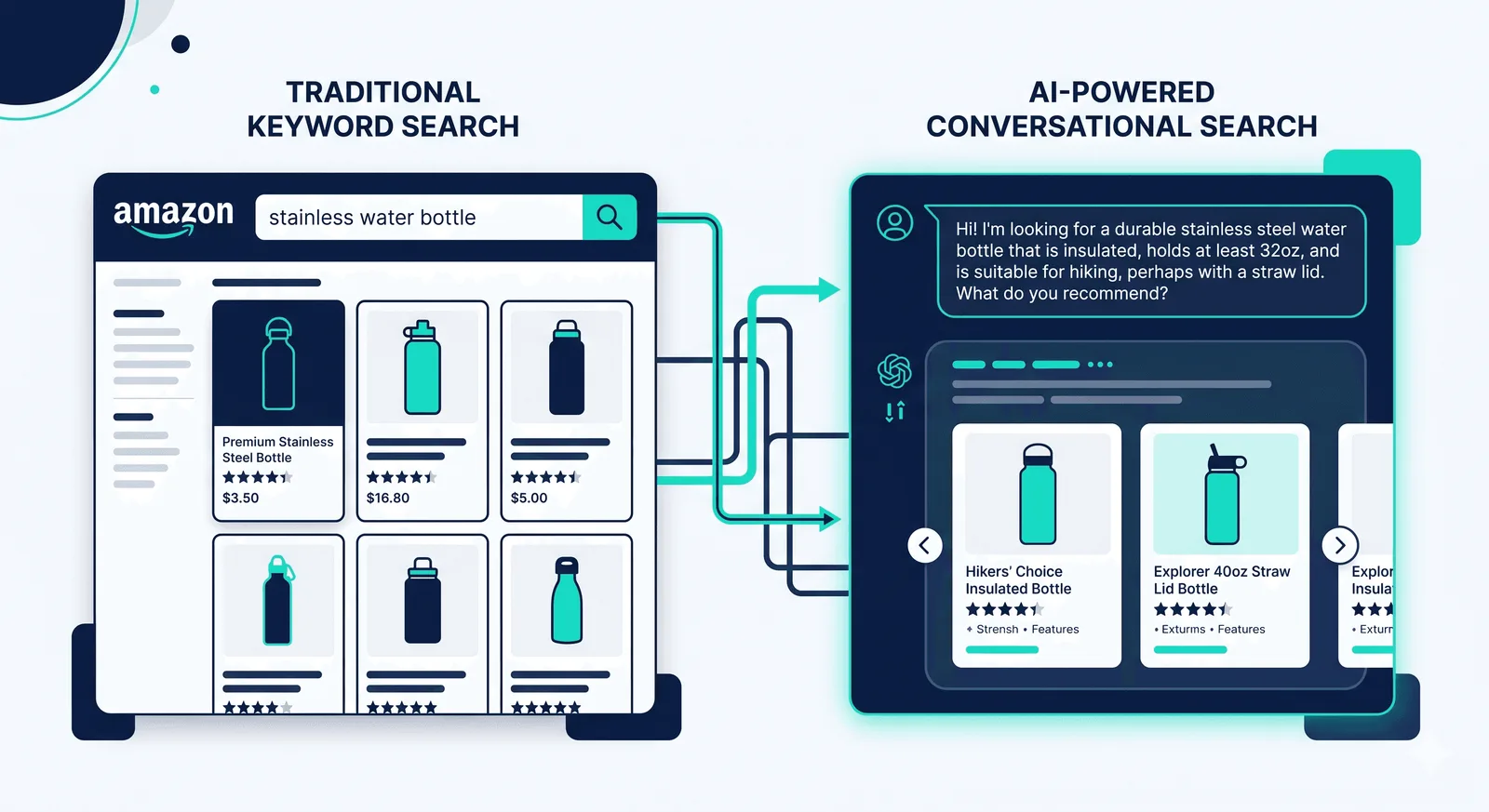
Traditional Amazon PPC was built on short, high-volume head terms. "Coffee grinder." "Dog harness XL." "LED desk lamp." You bid, you rank, you convert. The game was volume and relevance score.
Rufus breaks that model in two important ways.
First, Rufus compresses the discovery pool. Where a traditional Amazon search surfaces 50 to 100 products, Rufus filters and presents roughly five. That means your product either fits the AI's semantic understanding of the shopper's need, or it doesn't appear at all, regardless of your bid. If your listing and backend attributes don't signal the right use-case context, no amount of aggressive bidding on a head term will help you appear in Rufus-mediated sessions.
Second, the shoppers Rufus sends to the SERP are pre-qualified in a way that traditional searchers are not. A shopper who asked "which protein powder is best for women over 40 who don't want a chalky taste?" and then clicked your product from Rufus's recommendation has already been matched by AI to your product's specific attributes. That shopper converts. The data confirms it: Rufus-engaged shoppers convert at 30 to 40% compared to roughly 21% for non-Rufus sessions, with heavy Rufus users reaching 58% conversion rates.
The direct implication for your keyword strategy: the phrases that describe your product in the context of real-world use cases, not generic category terms, are now the phrases worth competing for.
The Shift from Head Terms to Conversational Long-Tail Keywords

The economics of long-tail keyword bidding have always been good. What Rufus has done is make them critical.
Long-tail queries on Amazon, defined as six or more words, now achieve a 13.5% conversion rate at an average CPC of around $0.64, compared to $1.18 for broad head terms that convert at roughly 9%. You are paying nearly half as much to get a buyer who is 50% more likely to purchase. That gap is widening as Rufus trains more shoppers to search conversationally.
The practical challenge is that conversational long-tail keywords are harder to discover manually. A shopper asking "best lightweight hiking daypack for women with hip belt and water bottle pocket" will not appear in your Search Term Report as a tidy, repeatable string unless you have campaigns structured to surface it. Most sellers running standard auto or broad match campaigns are capturing fragments of these queries, bidding on them as disconnected individual terms, and missing the full-phrase intent that actually drove the session.
The shift requires two things: discovery infrastructure that captures conversational queries at scale, and bid logic that weights them appropriately rather than suppressing them in favour of familiar head terms.
How to Build a Rufus-Aligned Keyword Discovery Loop
The most effective structure for capturing Rufus-mediated traffic is a three-tier campaign architecture:
Tier 1 — Discovery: Low-bid auto campaigns covering all four auto targeting types (close match, loose match, substitutes, complements). These campaigns act as your net, capturing the full range of queries shoppers are actually using. Budget these conservatively, because their job is intelligence-gathering, not conversion volume.
Tier 2 — Research: Manual broad match campaigns loaded with use-case-based seed phrases rather than pure category terms. Think "ergonomic office chair for lower back pain" not "office chair." Broad match here catches natural-language variations that your auto campaigns might miss.
Tier 3 — Performance: Manual exact match campaigns built from the converting long-tail winners you identify in Tiers 1 and 2. These are the phrases where Rufus pre-qualifies the shopper and your listing closes them. Bid these competitively because you're buying qualified traffic, not just impressions.
The loop only works if you are actively mining your Search Term Reports for long-tail patterns, negating head terms that consume budget without converting, and escalating winners to exact match on a consistent weekly cadence. Done manually, this is a significant time investment. Done with AI automation, it runs continuously without the weekly review bottleneck.
What Rufus Means for Your Bid Strategy Right Now

Rufus changes not just which keywords to bid on, but when and how aggressively to bid on them.
Rufus-mediated sessions tend to cluster around high-consideration purchase moments: shoppers who are further into research, with a specific use case defined, ready to decide. These sessions are disproportionately valuable. The right bid response is to defend them strongly, not treat them like ordinary impressions.
In practical terms, this means adjusting bid modifiers for sessions that match the profile of Rufus-routed traffic. Broad match campaigns targeting use-case phrases warrant higher bids than they might have received under traditional keyword economics. Exact match campaigns built on Rufus-converted long-tail terms warrant even higher bids, because you know those queries produce buyers.
With Prime Day confirmed for late June 2026, this recalibration is urgent. Prime Day CPC inflation for top keywords is expected to reach $2.50 to $8.00 across competitive categories, up 15 to 25% from 2025. Sellers who are still bidding primarily on short head terms will face brutal auction competition for average-converting traffic. Sellers who have seeded and validated a library of high-converting long-tail phrases over the next four weeks will enter Prime Day bidding on terms where competition is lower, quality is higher, and margin is more defensible.
The window for that preparation is now. Campaigns need a minimum of two to three weeks of data to surface reliable long-tail winners from auto and broad match discovery tiers.
One Thing to Do This Week
Run a Search Term Report across your last 90 days and filter for queries of six or more words with at least one conversion. For every phrase in that list that does not already have its own exact match campaign, create one. Those are your Rufus-aligned buyers. You've been underpricing them because they looked like low-volume outliers. In the conversational search era, they're the most valuable impressions in your account.
Let Autron Automate the Discovery Loop
Manually running this kind of keyword discovery and escalation process across dozens of products is prohibitively time-intensive for most brands. Autron's AI-powered platform runs this loop continuously, automatically mining search term data, identifying converting long-tail patterns, escalating winners to exact match, and adjusting bids in real time based on conversion signals.
Where most sellers are updating keywords weekly or monthly, Autron's AI is optimising bids and expanding keyword coverage every day, which matters more than ever when Rufus is shifting what shoppers search for in real time.
If you're preparing for Prime Day and want your campaigns to be capturing Rufus-qualified traffic by the time the event goes live, the practical answer is to start today, and to let automation handle the scale and speed that manual management cannot.
Try Autron free at https://autron.ai/ and see what your current campaigns are leaving on the table.