
Amazon Sponsored Display CPCs Are Up 49%: How to Stay Profitable in 2026
Sponsored Display CPCs hit $3.72 in 2026, up 49% YoY. Here's how to restructure your Amazon SD campaigns to protect margins and maximize ROAS.
TL;DR: Amazon Sponsored Display CPCs hit an average $3.72 in 2026, up 49% year-over-year — but cutting SD is the wrong move, since it targets warm audiences. The fix is precision: split campaigns by intent layer (purchases remarketing 8-18% ACoS, views remarketing 12-22%, prospecting 40%+ judged on new-to-brand) and push placement bids toward detail-page placements, which routinely lifts ROAS 15-25%.

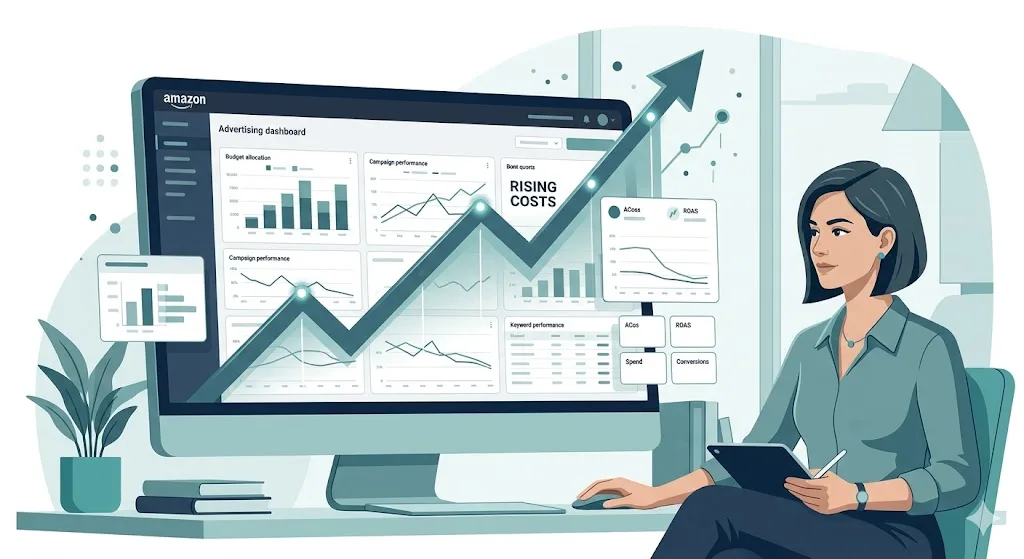
If you have noticed your Amazon Sponsored Display costs climbing this year, the data confirms what you're seeing. Sponsored Display CPCs hit a platform-wide average of $3.72 in 2026, a 49% jump year-over-year and the biggest single-year cost increase tracked across any Amazon ad format. For brands that set up their SD campaigns in 2024 or early 2025 and have not revisited them since, that's a significant margin hit sitting quietly in the background.
The instinctive response is to cut SD spend or abandon the format altogether. That would be the wrong move. The fundamentals that make Sponsored Display valuable — reaching warm shoppers at every stage of the funnel, both on and off Amazon — haven't changed. What has changed is the level of precision required to run it profitably. The brands scaling SD efficiently right now are not the ones spending more. They're the ones building smarter.
This guide covers what's driving the CPC surge, why SD still delivers strong returns when structured correctly, and the campaign architecture and automation tactics that separate profitable Sponsored Display programs from money-losing ones.
Why Amazon Sponsored Display CPCs Jumped 49% in One Year
Three compounding forces are driving the cost surge. Understanding each one matters because each points to a different part of your strategic response.
More Advertisers Are Competing for the Same Inventory
Sponsored Display was treated as a secondary format for years. Many sellers set it up, left it running on autopilot, and moved on. That changed as brands began reporting strong new-to-brand results from SD retargeting, particularly after Amazon expanded the format to include off-Amazon placements. Advertiser volume into SD has increased sharply, driving up auction pressure on views remarketing and purchases remarketing audiences that were once easy, low-competition wins.
Amazon's Programmatic Identity Push Is Making SD Inventory More Valuable
Amazon has been systematically integrating its first-party shopping signals more deeply into Sponsored Display targeting. SD inventory now carries richer audience identity data than it did 12 months ago — purchasing history, category browsing behavior, streaming signals from Prime Video — which makes it more valuable to advertisers and more expensive to win. The same impression that cost $2.50 last year now auctions at a higher floor because the targeting precision has improved. Higher signal quality commands a higher price.
The "All Tools" Console Consolidation Is Funneling More Brands Into SD
Amazon's recent Ads Console redesign surfaces Sponsored Display prominently alongside DSP, AMC, and Creative Studio in a unified interface. For mid-market brands exploring their ad stack for the first time, SD is now the most visible entry point to Amazon's full advertising infrastructure. That visibility is converting casual browsers into active bidders, adding new competition at the bottom of the funnel where your retargeting campaigns run.
Why Sponsored Display Is Still Worth It When Done Right
The $3.72 average CPC headline feels alarming until you put it in context. Sponsored Products CPCs for competitive keywords regularly run $2 to $8 or higher, and those clicks come from shoppers at every intent level, from casual browsers to ready-to-buy buyers with credit card in hand. Sponsored Display retargeting, by contrast, puts your ad in front of shoppers who have already visited your listing, added your product to their cart, or purchased from your category in the last 30 days. The audience quality is fundamentally different.

The Unit Economics of Retargeting at Scale
Purchases remarketing, the SD targeting type that re-engages your recent buyers, consistently delivers the lowest ACoS in most Amazon accounts: typically 8 to 18%. Views remarketing — targeting shoppers who viewed your listing but did not convert — runs 12 to 22% ACoS for most brands. Compare those numbers to broad Sponsored Products campaigns in competitive categories, where ACoS of 30 to 50% is common, and SD's higher cost per click starts looking far more manageable.
The key reframe is this: $3.72 targeting your own warm audience is often cheaper in cost-per-conversion terms than $1.50 targeting a cold shopper who has never heard of your brand and is comparing you to five competitors at once. The CPC is not the metric that matters. The cost per converted sale is.
The Campaign Architecture That Makes Sponsored Display Profitable
The single most common mistake brands make with Sponsored Display is running views remarketing, purchases remarketing, and audience prospecting inside the same campaign. When you mix intent layers, you lose the ability to optimize any of them. High-ROAS retargeting impressions subsidize low-ROAS prospecting clicks, your ACoS target becomes a meaningless average, and you cannot make confident bid decisions at the line-item level.
Separate Your Campaigns by Intent Layer
Build three distinct campaign types and treat them as separate products with different success metrics.
Purchases remarketing is your lowest-funnel, highest-conversion campaign. These are shoppers who have already bought from you and have proven they trust your brand. This campaign can carry your most aggressive bids and your tightest ACoS target, typically 8 to 18%. Evaluate it on raw ACoS and ROAS. This is not where you measure new-to-brand performance.
Views remarketing captures shoppers who browsed your listing but did not convert. They're mid-funnel and warrant a separate ACoS target of 12 to 22%. Start with a 14-day lookback window, extend to 30 days if CVR holds steady, and tighten to 7 days if ROAS starts to erode. This campaign performs especially well in categories with longer consideration cycles — supplements, home furnishings, electronics accessories — where shoppers research over days or weeks before buying.
Audience prospecting runs at 40 to 80%+ ACoS and should never be evaluated on raw ACoS alone. Measure this campaign on new-to-brand rate and new-to-brand revenue. If 60% of attributed sales are new-to-brand customers at an ACoS of 65%, the campaign may still be highly profitable on a customer lifetime value basis — but you will never see that if you are averaging its results into the same campaign as your purchases remarketing.

Use Placement-Level Bid Adjustments Aggressively
Sponsored Display now supports placement-level bid adjustments across detail page, home page, and off-Amazon placements. In the majority of accounts, detail page placements drive the strongest ROAS because they place your product directly next to competitor listings at the precise moment a shopper is evaluating alternatives. Home page and off-Amazon placements tend to drive awareness at lower conversion rates and are better evaluated on reach and NTB metrics than on short-window ROAS.
Pull your placement-level performance data from the last 30 to 60 days and apply bid multipliers to push spend toward your highest-converting placement. This single structural adjustment routinely improves SD ROAS by 15 to 25% without any change to targeting or creative.
How AI-Powered Optimization Keeps Sponsored Display Profitable as Costs Rise
Even with the correct campaign architecture in place, manual SD management at scale cannot keep pace with market conditions. Lookback windows need adjusting as seasonality shifts. Bid floors need tightening when competitor CPCs spike — as they just did by 49%. ACoS targets need recalibrating as your conversion rate changes week over week. Adding three distinct SD campaign layers to an already demanding Sponsored Products workload creates a volume of bid decisions that manual management simply cannot handle at the speed Amazon's auction system requires.
Amazon's Native SD Automation: A Starting Point, Not an Endpoint
Amazon's own SD automation supports ACoS goal-based bidding, adjusting bids daily against product targets and audiences using platform-level machine learning. This is a meaningful improvement over fully manual bidding, but it optimizes within Amazon's ecosystem using Amazon's cost signals. It does not account for your organic sales trends, your TACoS position, your contribution margin structure, or the downstream impact of SD spend on total account profitability.
A brand that set an SD ACoS target of 20% in January 2025 based on then-current CPCs is now, in April 2026, either overbidding for impressions that no longer convert at the same rate, or running a bid that is no longer competitive enough to win the retargeting auctions on their warmest audiences. Static targets in a dynamic CPC environment produce exactly this kind of silent inefficiency.
Continuous AI Optimization Across Your Full Ad Stack
AI-powered platforms like Autron layer additional intelligence on top of Amazon's native SD bidding. Rather than optimizing SD campaigns against a single ACoS target, Autron factors in organic sales velocity, overall TACoS position, and SD's contribution to total account profitability — adjusting bids continuously as market conditions change. SD bids are not tuned in isolation. They are tuned in the context of your full advertising program.
When Sponsored Display CPCs surge as they have in 2026, a static ACoS goal will either overbid and erode margin, or underbid and lose retargeting reach on the warmest, highest-converting audiences in your account. An AI system that continuously monitors market CPC conditions and adjusts bids relative to real-time conversion signals — not quarterly benchmarks — is what keeps SD profitable through a cost environment like this one.
The compound effect is measurable. Brands running automated SD management consistently outperform manual accounts on purchases remarketing ACoS by 20 to 35%, not because the targeting strategy is different, but because bid precision at the frequency Amazon requires is not achievable by hand.
What the Sponsored Display CPC Surge Means for Your Q2 Plan
April is historically one of the most profitable months to advertise on Amazon. Industry benchmarks consistently show average ACoS at its annual low this time of year, driven by strong conversion rates and relatively stable CPC floors before Prime Day season heats up. That window will not last.
The brands that will profit most from Sponsored Display through Q2 and into Prime Day are not the ones spending the most on it. They're the ones running it with the precision the format now demands: intent-layer-separated campaigns, placement-level bid optimization, lookback windows calibrated to their category's consideration cycle, and AI-driven bid management that keeps pace with daily CPC fluctuations.
Rising CPCs are a signal that more advertisers have recognized SD's value. The question is whether your program is built to extract that value more efficiently than your competitors.
If you want to see exactly how Autron's AI-powered platform manages Sponsored Display alongside your Sponsored Products and Sponsored Brands campaigns — optimizing bids continuously across every layer of your funnel — try it free at https://autron.ai/. No manual bid management. No guessing on ACoS targets. Just continuous AI optimization built for the way Amazon advertising actually works in 2026.