Amazon PPC dayparting has always been a nice-to-have: shave bids at 3 a.m., push them at 8 p.m., save a few percent. This week it becomes a budget problem. For the first time, Amazon is dropping deals twice on both Black Friday and Cyber Monday, at midnight and again at 8 a.m. PST. A campaign that spends its daily budget chasing the first wave can be dark by the time the evening shoppers arrive.
This guide covers what dayparting on Amazon actually is, how to read your hourly data, what Amazon's schedule rules can and can't do, and a day-by-day plan for November 23 to 30.
What Amazon PPC dayparting is, and what it isn't
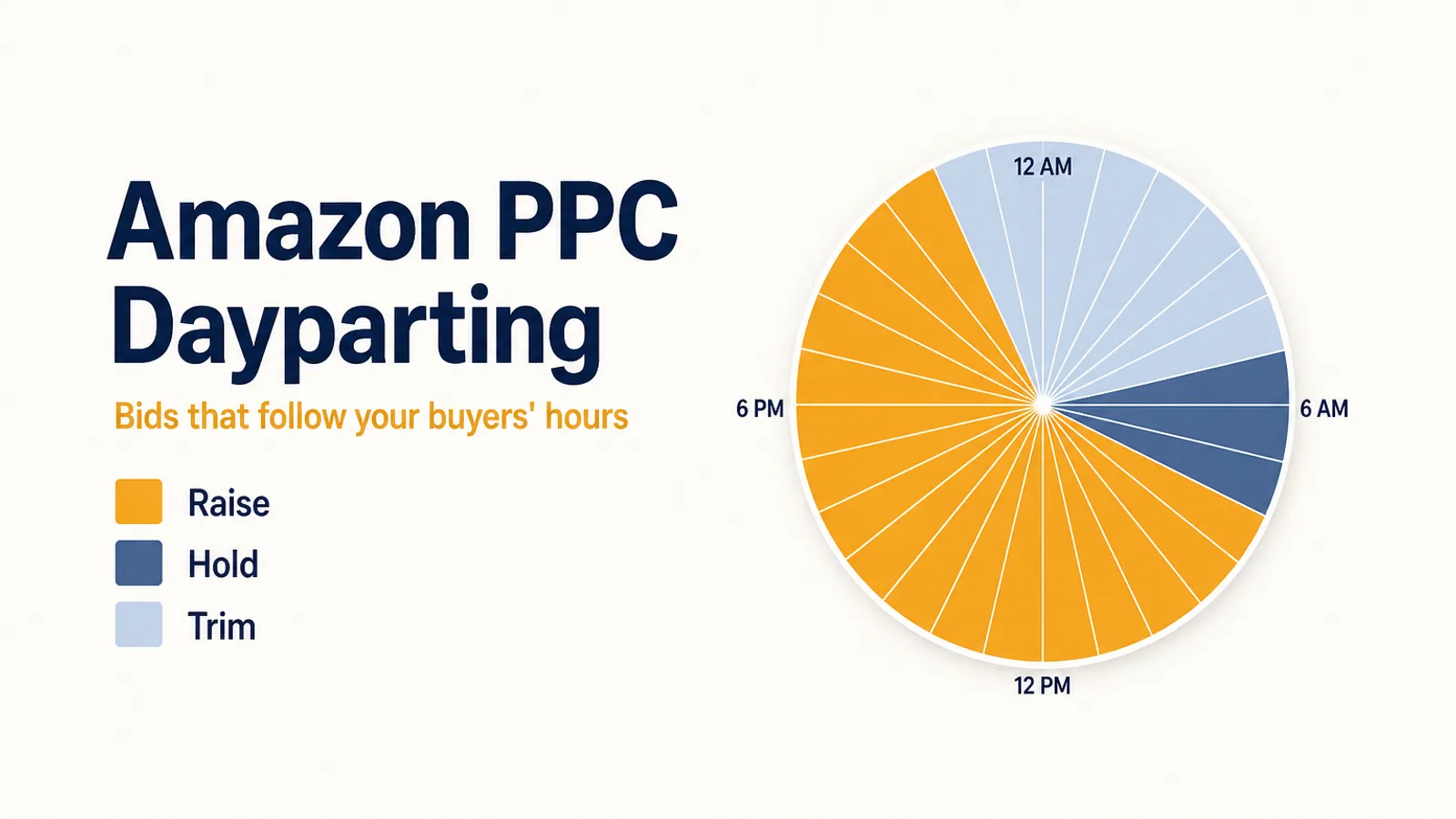
Dayparting means changing bids or budgets by hour of the day or day of the week, so your spend follows the hours your buyers convert. There are two levers:
- Bids by hour. Pay more per click in hours that convert well, less in hours that don't.
- Budget by hour or day. Make sure the campaign still has money when the good hours arrive.
It is not switching ads off overnight. A paused campaign loses its cheap overnight clicks and the sales that come with them, and it saves less than people expect, because overnight traffic is small anyway. Good dayparting reshapes the day. It rarely blacks part of it out.
It is also not a fix for a bad target. If a keyword loses money at every hour, dayparting just loses it more slowly. Get the target right first (our guide to ACoS vs TACoS covers which one to set), then shape the hours.
Why Black Friday Week 2026 makes the hours matter
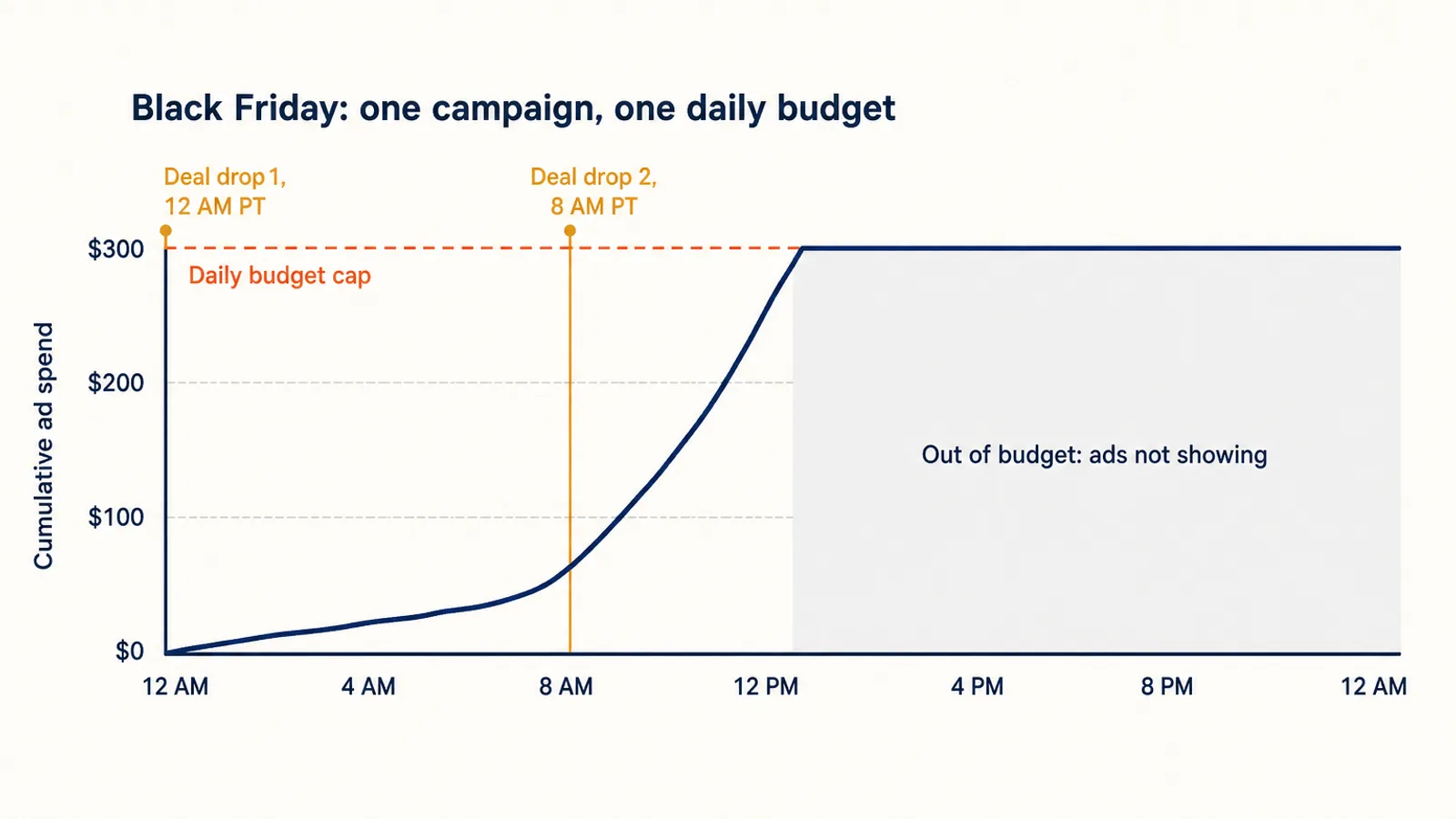
Amazon's Black Friday Week runs November 19 to 30, with themed deal drops every day. The new part is the double drop on November 27 and November 30: one batch at midnight PST, a second at 8 a.m. PST (11 a.m. Eastern).
That collides with how Sponsored Products budgets work. Amazon's own guidance is that a campaign that runs out of budget stays ineligible to show until the budget resets at midnight. Amazon already lets a campaign spend up to 100% more than its average daily budget on a busy day, but on a day with several times your normal traffic even double can be gone by early afternoon.
Three things follow from that:
- The 8 a.m. drop is the expensive one. It lands as the US East Coast is mid-morning and the West Coast is waking up, so traffic and CPCs climb together from there.
- The evening is what you lose. Shoppers who browsed deals at lunch often buy after work. A campaign that ran dry at 2 p.m. never sees them.
- Overnight is mostly a sideshow. The midnight drop brings deal hunters, but for most brands the overnight hours are a small share of the day's orders. Check your own data before bidding up for them.
How to read your hourly data before you change anything
Dayparting is only as good as the data behind it, and hourly data is noisy. When Amazon launched schedule bid rules it pointed advertisers to hourly performance reporting in the console to find their best hours. Tools connected to the Ads API can also read Amazon Marketing Stream, which delivers traffic and conversion metrics summarized hourly.
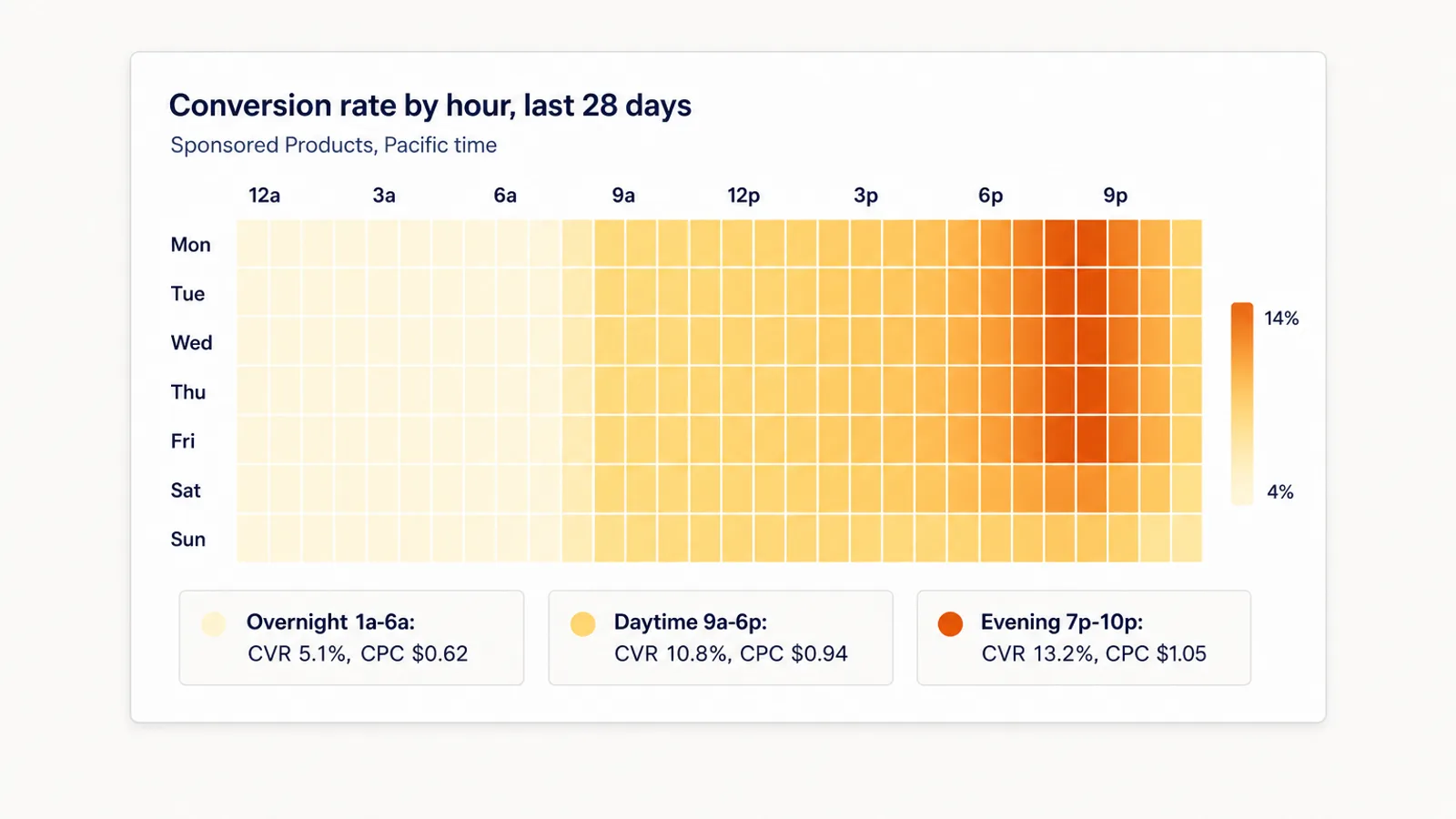
Read it like this:
- Look at conversion rate and CPC by hour, not sales by hour. Sales by hour mostly tracks traffic, so it tells you when people shop, not when your clicks are worth more. The question dayparting answers is whether a click at 9 p.m. is worth more than a click at 4 a.m.
- Use at least four weeks and group the hours. A single hour on a single day might hold a handful of clicks. Group the day into blocks (overnight, morning, afternoon, evening) and compare blocks across four weeks or more.
- Check the time zone. Reports and rules run on your marketplace's clock. If you sell in the US from Europe, your "8 p.m." is not your shoppers' 8 p.m.
- Allow for late conversions. A click at 11 p.m. that turns into a purchase the next morning blurs the picture at the edges of each block. Another reason to judge blocks, not single hours.
- Treat this week as unusual. Black Friday hourly patterns are not your normal week. Don't build a December curve from Black Friday data.
If the gap between your best and worst blocks is small, dayparting won't earn much and you can skip it. If evenings convert at twice the rate of overnight at a similar CPC, there is money in it.
The tools Amazon gives you, and the one-way limit
Amazon has three native options, all free:
- Schedule bid rules. Since November 2023, Sponsored Products can increase bids at specific times of the day, days of the week and date ranges, in the US, Canada, Mexico, Germany, Spain, France, Italy, the UK and India.
- Hour-of-day budget rules. Since November 30, 2023, schedule-based budget rules can increase budget at specific times of day in the US, Canada, UK, India and Japan, built to stop campaigns running out of budget on peak days and holiday events.
- Event budget rules. Schedule-based budget rules can set budgets in advance for special events or a date range you choose. Amazon's own budget guide uses a rule that increases the budget by 100% on Black Friday as its example.
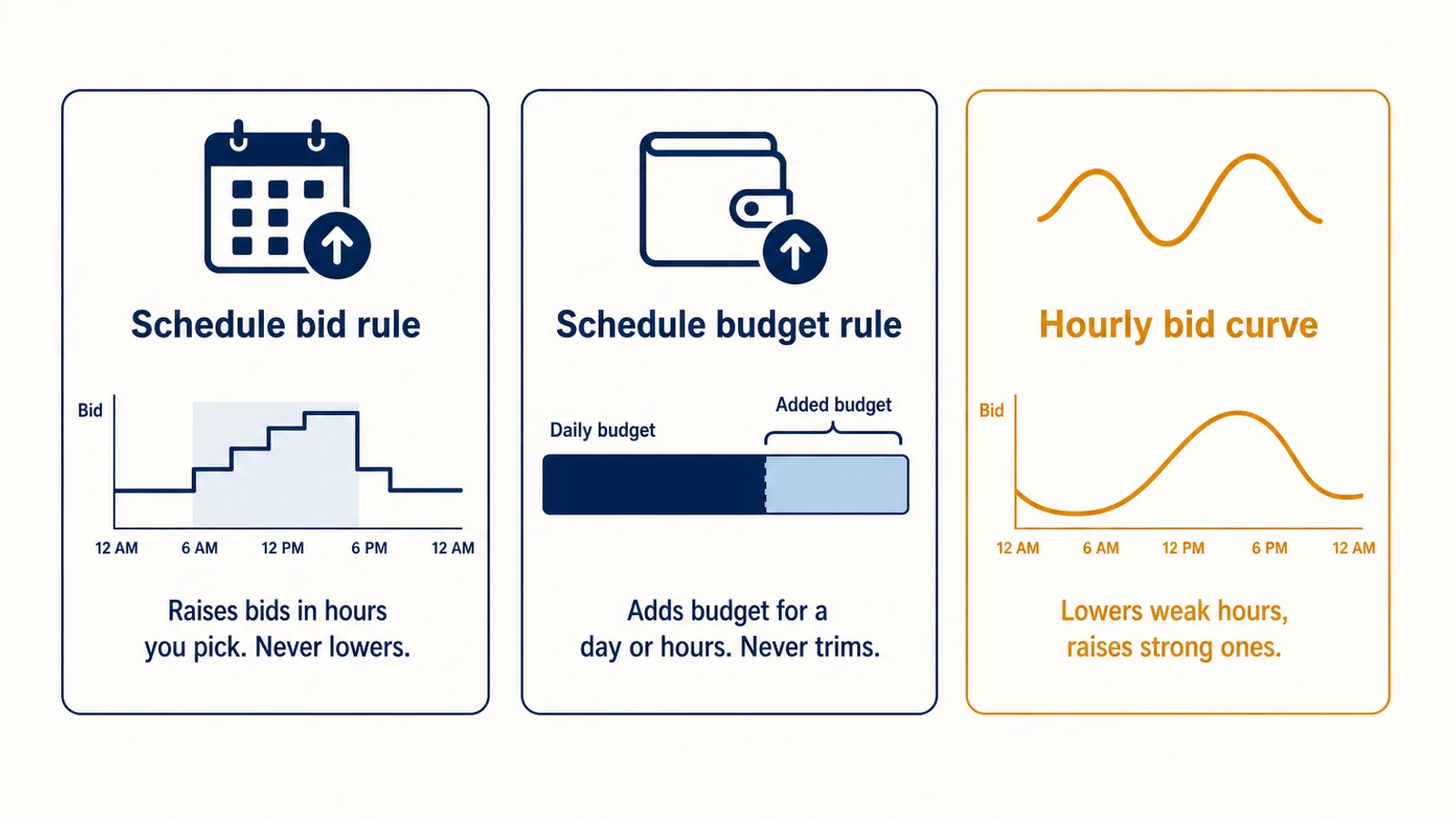
The catch: every one of them only raises. Amazon describes schedule bid rules and budget rules as ways to increase bids and budgets. None of them lowers a bid at 3 a.m.
The common workaround is to lower the base bid and let a schedule bid rule raise it in your strong hours. That works, with two costs. Your base bid is now your overnight bid in every hour the rule doesn't cover, and when the rule ends, the low base bid stays. Write down what you changed so you can undo it in December.
We compared Amazon's rules with handing the work to software in more detail in how to automate Amazon advertising.
A dayparting plan for November 23 to 30
You don't need a full hour-by-hour curve this week. You need budget in the right hours and no surprises.
| When | What to do |
|---|---|
| Mon to Wed, Nov 23 to 25 | Pull four weeks of hourly data for your top 10 spending campaigns. Check stock on every ASIN they advertise. Set schedule budget rules for Nov 27 and Nov 30. |
| Thu, Nov 26 (Thanksgiving) | Leave bids alone. Check that the rules show as scheduled and that every campaign has a daily budget it can actually spend. |
| Fri, Nov 27 (Black Friday) | After the 8 a.m. PST drop, check your top campaigns for out-of-budget status at around 10 a.m. and 2 p.m. PST. Add budget to the ones with a good ACoS. Leave the rest. |
| Sat to Sun, Nov 28 to 29 | Weekend traffic stays high. Keep the budget headroom, and pull any ASIN that is close to selling out from heavy bidding. |
| Mon, Nov 30 (Cyber Monday) | Same drill as Friday. Same two checks. |
| Tue, Dec 1 | Date-range rules end on their own. Undo any base-bid cuts you made for a schedule bid rule, and note which hours ran out of budget for next year. |
Two rules of thumb for the checks:
- Add budget only where the campaign is under your break-even ACoS. Peak-season fees move that line, which we worked through in your break-even ACoS for Q4 2026. A campaign losing money at noon will lose more at 8 p.m.
- Raise bids only in hours your data already backs. A schedule bid rule on Black Friday morning, built on a guess, mostly makes the most expensive hours of the year more expensive.
If you are also working through Amazon's own bid and budget suggestions this week, our campaign intelligence guide covers which to apply before Black Friday and which to skip.
Mistakes that make dayparting cost money
- Pausing ads overnight. You lose cheap clicks and save little. Lower bids instead.
- Reading single hours. Five clicks at 3 a.m. is not a pattern. Group hours and use four weeks or more.
- Ignoring the time zone. Rules run on the marketplace's clock, and so do the deal drops.
- Dayparting every campaign. Start with the campaigns that spend the most. On a campaign spending $5 a day the hours barely matter.
- Bidding up on low stock. An ASIN about to sell out doesn't need a stronger evening. It needs bids pulled before it goes out of stock and loses its ranking.
- Forgetting to undo. Lowered base bids and one-off rules outlive the event. Put the undo on your calendar for December 1.
Where Autron fits
Hourly bidding is the part of dayparting that is hard to do by hand, because it never stops. Autron Pro, our ad engine, adjusts Sponsored Products bids through the day on an hour-of-week shape, in your marketplace's local time. It lowers bids in hours that convert poorly and brings them back up when buyers are active, alongside daily bid optimization, budgets and negative keywords against the ACoS or TACoS target you set. Pro is $150 a month plus a commission on ad sales, paid from day one.
A fair warning if you are thinking about it this week: bid automation needs a couple of weeks of data to settle, so switching it on now means it would still be learning on Black Friday. For this week, Amazon's budget rules are the right tool. Pro is a December decision.
If you just want to see your own hours first, the free plan lets you ask the Autron agent about your campaigns on 5 credits a day, with no card. You can also run a free PPC audit before the busiest week of the year.
FAQ
What is Amazon PPC dayparting?
Dayparting is changing your Sponsored Products bids or budgets by hour of the day or day of the week, so you pay more in the hours your shoppers convert and less in the hours they browse. It reshapes spend across the day. It doesn't mean switching ads off overnight.
Does Amazon have built-in dayparting?
Partly. Since November 2023, schedule bid rules can increase Sponsored Products bids at set times of day, days of the week and date ranges, and schedule budget rules can add budget by hour in the US, Canada, UK, India and Japan. Both only raise. Lowering bids in weak hours is still a manual change or a job for a tool.
When do the Black Friday and Cyber Monday 2026 deal drops happen on Amazon?
Amazon's Black Friday Week runs November 19 to 30, 2026. On Black Friday (November 27) and Cyber Monday (November 30), deals drop twice, at midnight and 8 a.m. PST. It is the first year Amazon has done a double drop.
Should I turn my Amazon ads off overnight?
Usually not. Overnight clicks are often cheap, and pausing loses them for little saving. Lower bids in hours that convert poorly instead, and only after four weeks of hourly data show the gap is real.
Is it too late to set up dayparting for Black Friday?
Not for budgets. A schedule budget rule for November 27 and 30 takes minutes and is the most useful change this week. Leave hour-by-hour bid curves on new campaigns until December, when you have clean data to build them from.