
Why You Should Avoid Adding Duplicate Keywords Across Ad Groups
Duplicate keywords across ad groups do not buy you more impressions. They split your conversion history, blur your bids, and slow optimization. Here is the fix.
TL;DR: Adding the same keyword to multiple ad groups does not increase your impressions. Amazon serves one of your ads for a given shopper search, so the duplicate mostly splits click and conversion history across ad groups, which slows learning and makes bids harder to set. Keep one keyword in one ad group per match type, and use negatives to enforce it.

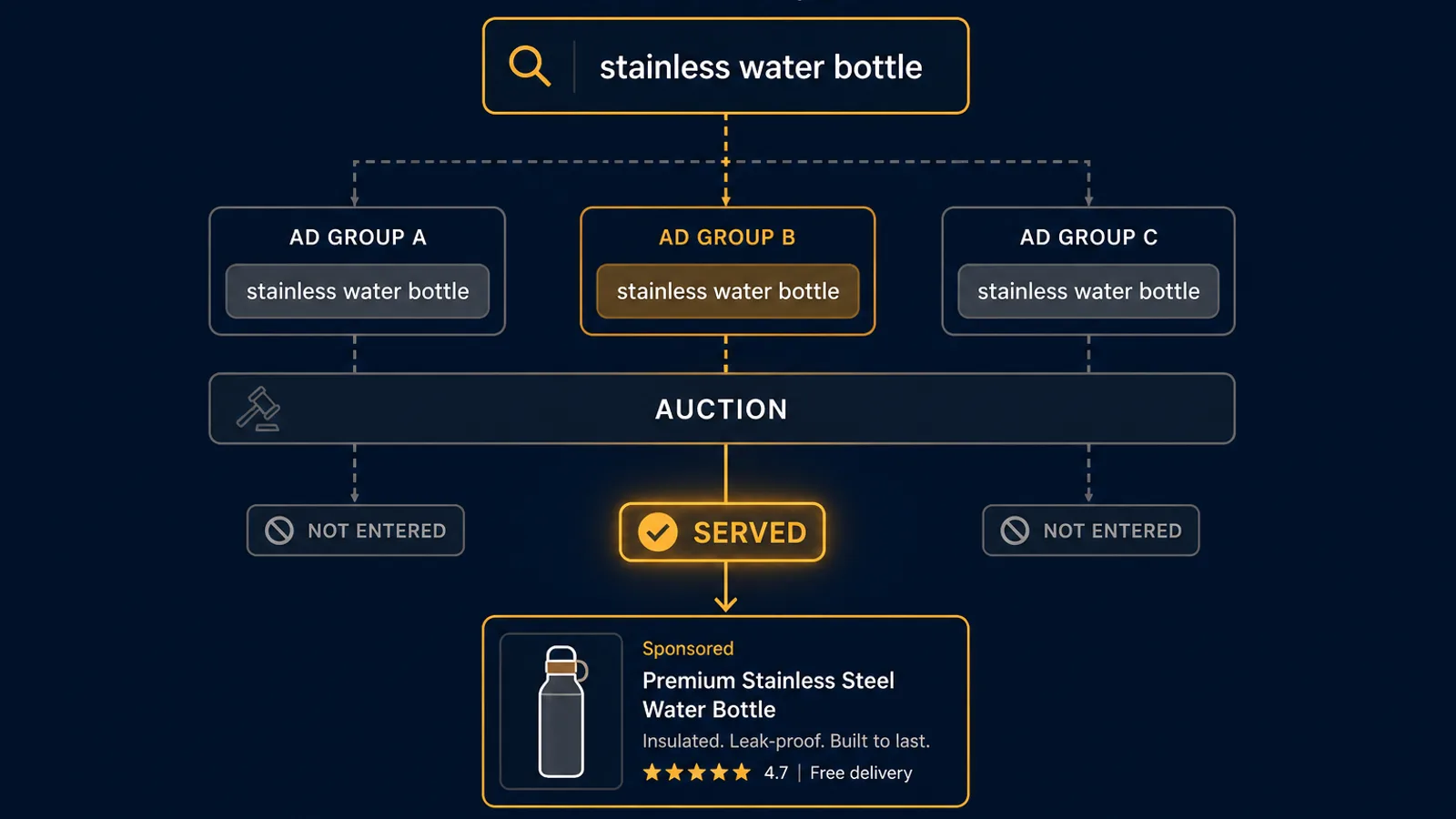
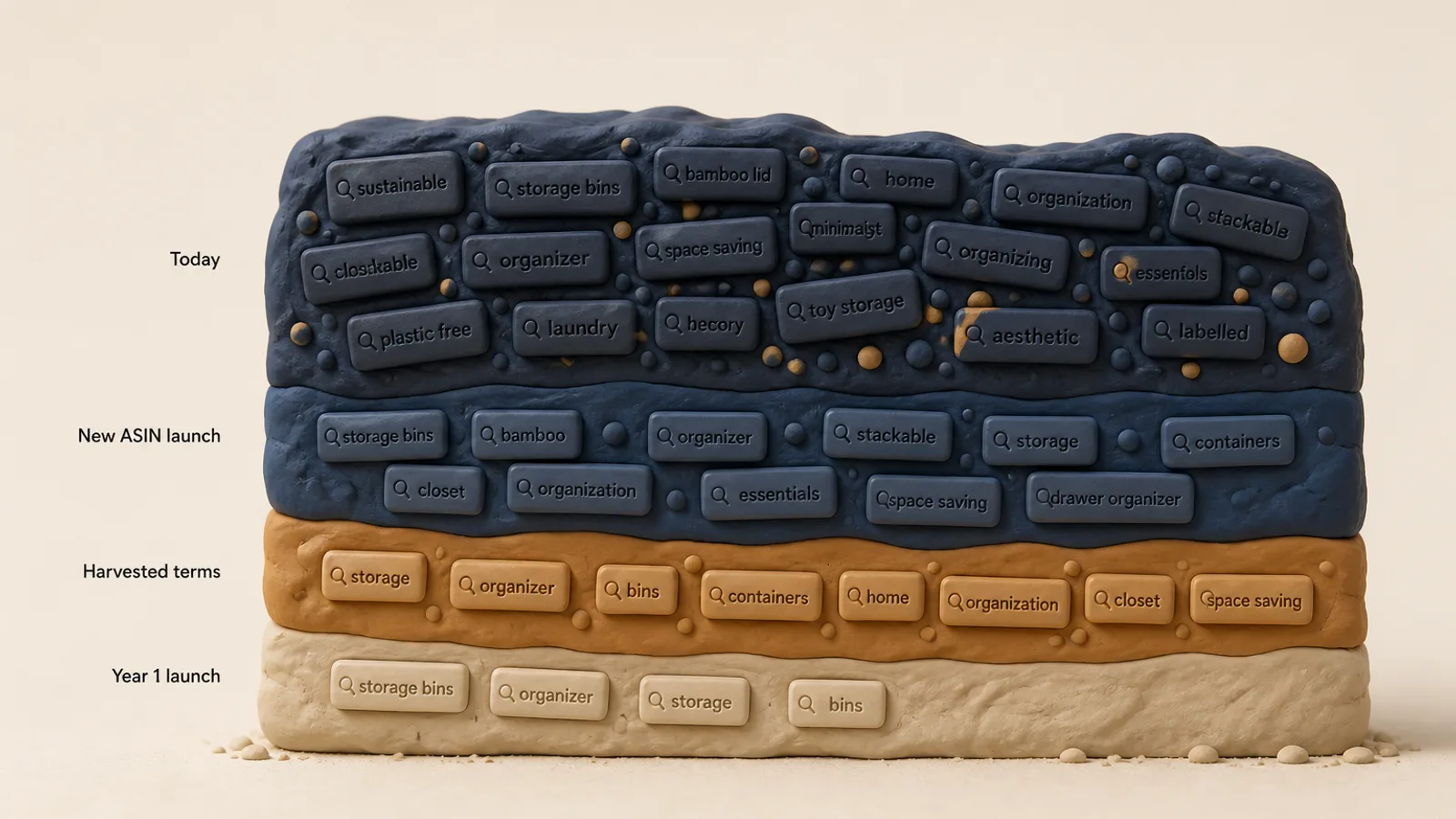
Somewhere in most Amazon accounts there is a keyword sitting in three different ad groups. It got there honestly: once when the campaign was built, once when someone harvested it out of an auto campaign, and once when a new ASIN launched and the keyword list was copied over wholesale. The instinct behind duplicate keywords across ad groups is reasonable, more entries should mean more chances to show. That is not how the auction works, and the cost of the duplicate is not the one most sellers expect.
The damage is not that you overpay for a click. It is that you destroy the evidence you need to set the bid in the first place.
What Actually Happens When the Same Keyword Sits in Two Ad Groups
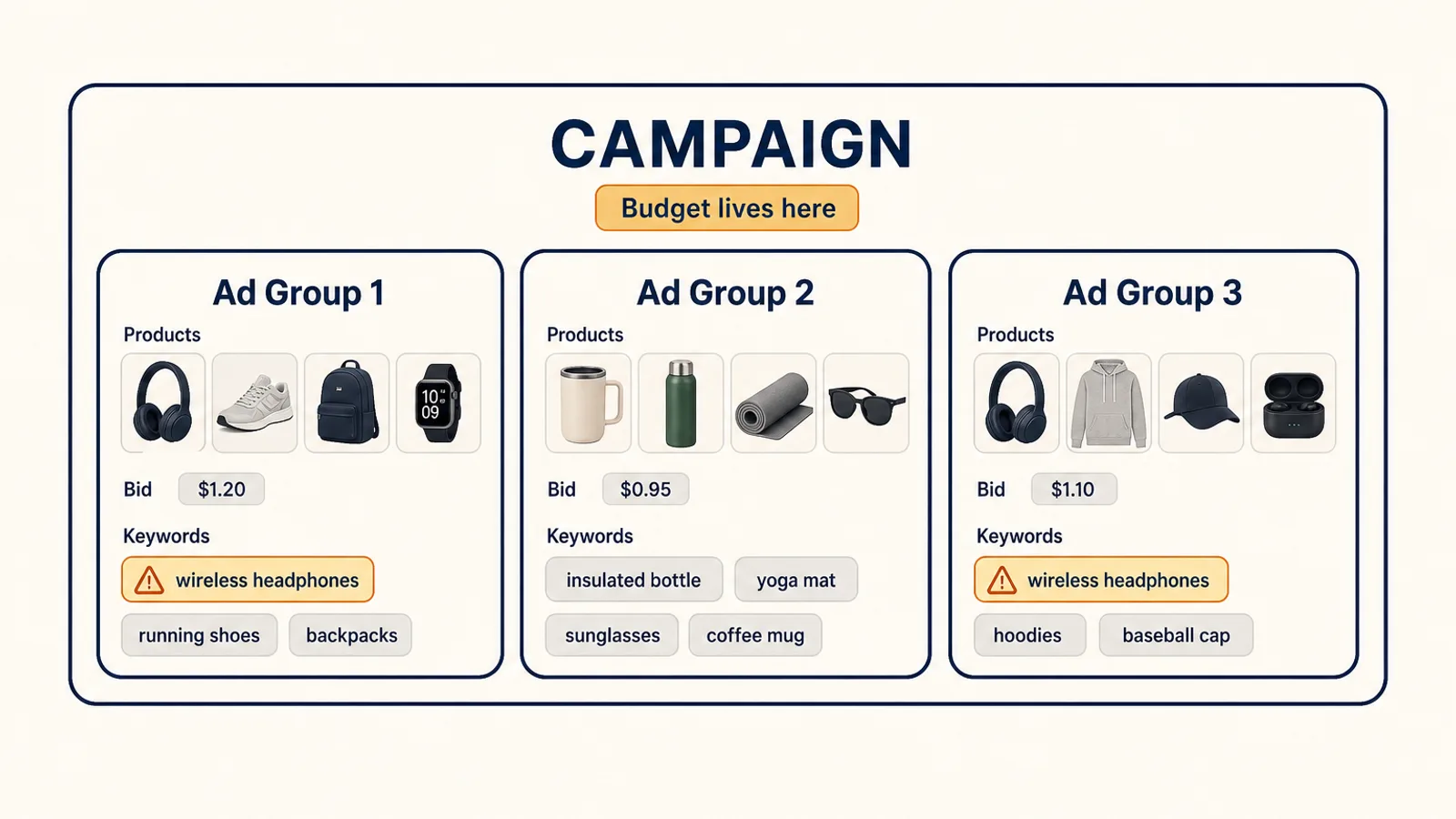
Start with the structure. A Sponsored Products campaign holds the budget. Ad groups sit inside it, and as Amazon's own Sponsored Products best practices put it, "keyword or product targeting, and bids apply to all products within an ad group, so we recommend choosing products that are closely related to each other." The ad group is the unit where a bid and a set of products meet. That is the whole reason it exists.
Now a shopper types your keyword. Amazon does not enter three of your ads into that auction and let them fight. It picks one of your ads to represent you, weighing bid strength and relevance, and that one competes against other advertisers. Amazon has never published the exact selection logic, but the behaviour is visible in any account: for a given search, impressions land in one ad group, not spread evenly across the copies.
So the second and third copies of the keyword are not additional lottery tickets. Most of the time they are dormant, and occasionally they win the pick and serve instead of the ad group you would have chosen. Neither outcome is what the seller who added them was going for.
Cost One: Your Conversion History Gets Cut Into Pieces
This is the expensive one, and it is almost invisible on a dashboard.
Every keyword accumulates a record: impressions, clicks, orders, conversion rate at a given bid. That record is what any bidding decision, yours or an algorithm's, actually runs on. Amazon's own guidance is to evaluate a target only once it has meaningful click volume behind it, and a common working threshold is around 20 clicks before you trust the signal at all.
Split one keyword across three ad groups and you do not get three records worth 20 clicks each. You get the same total clicks divided three ways, so a term that would have hit a decision threshold in two weeks now takes six, in three separate places, each of which looks statistically thin. You have not changed how much traffic the keyword gets. You have changed how long it takes you to understand it.
At a cross-category average CPC of about $1.13 in 2026, those extra weeks of ambiguity are not free. You are paying real money to learn something more slowly than you needed to.
Cost Two: You Cannot Answer Simple Questions
Ask a straightforward question of an account with duplicates. "Is this keyword profitable?"
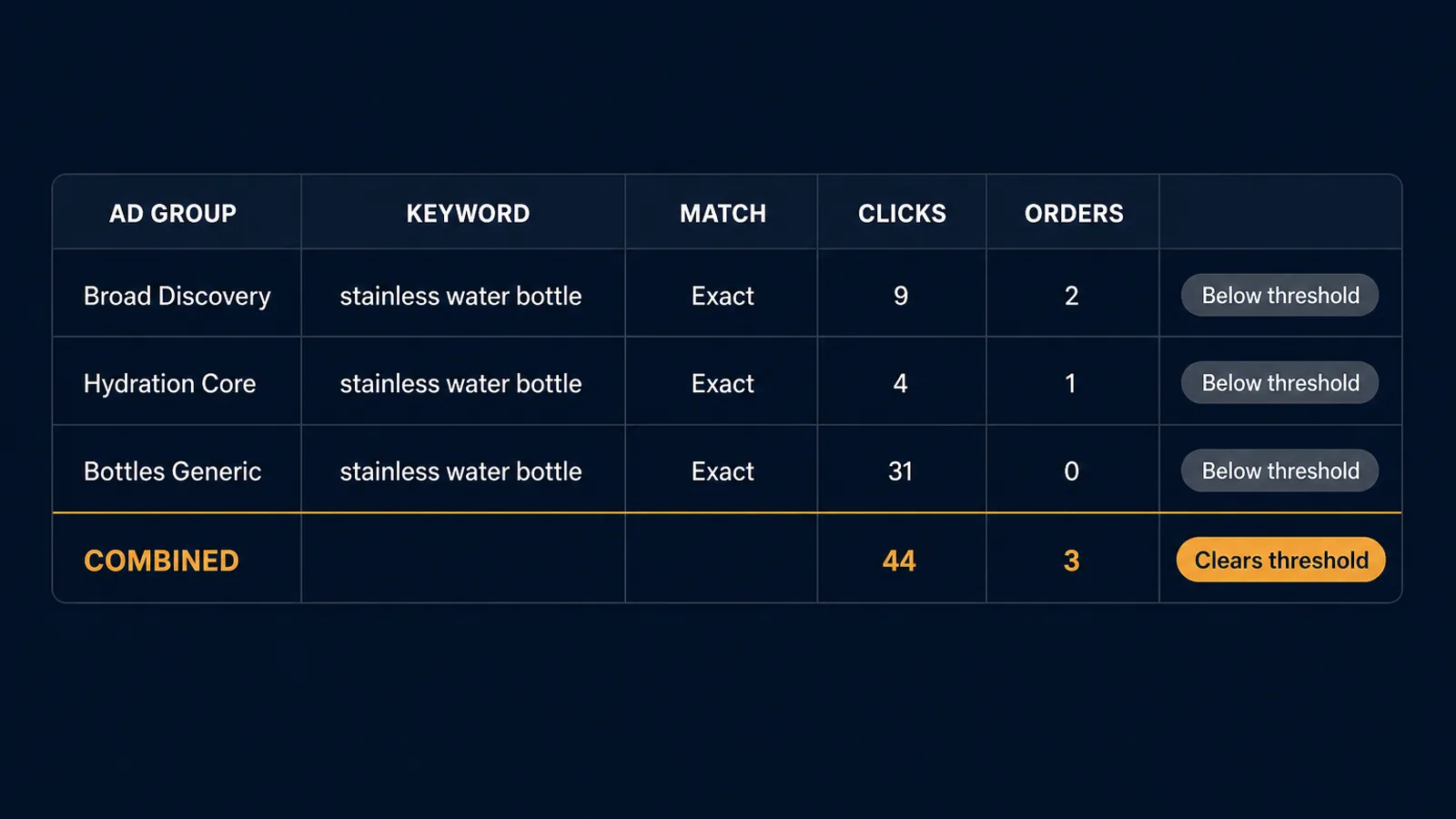
There is no single answer, because there are three rows. One shows two orders on nine clicks. One shows one order on four clicks. One has taken 31 clicks and never converted. Every one of those rows is real, none of them is the truth about the keyword, and the honest aggregate needs a spreadsheet and someone willing to build it. Faced with three contradictory rows, most operators pick the one that confirms what they already thought, or skip the keyword and optimize something easier to read. It keeps spending either way.
Cost Three: Bids Stop Meaning Anything
A bid is a statement about what a click on a search term is worth to you. When the same keyword carries three different bids in three ad groups, you have made three contradictory statements, and Amazon resolves the contradiction on your behalf.
The failure mode is specific: the ad group with the strongest bid tends to win the pick, and that is frequently not the ad group with the best conversion rate. Bids drift upward in whichever ad group someone last touched, not in whichever one actually earns it. So your worst-converting copy captures the traffic while your best-converting copy sits idle and looks, in the report, like a keyword that never took off.
Where Duplicates Actually Come From
Nobody sets out to build this. Duplicates are sediment, deposited by normal work over time:
- Search-term harvesting. A term converts in a broad or auto ad group, someone promotes it to exact in a new ad group, and the original is never negated. Now it lives in both.
- Copying a keyword list to a new ASIN. The list is good, so it gets reused, and the new ad group targets products that overlap with the old ones.
- Match-type expansion. Broad, phrase, and exact copies of the same term scatter across several ad groups with no negatives separating them.
- Staff turnover and account age. The person who knew why the keyword was in two places left, so nobody deletes anything. Every one of these events is small. Two years of them is not.
How to Find Every Duplicate in Your Account
This takes about twenty minutes and needs no tooling beyond a spreadsheet.
- Export a bulk operations file from the campaign manager covering the last 60 days.
- Filter to keyword rows only. Drop campaigns, ad groups, product ads, and negatives for now.
- Build a composite key: keyword text plus match type, lowercased and trimmed.
"stainless water bottle" + exactis a different key from the same text in broad, and should be. - Count ad groups per key. Any count above one is a duplicate.
- Sort by combined spend, highest first. This is your work queue, and it is usually much shorter than the raw duplicate count suggests. A handful of terms tend to account for most of the wasted ambiguity.
Run the same pass across campaigns, not just within them, if multiple campaigns advertise overlapping ASINs. Our n-gram analyzer helps with the harder version of this problem: several ad groups chasing the same intent under different keyword text, which an exact-string match will never catch.
The Fix: One Keyword, One Ad Group, One Job
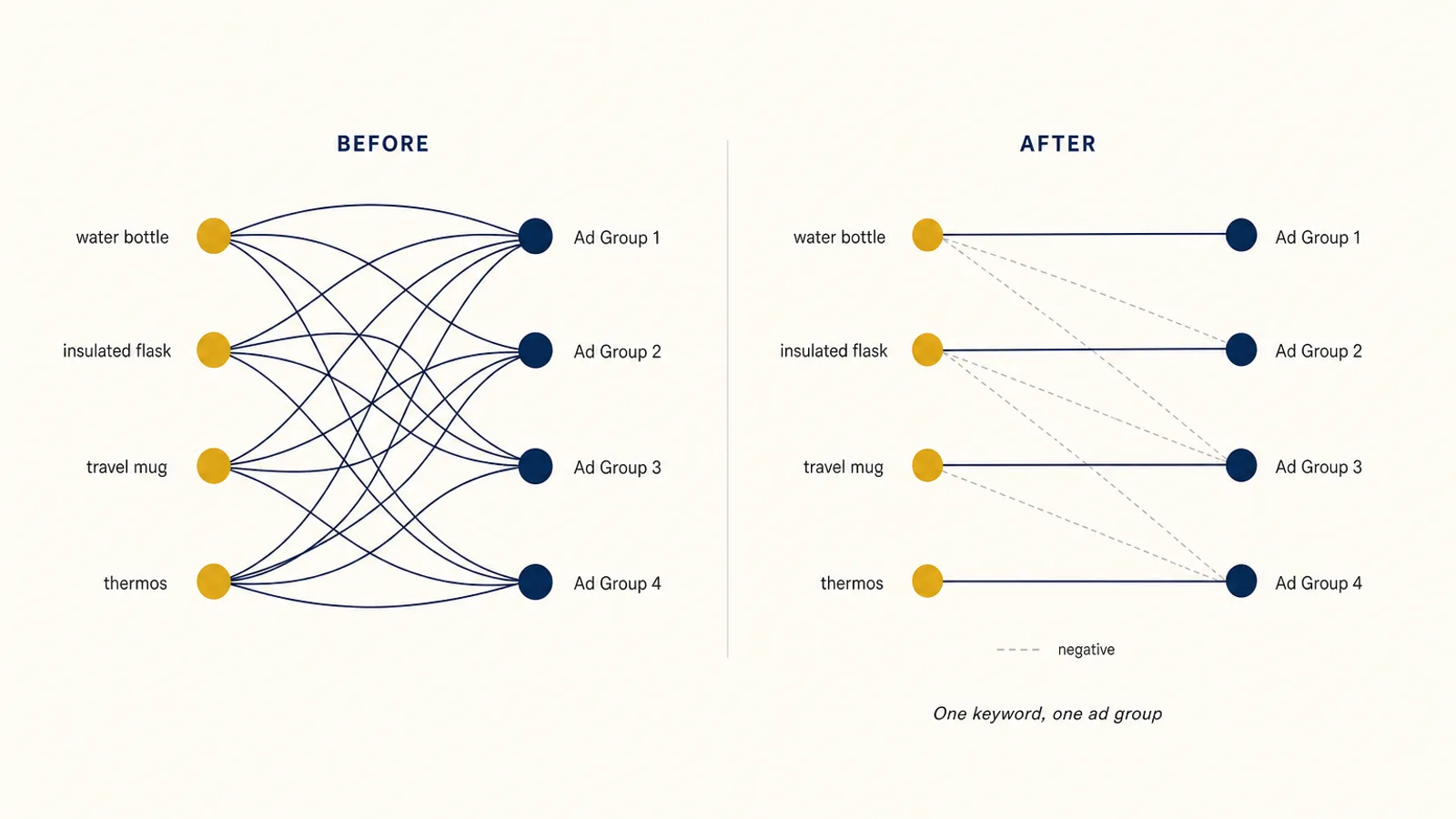
The rule is simple to state and slightly annoying to apply: each keyword and match-type pair lives in exactly one ad group, and that ad group has one job.
Applying it to a duplicate you have found:
- Pick the survivor on conversion rate, not on spend or age. The ad group with the best conversion record for that term keeps it, even if it is the newer one.
- Pause the losing copies rather than deleting them for the first two weeks. Deletion loses the history, and you may want to compare.
- Add the surviving term as a negative exact in the ad groups you removed it from. This is the step people skip, and skipping it is why the duplicate comes back. Without the negative, the broad or auto ad group happily starts serving the term again next week. Our negative keywords guide covers where to place these so you cut the overlap without strangling discovery.
- Set the survivor's bid deliberately, using the combined history from all copies rather than just the one that survived. You have more data than the surviving row shows.
- Give the ad group a name that states its job, so the next person does not recreate the duplicate in six months.
If your account has enough of these that the cleanup feels endless, the underlying problem is usually structural rather than clerical. Too many ad groups, each too thin, is the condition that makes duplicates inevitable in the first place. That is a separate argument, and we made it in why fewer campaigns now beat more.
When Duplicating Is Genuinely Fine
The rule has real exceptions, and treating it as absolute causes its own damage.
Different match types doing different jobs. Broad match for discovery and exact match for harvested winners is a legitimate structure, and Amazon's keyword targeting guidance describes exactly this division of labour between match types. It only works if you add the exact term as a negative in the broad ad group. Without that, it is not a funnel, it is a duplicate with extra steps.
Genuinely different ASINs. Two unrelated products that both legitimately answer the same shopper search belong in different ad groups with different bids. That is not duplication, that is correct segmentation, and Amazon's structural advice is to keep closely related products together and different ones apart.
A deliberate migration window. Moving a keyword from an old ad group to a new one with a few days of overlap is fine. The problem is when "a few days" becomes the permanent state, which is the origin story of most duplicates.
Keeping It Clean Without Doing It Monthly
Here is the part worth being honest about: the audit above works, and it will not hold. Duplicates are produced by the ordinary act of running the account well. Every search term you harvest is a candidate duplicate the moment you promote it, and the negative that would prevent it is a separate manual step that gets forgotten under time pressure. That makes this a maintenance problem rather than a project.
This is the specific loop Autron runs continuously. When the engine harvests a converting search term out of an auto or broad ad group and creates the exact-match target for it, the negative goes into the source ad group in the same pass, so the term does not end up served from two places. Bid decisions read the full history for a term rather than whichever fragment sits in the ad group you happen to be looking at. The point is not that a human could not do this. It is that a human does it monthly at best, and the account creates new duplicates weekly.
FAQ
Does adding the same keyword to multiple ad groups get me more impressions? No. For a given shopper search, Amazon serves one of your ads rather than several, so the second and third copies do not buy extra placements. What they do buy is a split record: clicks, orders, and conversion history that would have accumulated on one keyword spread across two or three, and each copy learns more slowly than the single version would have.
Do my own ad groups bid against each other and raise my CPC? Not in the direct sense most sellers fear. You are not paying a higher price because two of your own ad groups entered the same auction. The real cost is indirect: fragmented conversion data makes every bid decision noisier, and a duplicate in a weaker ad group can win the impression on bid strength while converting worse than the version you wanted to serve.
How do I find duplicate keywords in my Amazon account? Export a bulk operations file for the last 60 days, keep the keyword rows, then build a key of keyword text plus match type and count how many ad groups each key appears in. Anything above one is a duplicate. Sort by combined spend so you fix the expensive ones first, and check across campaigns as well as within them.
When is it actually fine to run the same keyword in two places? Three cases: different match types doing different jobs (with the exact term negated in the broad ad group), genuinely different ASINs that share a search term, and a short migration window while you move a keyword between ad groups. The last one should last days, not quarters.
How do I stop duplicates from coming back? Add a pre-flight check to your harvesting routine, or use software that keeps the negative layer in sync automatically so a newly promoted term is excluded from its source ad group the same day it is created.
The Short Version
Duplicate keywords across ad groups are not an auction problem, they are a measurement problem. You do not lose money on the click. You lose the ability to tell whether the click was worth it, and then you make worse bids for months on the basis of thinner evidence than you actually collected.
One keyword, one ad group, one job. Enforce it with negatives, not with intentions.
If you want to see how much of this is sitting in your account before committing to anything, run a free PPC audit; it surfaces overlapping targeting and wasted spend across your campaigns. And if the answer is "more than I want to fix by hand every month," Autron Pro runs the harvest, negative, and bid loop daily so the sediment stops accumulating in the first place.