
Amazon's Ad Auction Stopped Behaving Like a Second-Price Auction. Here Is What That Means for Your Bids
The FTC says Sponsored Products advertisers paid their full bid about 80% of the time by 2024. Whatever the courts decide, here is how to audit your own bid-to-CPC gap and set bids accordingly.
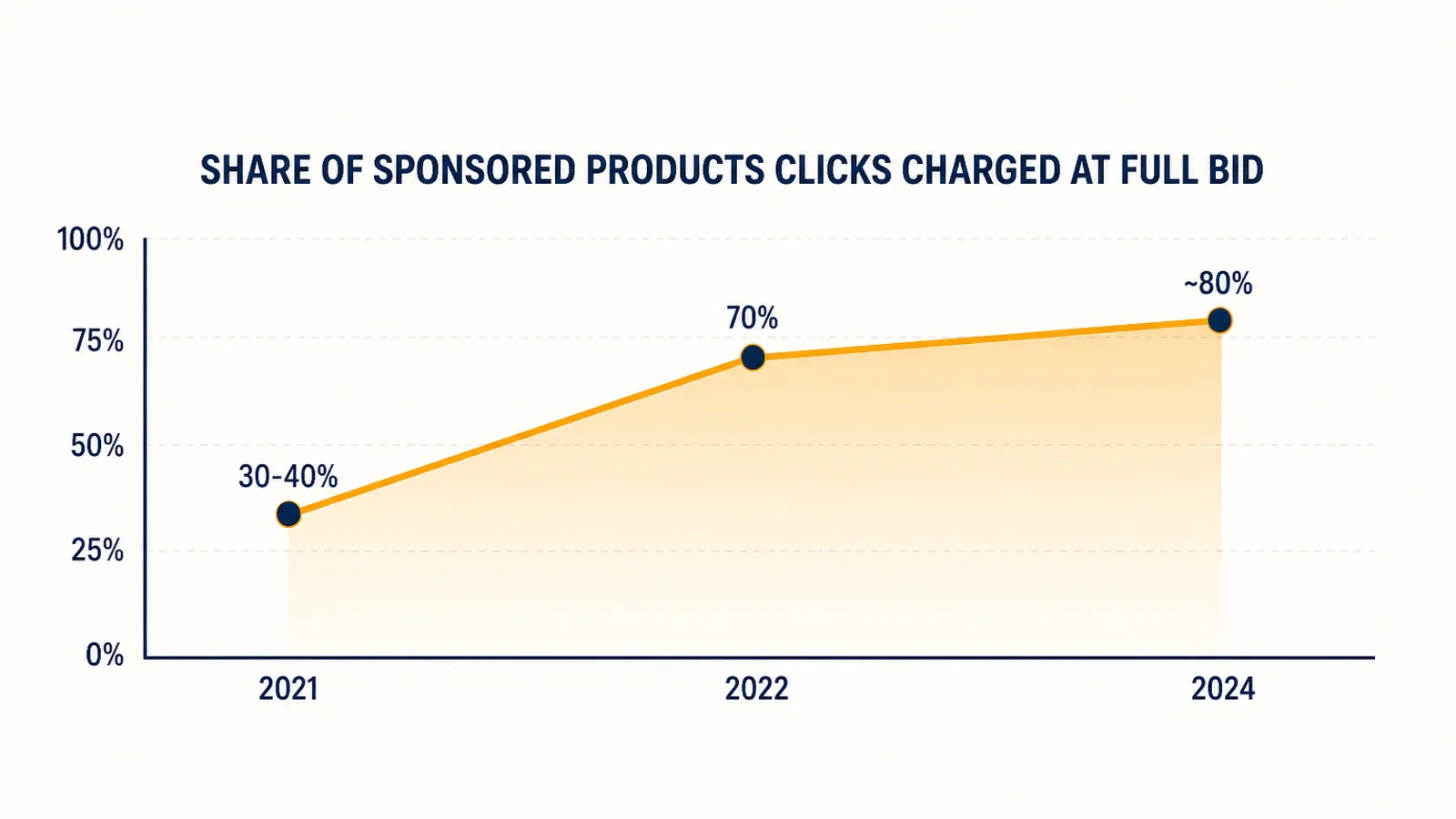
TL;DR: On August 31, 2026 the FTC and 22 states sued Amazon, alleging an undisclosed surcharge on its ad auctions from 2019. The complaint says Sponsored Products advertisers paid their full bid about 80% of the time by 2024, up from 30 to 40% in 2021. The takeaway holds either way: your bid is not a ceiling you rarely reach. Measure your CPC-to-bid ratio per target and bid from unit economics.

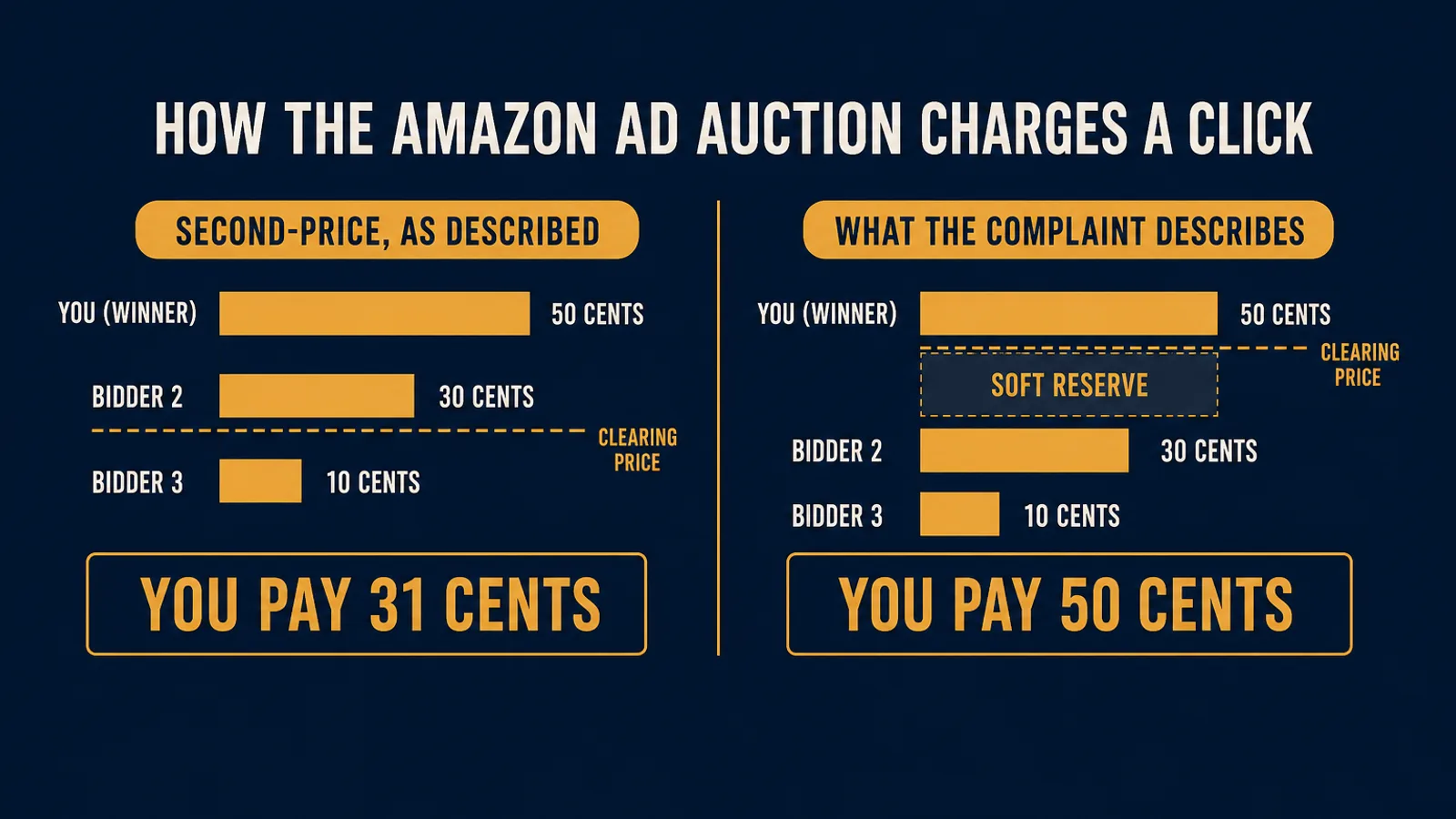
Ask most Amazon sellers how the ad auction charges them and you will get the textbook answer: it is a second-price auction, so you pay one cent more than the next-highest bid. Your bid is a ceiling you rarely touch. Bid a little high, the reasoning goes, because the auction protects you.
That answer is now the subject of a federal lawsuit. On August 31, 2026 the FTC and 22 state attorneys general sued Amazon in the Western District of Washington, alleging the company quietly changed how the Amazon ad auction priced clicks and did not tell the advertisers paying for them. The number in the complaint that should stop any PPC operator mid-scroll: for Sponsored Products, the share of the time advertisers paid the full amount of their own bid went from between 30% and 40% in 2021, to 70% in 2022, and to roughly 80% in 2024.
Amazon disputes the case and it will take years to resolve. You do not need to wait for it. The operator question is separate from the legal one, and you can answer yours this week with a report you already have access to.
What the complaint actually says
The mechanics matter, so it is worth being precise rather than reaching for the headline.
Amazon has told advertisers for years that it runs a generalized second-price auction: the winner pays one cent more than the next-highest bidder. The FTC alleges that beginning in 2019, Amazon added an undisclosed charge on top of that clearing price, referred to internally as a soft reserve price. A reserve price is normally a floor: bid under it and you do not clear. A soft reserve does something different. It lifts the price the winner pays toward that winner's own bid, without rejecting the bid.
The complaint goes further, alleging Amazon used what it calls an invented auction participant and a proxy second price to calculate the charge, so the number setting your cost was not necessarily another real advertiser competing for the same click. The FTC says over one million brands and sellers were affected, including more than 500,000 small and medium-sized businesses, and characterizes the amounts involved as tens of billions of dollars. Sponsored Products, Sponsored Brands, and display placements are all named.
One detail deserves its own line, because it lands squarely on the calendar you are currently planning around: the complaint alleges the increases were applied more aggressively during high-volume events like Prime Day and Black Friday.
Amazon's answer, and why it does not settle the operator question
Amazon's response is not a denial that soft reserve prices exist. The company's position is that reserve pricing is standard practice across the ad industry, that the internal documents the FTC quotes were brainstorming rather than policy, and that advertisers adjust bids based on real-world performance, not descriptions of auction mechanics. Amazon also points out that Sponsored Products cost-per-click was roughly flat in inflation-adjusted terms between 2019 and 2024 while conversion rates rose 24%, and says its auction systems saved advertisers money over that period rather than costing them.
That is a reasonable argument about outcomes, and it may well carry the day in court. The legal fight is about disclosure: whether describing the auction one way while pricing it another is deceptive.
Your question is narrower and more useful. If the price you pay is frequently your own bid rather than a competitor's, then the bid field in your campaign is doing something different from what you were taught, and your bidding strategy should reflect the auction you are actually in.
Your bid is a price now, not an anchor
This is the whole practical point, and it is worth sitting with.
In a clean second-price auction, bidding your true value is the safe move. Overshoot and the auction refunds the difference by charging you the runner-up's price. That property is why "bid aggressively, the auction will protect you" became standard Amazon PPC advice, and it is why so many accounts carry bids nobody has revisited in a year. Under those rules, a stale high bid costs you nothing most of the time.
Change the payment rule so the winner usually pays their own bid and that logic inverts. Now the auction behaves much closer to a first-price auction, where your bid is simply your price. A bid you set 30% above what a click is worth to you is not a harmless ceiling. It is an instruction to pay 30% too much, roughly four times out of five.
Two habits get expensive under the second rule set, and both are common:
Bidding off suggested ranges. Amazon's suggested bid is derived from what other advertisers are paying, not from your margin. Treating the top of that range as a starting point was defensible when the auction discounted you back down. It is a direct cost when it does not.
Bidding for rank rather than for value. Pushing bids until you hold top-of-search on a hero keyword is a legitimate strategy, but it was priced as an option and is now priced as a purchase. If the position is worth it on contribution margin, keep it. If you were holding it because it felt cheap, re-check the arithmetic.
Audit your bid-to-CPC gap this week
You do not have to take anyone's aggregate numbers, Amazon's or the FTC's. Your own account will tell you what it is charging you.
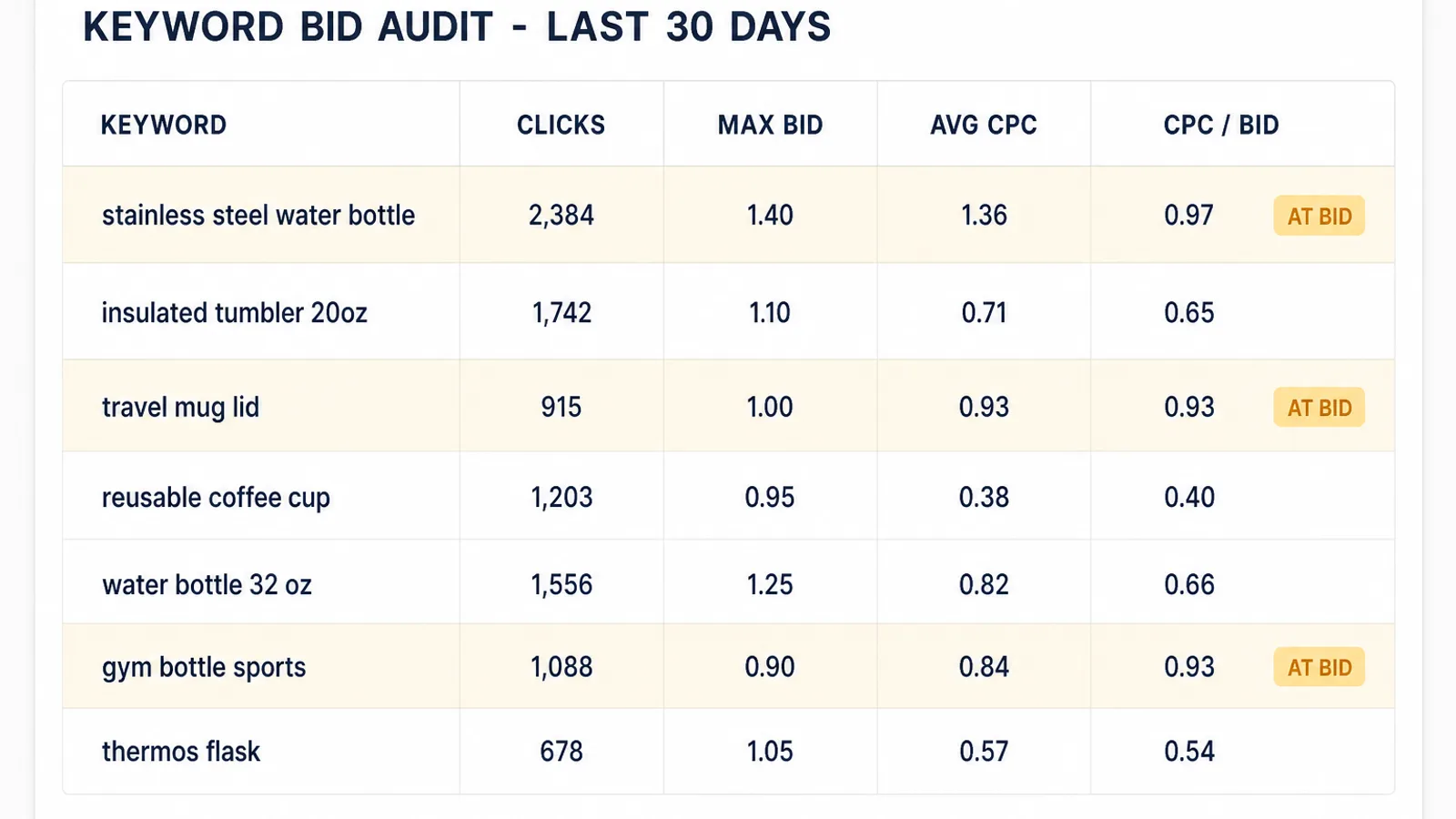
Pull a Sponsored Products targeting report for the last 30 days and put three columns next to each other per target: the bid you set, the average CPC you were charged, and the ratio of the two. Do this at the keyword and target level. Campaign averages hide everything interesting, because a campaign blends targets that clear well under their bid with targets that clear at it.
Then read the buckets:
- Ratio near 1.0. You are paying essentially your bid. Your bid is your price on this target, so it needs to be a number you would consciously pay, not one you set as headroom.
- Ratio around 0.6 to 0.8. Normal-looking, but check the volume. A handful of cheap clicks can drag the average down while your high-intent clicks still clear at the top.
- Ratio well under 0.5. The target genuinely is not competitive at your bid. That is real headroom, and usually a sign the bid is not the binding constraint on that keyword's performance.
Two corrections before you trust the ratio. First, dynamic bidding changes the number being compared. Under dynamic bids up and down, Amazon raises your bid for clicks it judges more likely to convert and lowers it for clicks it judges less likely, so the effective bid entering the auction is not the base bid you typed. Second, placement multipliers stack on top of that. A base bid of $1.00, raised by dynamic bidding, then multiplied by a top-of-search adjustment, can enter the auction well north of $2.00. Compare CPC against the effective bid for the placement, not against the base bid, or you will conclude you are getting a discount that does not exist.
What to change, and what to leave alone
The wrong response to this story is an account-wide bid cut. If a target was profitable at the price you were actually paying, that has not changed, and trimming its bid just hands impression share to someone else. Four adjustments are worth making instead.
Derive bids from unit economics, per target. Your maximum sensible bid is contribution margin per unit multiplied by conversion rate for that target. That was always the right method. It matters more now, because the auction has stopped correcting your errors for you.
Move bids in smaller steps. A 40% jump used to be a cheap probe. Prefer 10 to 15% increments with enough clicks between them to read the result. This is also the case for revisiting bids more often than most accounts do, since the correction is now paid for in real spend rather than absorbed by the auction.
Treat the multiplier stack as a real cost. Audit placement adjustments alongside bidding strategy rather than separately. Aggressive top-of-search multipliers combined with up-and-down dynamic bidding are the fastest way to an effective bid nobody in the account intended to set.
Tighten the waste side. When every click costs closer to full freight, irrelevant clicks hurt more in absolute terms. Search-term harvesting and negative keyword hygiene do more for the P&L under this payment rule than under the one you thought you were in.
Why the Q4 timing is unhelpful
The complaint's allegation that surcharges ran higher during Prime Day and Black Friday collides with a second problem: Q4 compresses your margin from the other direction too. Amazon's holiday peak fulfillment fees start on October 15, which lowers break-even ACoS by roughly two points on a typical FBA unit at exactly the moment CPCs climb.
Squeeze both ends and the SKUs you deliberately run near break-even for rank and velocity are the ones that flip negative first, quietly, at the target level where nobody is looking. Run the bid-to-CPC audit before your Black Friday bids go in, not after, and pay particular attention to the targets you plan to push hardest.

The part software is actually better at
None of the above is intellectually difficult. It is just a large amount of small, repetitive arithmetic that has to be redone as conversion rates and prices move, across every target in the account, forever. That is the part manual management loses on.
It is also what Autron's bid optimization loop is built around. Autron reads realized CPC per target rather than assuming the bid is a ceiling, sets bids against your goal and your product costs instead of against a suggested-bid range, and re-runs the loop daily rather than whenever someone opens the console. Because the sync layer pulls sales and traffic, search query performance, and FBA fee data alongside the Ads API, the conversion rate and margin inputs behind each bid are current rather than remembered from a spreadsheet built in July.
If you want the audit run before your Q4 bids lock in, the free PPC audit looks at exactly this: what you bid, what you were charged, and where the gap between them is costing you. If you would rather ask your own data directly, Autron Agent starts free and runs from $50/mo, and will pull the per-target CPC-to-bid ratio for you in a sentence.
FAQ
Is Amazon's ad auction a second-price auction? Amazon has long described it as one, where the winner pays a penny more than the next-highest bid. The FTC's August 31, 2026 complaint alleges that from 2019 Amazon added an undisclosed surcharge on top, so the price paid was frequently the advertiser's own full bid. The complaint cites Sponsored Products figures rising from 30 to 40% of the time in 2021 to about 80% in 2024. Amazon disputes the characterization and the case is unresolved.
What is a soft reserve price? A reserve price is a floor below which an auction will not clear. A soft reserve raises the clearing price toward the winner's own bid rather than rejecting it outright. The FTC alleges Amazon used one internally under that name, plus what its complaint calls an invented auction participant, to lift what advertisers were charged without disclosing it.
How do I check what I actually pay versus what I bid? Pull a Sponsored Products targeting report for the last 30 days, put average CPC next to the target's bid, and compute CPC divided by bid. Do this at the target level, not the campaign level, and account for placement multipliers and dynamic bidding, both of which raise the effective bid above the base bid you set.
Should I lower my Amazon PPC bids because of the FTC lawsuit? Not as a blanket move. The right response is to bid what a click is genuinely worth on your unit economics, because if you are charged close to your bid, an inflated bid is no longer a cheap option. Cutting bids across the board just loses impression share on the targets that were already profitable.
Does this change how dynamic bidding and placement multipliers work? The mechanics are unchanged, but the stakes are higher. A base bid raised by up-and-down dynamic bidding and then multiplied again by a top-of-search adjustment produces an effective bid well above the number you typed, and if you are charged near that effective bid, the stack costs real money rather than theoretical money.