
Amazon Sponsored Products ROAS Auto-Bidding: What Every Seller Needs to Know in 2026
Amazon's new ROAS auto-bidding beta for Sponsored Products is live. Learn how it works, where it falls short, and how to maximise your returns in 2026.

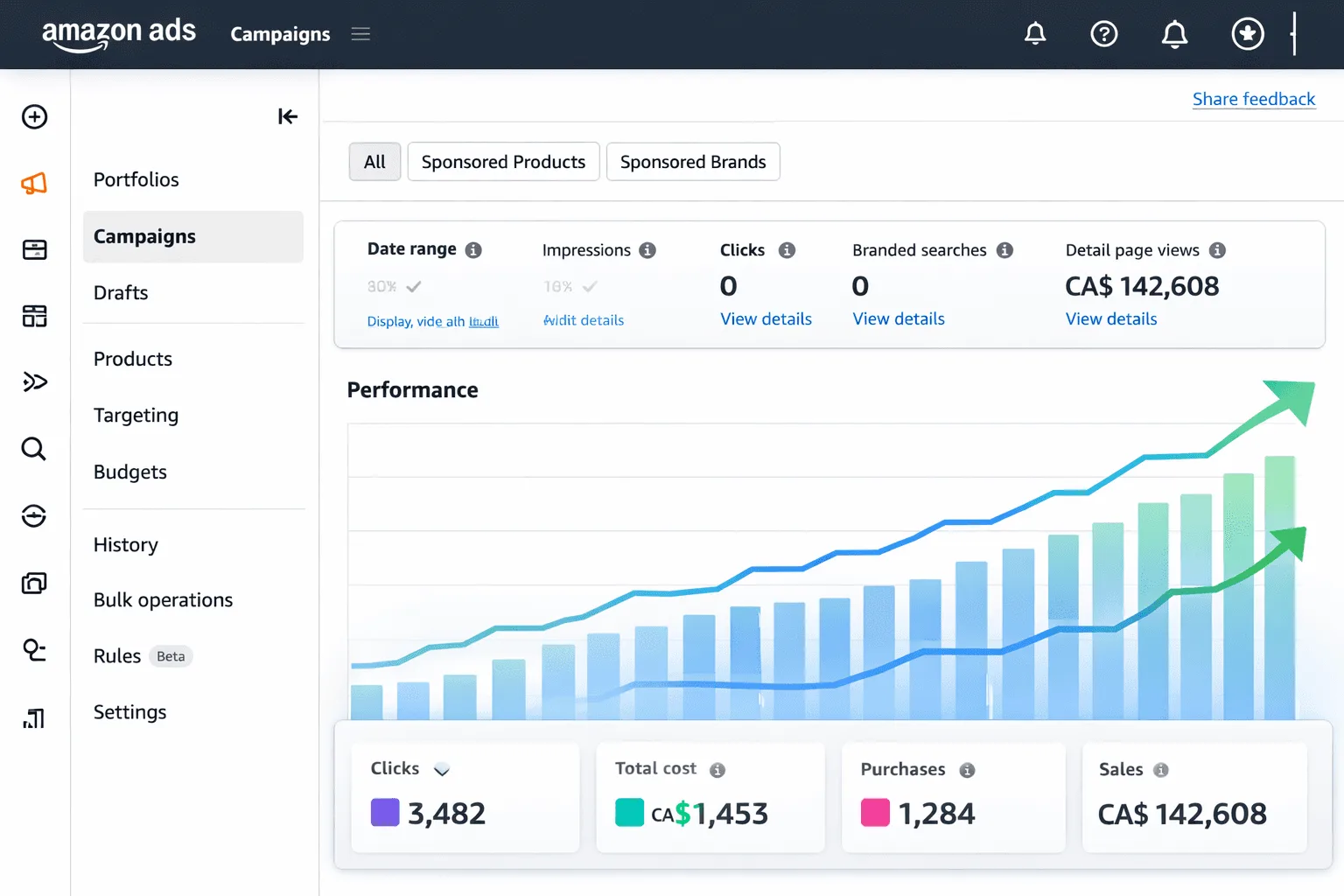
Amazon's advertising platform does not stand still. In early February 2026, Amazon quietly rolled out a beta bidding option for Sponsored Products called "Automatically Optimising ROAS within Campaign Budget," and it is already generating serious discussion among sellers and PPC managers across the industry.
The premise is straightforward: set a daily budget, and Amazon's algorithm adjusts your bids throughout the day to maximise return on ad spend without you having to intervene. No target ROAS required. No manual bid adjustments. Just let the machine do the work.
But is it really that simple? More importantly, should you trust Amazon's native automation to manage one of the most performance-critical levers in your business?
This guide breaks down exactly how the new feature works, where it performs well, where it introduces risk, and how the smartest sellers are combining Amazon's native automation with external AI-powered tools to maintain a decisive edge.
What Is Amazon's ROAS Auto-Bidding Feature for Sponsored Products?

Amazon's new ROAS auto-bidding option sits within the rule-based bidding section of Sponsored Products campaign management. When enabled, it removes the requirement for advertisers to specify a target ROAS. Instead, Amazon's algorithm dynamically adjusts bids across keywords and placements throughout the day with the single goal of maximising ROAS while staying within the campaign's set daily budget.
This is a meaningful departure from the previous approach, where automation still required a human-defined efficiency anchor.
How "Automatically Optimising ROAS Within Campaign Budget" Works
Unlike Amazon's existing Target ACOS bidding, which requires a specific ACOS goal and optimises toward it, this new feature is outcome-based without a target anchor. Amazon's system evaluates real-time signals, including shopper behaviour, time of day, device type, placement, and historical conversion data, then raises or lowers bids accordingly to extract maximum ROAS from every pound or dollar of your budget.
In practice, Amazon may aggressively bid on a high-converting keyword at 9am and pull back sharply by mid-afternoon if conversion signals weaken, all without any input from you. The algorithm responds to live data at a frequency that no manual process can match.
How It Differs From Target ACOS Bidding
With Target ACOS, you define an acceptable cost-of-sale percentage and Amazon optimises bids to hit that number. You have a performance guardrail in place, which gives you a degree of predictability and control over efficiency.
With ROAS auto-bidding, there is no floor or ceiling on efficiency. Amazon optimises for maximum return within your budget envelope. That sounds attractive, but it can produce volatile outcomes, particularly for newer campaigns with limited conversion data or products with demand patterns that shift significantly by day, week, or season. Understanding this distinction is critical before enabling the feature across your catalog.
The Real Benefits for Amazon Sellers, and the Limitations

Where the Feature Shines
For sellers managing large, mature catalogs with established conversion history, ROAS auto-bidding can deliver genuine efficiency gains. Amazon's algorithm has access to first-party purchase signals that third-party tools simply cannot replicate: real browsing behaviour, purchase intent data across billions of shopping sessions, and real-time demand shifts at scale.
In campaigns with 90 or more days of clean conversion data, enabling ROAS auto-bidding can meaningfully reduce the manual overhead of daily bid reviews and help surface time-of-day or placement-level efficiencies that most sellers miss in their reporting. Early testers have reported ROAS improvements of 15 to 25% on established, well-reviewed products where the algorithm had sufficient historical data to work from.
The feature also pairs well with budget-constrained campaigns. If you are running a fixed daily budget and want Amazon to allocate that spend toward the highest-return opportunities in real time, this bidding mode is designed for exactly that use case. Rather than distributing budget evenly, the algorithm concentrates spend where conversion probability is highest at any given moment.

Where It Falls Short
Here is where sellers need to exercise real caution. ROAS auto-bidding has several meaningful limitations that make it a poor fit for many common scenarios.
It requires data. New product launches, seasonal items with limited history, and listings with fewer than 30 reviews do not give Amazon's algorithm enough conversion signal to bid intelligently. Enabling ROAS auto-bidding on a new ASIN is likely to produce erratic performance and accelerated wasted spend before the system finds a useful pattern.
There is no transparency. Unlike Target ACOS or manual bidding, ROAS auto-bidding gives you minimal insight into why Amazon is making specific bid decisions at specific moments. You are effectively handing the wheel to an algorithm and watching the outcome, which makes it difficult to diagnose underperformance or apply category-specific knowledge you have earned over time.
It does not account for your business context. Amazon's algorithm optimises for ROAS based on what it can observe, but it has no visibility into your actual cost structure, inventory levels, profit margin targets, or your broader competitive strategy. A 400% ROAS that is still unprofitable after fees and cost of goods is not a win, but Amazon's bidding system cannot make that distinction.
It can create cannibalisation. For sellers running multiple campaigns targeting the same keywords or ASINs, enabling ROAS auto-bidding across all of them can result in your own campaigns competing against each other. Without an intelligent layer managing portfolio-level allocation, you end up bidding against yourself and inflating your own CPCs.
How to Structure Campaigns to Get the Most From ROAS Auto-Bidding

Setting Up for Success: Data, Budget, and Campaign Isolation
If you decide to test ROAS auto-bidding, the single most important prerequisite is conversion history. Aim for campaigns with at least 90 days of data, a minimum of 50 attributed orders per month, and a well-maintained negative keyword list to remove irrelevant traffic before enabling the feature.
Keep campaigns running ROAS auto-bidding isolated from your manually managed campaigns where those campaigns share ASINs or keywords. Mixing bidding strategies across overlapping campaigns makes performance attribution unreliable and creates bid conflicts that undermine both approaches.
Budget setting matters more than most sellers anticipate. Because the algorithm is optimising to maximise ROAS within a budget ceiling, setting that ceiling too conservatively constrains the system's ability to learn quickly and allocate efficiently across high-opportunity windows. Budgets should reflect realistic daily spend potential based on actual category traffic volumes, not arbitrary conservative limits.
Which Products Should You Enable It On?
The strongest candidates for ROAS auto-bidding are hero SKUs with 12 or more months of advertising history and strong review velocity, products in stable categories where demand signals remain consistent across the week, mid-to-lower funnel campaigns where purchase intent is already high, and any campaign where you have exhausted the gains available through manual optimisation.
Avoid enabling it on new launches, clearance or end-of-life ASINs, products with fluctuating inventory levels, or any campaign where strategic control and predictability matter more than peak algorithmic efficiency.

Why AI-Powered Automation Still Has the Edge
Amazon's native ROAS auto-bidding is a meaningful step forward, but it operates within a closed system. It optimises what Amazon can see, which is limited to bidding signals and placement performance within its own platform. It cannot factor in your real profit margins, cross-portfolio strategy, organic ranking impact, or the broader health of your advertising account across multiple campaigns and product lines.
The Gap Between Amazon's Native Tools and Full-Funnel Optimisation
Third-party AI-powered platforms address the gaps Amazon's native automation cannot reach. While Amazon's system optimises bids in real time, a platform like Autron layers additional intelligence on top: margin-aware bid modelling, portfolio-level budget allocation across campaigns, TACoS tracking to balance paid and organic performance, and anomaly detection that flags when apparent ROAS improvements are masking a deeper structural problem.
TACoS, Total Advertising Cost of Sales, is a metric Amazon's native auto-bidding completely ignores. Yet TACoS is arguably the more important number for established brands. A campaign running at a 15% ACOS that simultaneously drives organic rank improvements generating 5x the equivalent organic revenue is far more valuable than one running at an identical ACOS with no organic halo effect. Managing that balance requires intelligence that extends beyond what Amazon's algorithm can observe.
The data supports this. Research tracking AI-managed Amazon campaigns in 2026 shows that advertisers using third-party automation alongside Amazon's native tools achieve, on average, 25% higher ROAS and 30% reductions in wasted ad spend compared to sellers relying on Amazon-native bidding alone. The combination of Amazon's real-time first-party signals and external AI intelligence gives sellers access to the best of both approaches.
In a market where CPCs are rising, organic competition is intensifying, and Amazon's own advertising platform is growing more complex with each quarterly update, sellers who rely solely on Amazon's native automation are likely leaving significant performance on the table and handing that advantage to competitors who are not.

Use ROAS Auto-Bidding as One Tool, Not the Whole Strategy
Amazon's new ROAS auto-bidding feature for Sponsored Products is a genuinely useful addition to the advertiser's toolkit, particularly for mature campaigns with strong conversion history and stable demand patterns. But it is not a complete strategy, and it was not designed to be one.
The algorithm has real blind spots: margin context, inventory dynamics, portfolio-level conflicts, and TACoS impact are all outside its field of view. No native Amazon feature can substitute for intelligent, margin-aware, portfolio-level campaign management built around your business goals rather than Amazon's platform metrics.
The sellers winning on Amazon in 2026 are those combining Amazon's first-party signals with smarter external automation, monitoring ACoS and TACoS in parallel, and making bid and budget decisions that reflect the full commercial picture, not just what the platform reports.
Ready to go beyond Amazon's native automation and put AI to work across your entire advertising account? Try Autron free at autron.ai. Our AI continuously optimises bids, budgets, and targeting to drive profitable growth, while giving you complete visibility into exactly what is working and why.