
Does Amazon PPC Cannibalize Your Organic Sales? The 2026 TACoS Guide
Worried Amazon PPC is eating your organic sales? Learn how TACoS exposes the real cost of your ad spend and how to balance paid and organic growth in 2026.
TL;DR: TACoS (Total Advertising Cost of Sale) is your ad spend divided by total sales, paid plus organic. It is the metric that shows whether Amazon PPC is growing your business or just cannibalizing organic sales that a healthy-looking ACoS hides. Most mature products target 8 to 15%, and the trend matters more than the snapshot.

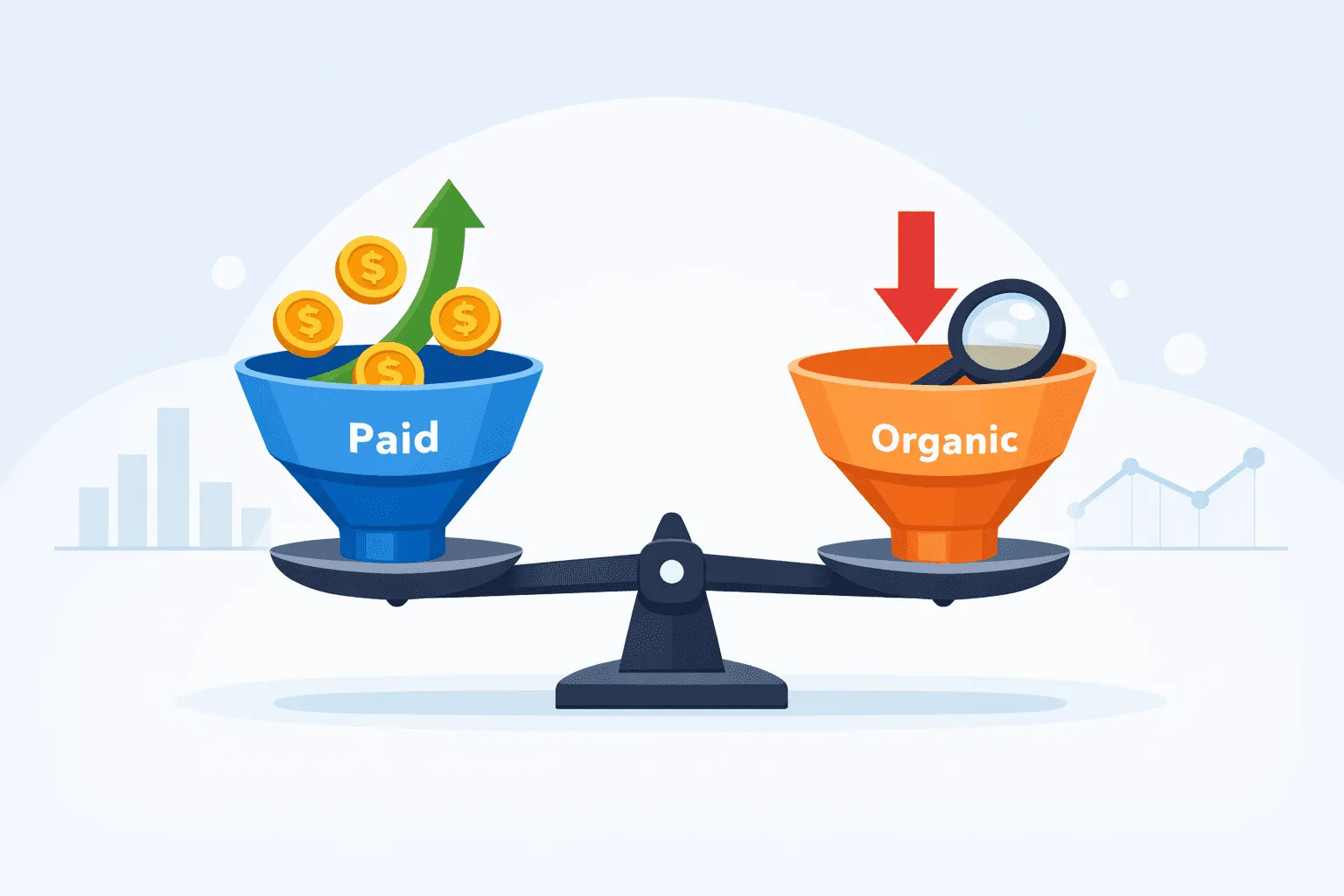
You've done everything right. You scaled your Sponsored Products campaigns, watched your ad sales triple, and hit record ROAS. Then you check your organic rankings — and they've collapsed.
This scenario is playing out in seller accounts across every category in 2026. As competition on Amazon intensifies and cost-per-click averages climb to $1.12 (up $0.15 year-over-year), more sellers are asking an uncomfortable question: is my PPC spend actually undermining my organic performance?
The answer is more nuanced than a simple yes or no — and understanding it requires shifting your focus from ACoS to a metric that tells the whole story: TACoS, or Total Advertising Cost of Sale. This guide breaks down exactly how Amazon PPC cannibalization happens, how to detect it in your own account, and how to use TACoS as your north-star metric to build an ad strategy that grows total sales rather than just shifting them.
What Is Amazon PPC Cannibalization — and Is It Actually Real?
Amazon PPC cannibalization of organic sales refers to a specific dynamic where your paid ads appear for keywords you already rank for organically, capturing clicks (and paying for them) that your listing would have won for free. The result: your ad spend climbs, your attributed ad revenue looks strong, but your total sales remain flat or even decline.
The Mechanics of Cannibalization
When a shopper searches for a keyword where you hold a strong organic position — say, page one, position three — and your Sponsored Product ad also appears above organic results, there are two possible outcomes.
The first is additive: the shopper wouldn't have scrolled down to your organic listing, and the ad captures an incremental sale. The second is cannibalistic: the shopper would have found and bought your product organically, but instead clicked your ad, converting a free sale into a paid one. You've spent money on a sale that was already yours.
The challenge is that Amazon doesn't tell you which scenario occurred. Your campaign dashboard shows attributed ad sales, but it doesn't show the organic sales you may have displaced.
When Cannibalization Becomes a Real Problem
Keyword-level cannibalization — two of your own campaigns competing for the same keyword — is a structural issue worth fixing, but it's relatively mechanical. The deeper, more costly version is when aggressive bidding on your strongest organic keywords consistently pulls sales from organic to paid, inflating your reported ACoS without growing your actual revenue.
This matters most for brands that have built genuine organic authority. If your product ranks in the top three results for its primary keyword, pouring budget into that same keyword isn't growing the pie — it's redistributing it at a cost.

ACoS vs. TACoS: The Metric That Reveals the Full Picture
This is where most sellers make the critical mistake. They optimize relentlessly toward a target ACoS — typically around 20-30% — and consider the job done. But ACoS only measures your advertising efficiency in isolation. It tells you how much you spent to generate attributed ad revenue. It says nothing about what's happening to your overall sales.
TACoS — Total Advertising Cost of Sale — closes this gap entirely.
TACoS = Total Ad Spend ÷ Total Revenue (paid + organic) × 100
You can calculate your own TACoS in seconds with our free Amazon profit & TACoS calculator.
Where ACoS might show a healthy 22%, your TACoS could be 35% if organic sales have been declining while ad spend holds steady. That divergence is the warning signal most sellers miss.
How TACoS Exposes Hidden Inefficiency
Consider two sellers with identical ACoS:
-
Seller A runs $10,000 in ad spend, generates $45,000 in ad sales (ACoS: 22%) and $80,000 in total revenue. TACoS: 12.5%.
-
Seller B runs $10,000 in ad spend, generates $45,000 in ad sales (ACoS: 22%) and $45,000 in total revenue. TACoS: 22%.
Both look equally efficient on the campaign dashboard. But Seller A's ads are supplementing strong organic performance, while Seller B's ads appear to be replacing it — every sale is paid, with no organic lift at all.
A rising ACoS alone is a budget problem. A rising TACoS alongside flat or falling total revenue is a cannibalization signal.
What a Healthy TACoS Looks Like in 2026
TACoS benchmarks vary significantly by category and business stage. Broadly:
-
Launch phase: 25-40% is acceptable, as paid spend is building velocity, review count, and organic rank.
-
Growth phase: 15-25% signals that ads are driving incremental revenue beyond your organic baseline.
-
Mature/established products: 8-15% indicates strong organic performance with ads acting as a supplemental growth layer.
If your TACoS is climbing while total revenue stagnates, you're likely funding cannibalization. If TACoS is declining while total revenue grows, your ad investment is generating genuine organic lift — a clear signal to scale.

How to Diagnose and Fix PPC Cannibalization in Your Account
Knowing the theory is one thing. Finding and fixing cannibalization in a live account requires a systematic approach.
Step 1: Identify High Organic Rank, High Ad Spend Overlap
Start by pulling your Search Query Performance report from Amazon Seller Central. Cross-reference your top organic ranking keywords (those driving organic sales) with your highest-spend Sponsored Products keywords. Any keyword where you hold an organic rank in positions 1-5 and are also spending heavily on paid ads is a candidate for review.
The diagnostic question: if you paused the ad on this keyword, would total sales for this ASIN decline, or simply shift back to organic attribution?
Step 2: Apply Targeted Bid Reductions on Strong Organic Performers
For keywords where your organic rank is genuinely strong and stable, reduce bids rather than pausing entirely. A soft bid reduction of 20-30% will allow your ad to still appear — capturing incremental placements like top-of-search — without outbidding your own organic position. Monitor total sales (not just ad sales) over the following two weeks before making further adjustments.
Step 3: Build a Harvest-and-Hold Keyword Framework
The most durable fix is a structured keyword strategy that separates growth keywords (where you need paid traffic to build rank) from established keywords (where you're defending organic position). Reserve aggressive bids for keywords where you're still climbing the organic ladder. For keywords where you've already arrived, shift to a defensive minimum bid and let organic do the work.
This approach — sometimes called a "harvest and hold" model — treats PPC as an investment in organic ranking rather than a permanent revenue channel. The goal is to graduate keywords from paid-dependent to organically self-sustaining.

Why AI Is the Only Scalable Way to Manage TACoS in 2026
The logic above is straightforward in principle. In practice, most Amazon sellers are managing hundreds or thousands of ASINs, each with dozens of active keywords across multiple campaign types. Manually auditing organic rank versus ad spend overlap on any meaningful cadence is simply not feasible.
The Limits of Manual Monitoring
Amazon's organic rankings shift daily — sometimes hourly in competitive categories. A keyword that warranted aggressive bidding last Monday may have climbed to position two by the weekend, at which point continued aggressive spend is eroding margin without building anything. Manual bid management, even with weekly reviews, will always lag behind these changes.
The sellers who manage TACoS most effectively in 2026 are those with systems that can monitor total revenue alongside campaign metrics in real time and adjust bids automatically when the organic-to-paid ratio changes.
How Autron's AI Keeps TACoS in Check
Autron's AI-powered platform is built specifically for this challenge. Rather than optimizing campaigns toward a fixed ACoS target in isolation, Autron's goal-based system can optimize toward a TACoS target — continuously balancing paid investment against organic performance at the ASIN level.
When Autron detects that a product's organic sales are strong and stable, it automatically reduces bids on cannibalizing keywords, protecting your organic margin. When organic rank drops or a product enters a launch phase, Autron increases aggression to rebuild velocity. This dynamic, always-on calibration is what separates AI-powered PPC management from traditional rule-based automation.
The result is a TACoS that trends down over time as ad spend becomes progressively more targeted, while total revenue trends up as organic authority compounds.

The Bottom Line: Stop Optimizing for ACoS in a TACoS World
Amazon PPC cannibalization of organic sales is real, and in 2026 it's more costly than ever as CPCs rise and competition for prime placements intensifies. The sellers who thrive this year are those who measure success not by ACoS, but by TACoS — total revenue in, total spend out.
The framework is clear: identify where your ads are displacing organic sales rather than supplementing them, reduce bid aggression on your strongest organic keywords, and build a keyword strategy that graduates products from paid-dependent to organically self-sustaining.
And if you're managing more than a handful of ASINs, manual monitoring will always leave money on the table. The compounding advantage goes to sellers whose bidding decisions are informed by organic performance signals in real time.
Autron's AI was designed to manage exactly this complexity — automatically. If you're ready to stop funding cannibalization and start building sustainable growth on Amazon, try Autron for free at https://autron.ai/.
FAQ
What is TACoS on Amazon? TACoS (Total Advertising Cost of Sale) is total ad spend divided by total sales, paid plus organic, shown as a percentage. Unlike ACoS, which only counts ad-attributed sales, TACoS shows how much of your whole business depends on advertising.
What is the difference between ACoS and TACoS? ACoS is ad spend divided by ad-attributed sales, so it measures the ads in isolation. TACoS is ad spend divided by total sales, ads plus organic. ACoS can look healthy at 20 to 25% while TACoS quietly climbs, which usually means you are paying for sales your organic listing would have won for free.
What is a good TACoS on Amazon in 2026? It depends on stage and category. A launch often runs 25 to 40% on purpose to build rank, a growing product 15 to 25%, and a mature product with strong organic authority 8 to 15%. The direction matters more than the number: a falling TACoS with flat or rising revenue is the healthiest signal.
How do I calculate TACoS? TACoS is total ad spend divided by total revenue (paid plus organic), times 100. For example, $10,000 of ad spend on $80,000 of total revenue is a 12.5% TACoS. You can work it out for your own account with our free Amazon profit & TACoS calculator.
Does Amazon PPC cannibalize organic sales? It can. When your ads show for keywords you already rank for organically, some clicks you would have won for free become paid. A rising TACoS alongside flat total revenue is the warning sign. The fix is reducing bids on your strongest organic keywords rather than pausing them outright.