
How to Choose Amazon PPC Software in 2026: A Buyer's Guide
A practical buyer's guide to choosing Amazon PPC software in 2026: how to weigh automation depth, profit context, data coverage, and execution speed before you buy.
TL;DR: The best Amazon PPC software in 2026 is judged on four things: whether its automation genuinely learns instead of firing static rules, whether it optimizes to profit rather than reported ROAS, how much of your data it can actually see (Ads API only, or Ads plus SP-API and Brand Analytics), and whether it executes changes or just recommends them. Match that to your ad-spend stage before you commit.

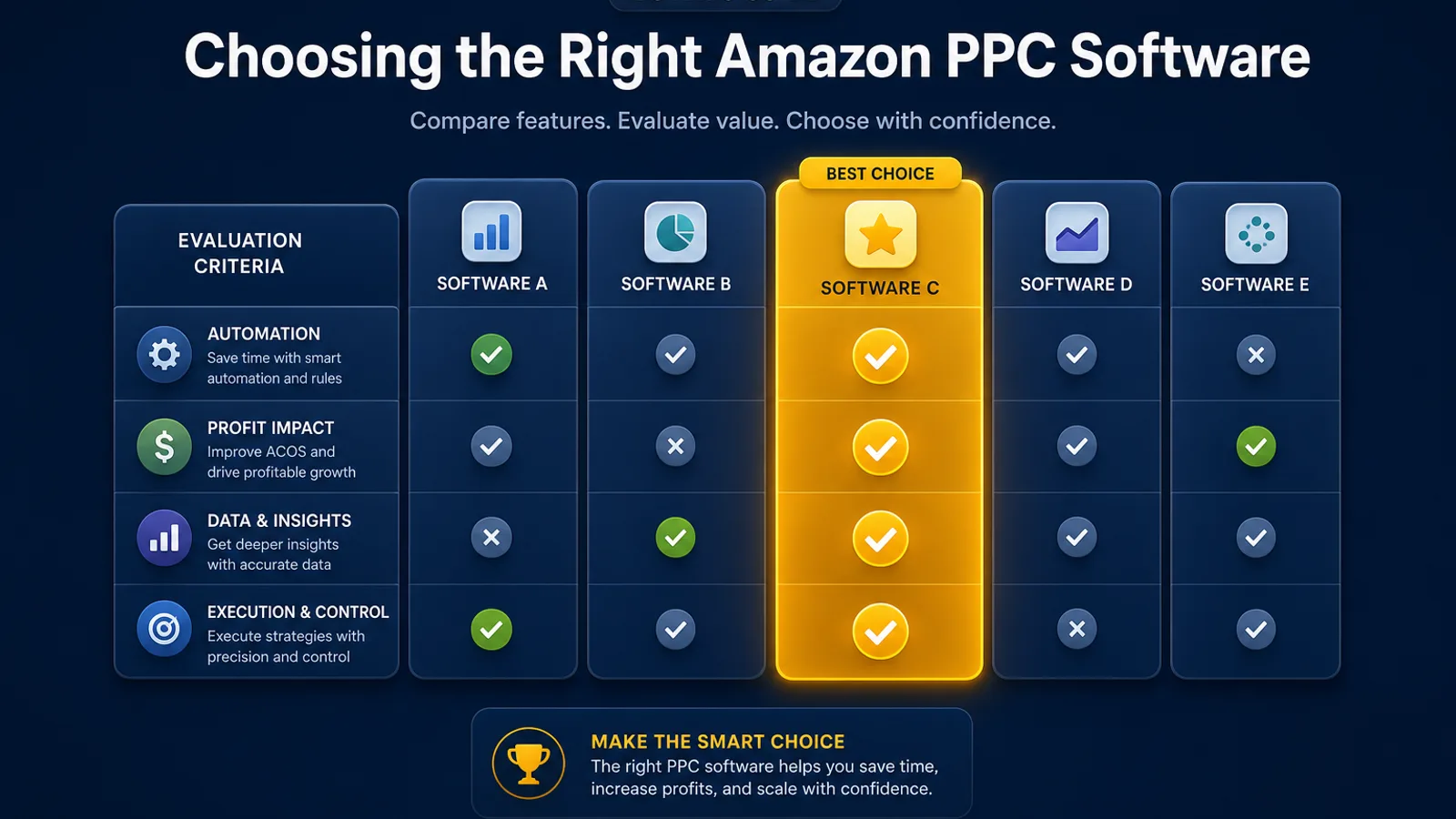
Choosing Amazon PPC software in 2026 is harder than it looks, because most tools describe themselves the same way. Every product page promises automation, AI, and better ACoS. The words are identical; what sits behind them is not. Two tools that both say "AI bid optimization" can mean a handful of static rules in one case and a model that reads a year of your search-term history in the other. This buyer's guide is about the questions that actually separate them, so you can pick Amazon PPC software that fits how you run your business instead of the one with the best landing page.
The stakes are higher this year for a specific reason: the Amazon Ads console itself is consolidating, and the tool you pick has to keep up with it.
The 2026 backdrop: the console is consolidating
Amazon is pulling its advertising surfaces together. Unified reporting moved into general availability in the Ads Console on June 8, 2026, pulling Sponsored Ads and Amazon DSP into a single report, and Amazon is sunsetting the separate Sponsored Ads and DSP reports by December 31, 2026. The Campaign Manager is heading the same direction, toward one command center instead of separate consoles per ad type.
That matters for a buyer for two reasons. First, any tool you pick needs to track these changes without breaking, because the underlying reports it reads are being retired on a published timeline. Second, consolidation raises the floor on what "managing PPC" means. When Sponsored Products, Sponsored Brands, and Sponsored Display share budget and compete for the same placements, managing them in three separate tabs, or three separate tools, is how spend leaks. The software you choose should treat the account as one system. For the fuller picture of the console merge, see our breakdown of what Amazon's unified Campaign Manager means for sellers.
With that backdrop set, here are the four questions that decide the purchase.
Automation depth: rules versus real learning
This is the first fork, and the biggest. Ask any tool one question: when it changes a bid, what is it reacting to?
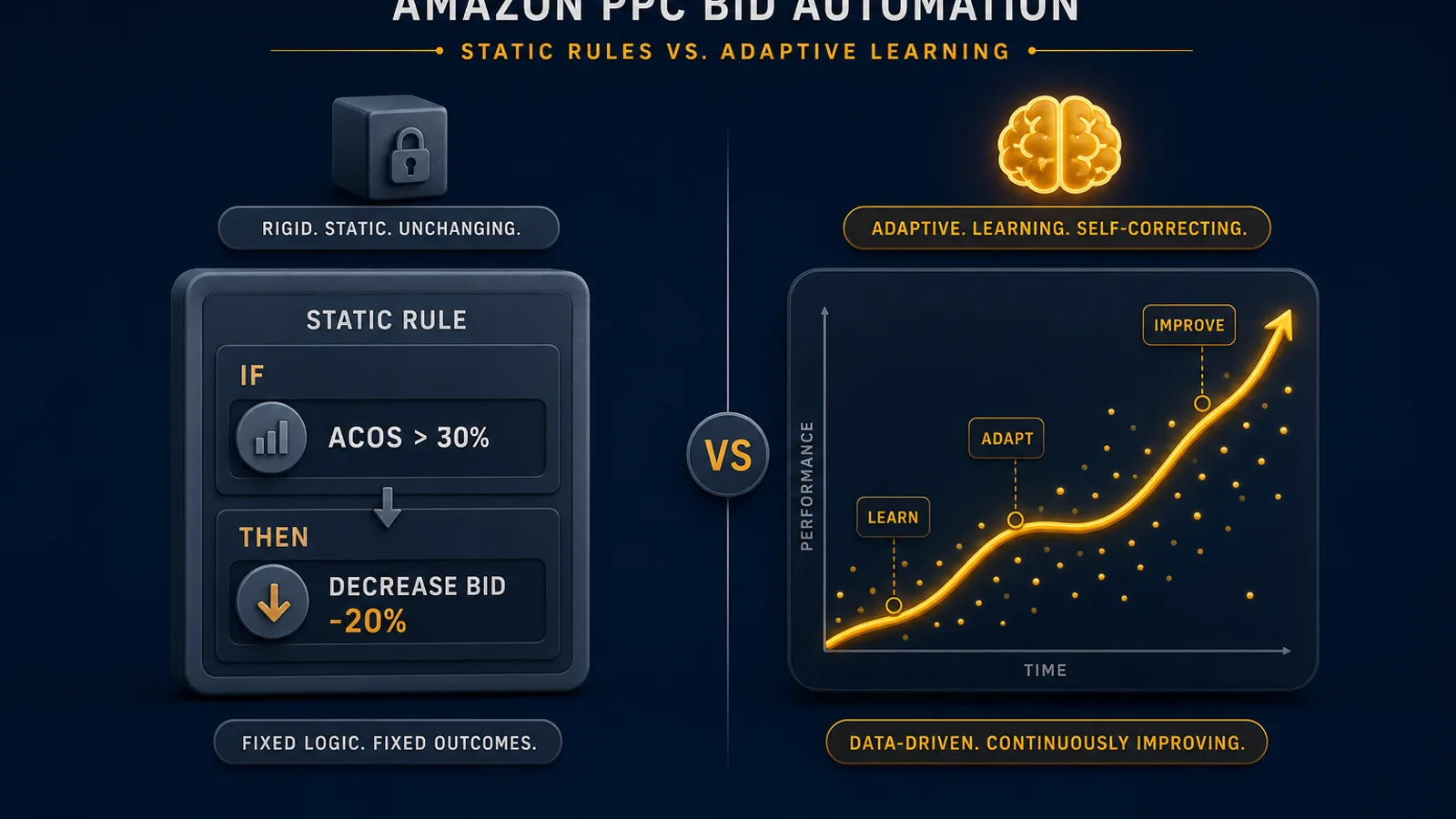
Rules-based software applies fixed conditions you configure. "If ACoS is above 30%, lower the bid by 10%." "If a search term spends more than $X with no sale, add it as a negative." These rules are transparent and easy to reason about, and for a small account they can be enough. The limit is that the rule only knows what you told it. It cannot tell a keyword that spent $20 with no sale because it is genuinely unprofitable from one that is three clicks into a longer path to conversion. It fires the same way every time, and it goes stale the moment your market moves.
Learning-based software sets bids against a goal, your target ACoS or TACoS, using your own performance history and current market signals, and it adjusts far more often than a person would sit down to review. The practical test when you demo a tool: ask how often it re-evaluates bids, what data it looks at when it does, and whether you have to hand-write the logic or just state the goal. If the answer is "you build the rules," you are buying a faster spreadsheet, not automation. If the answer is "you set the target and it works out the bids," you are buying something that keeps working when you are not watching.
Judge it on profit, not reported ROAS
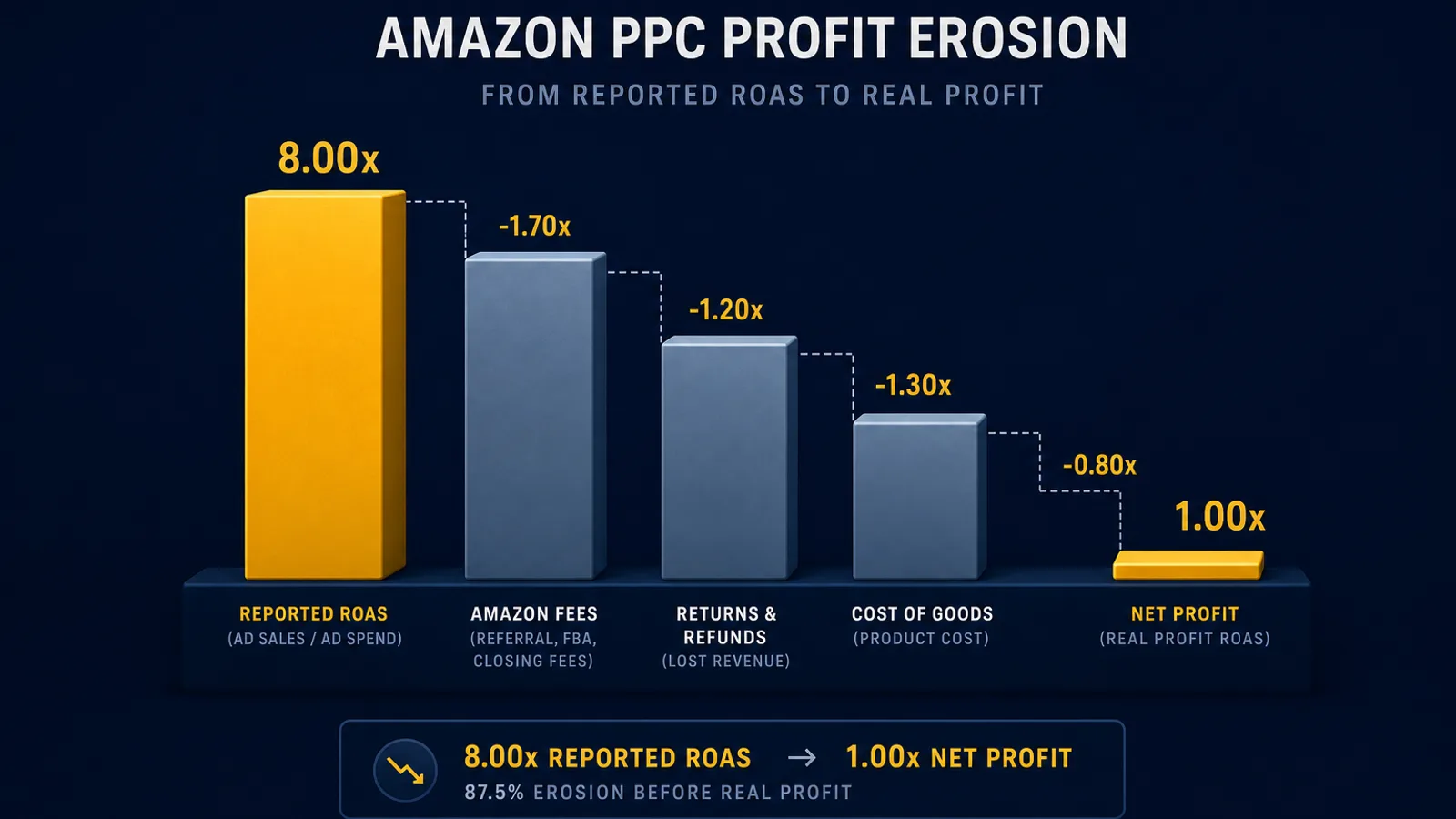
A tool can show you a 4x ROAS and still be losing you money. Reported ad ROAS is revenue over ad spend. It says nothing about Amazon referral and FBA fees, returns, or your cost of goods. A campaign that looks healthy on the dashboard can be underwater once those come out, and software that optimizes to a ROAS or ACoS number in isolation will happily scale a campaign that erodes margin.
The better question is whether the software knows your true cost. Does it let you enter product cost and margin, and does it optimize toward profit and total advertising cost of sales rather than just ad-level ACoS? This is also where ad spend and organic sales meet: heavy branded spend can inflate ROAS while cannibalizing sales you would have won for free. If you want to go deeper on that trade-off, our 2026 TACoS guide covers how to tell real incremental sales from ads paying twice for the same customer. When you evaluate a tool, put your real margins in front of it and see whether its recommendations still make sense. If it cannot take a cost input, it cannot optimize for profit, full stop.
Data coverage: what the software can actually see

A bid decision is only as good as the data behind it. Many PPC tools read the Amazon Advertising API and nothing else. That gives them campaigns, keywords, bids, and ad-level performance, which is enough to react, but not enough to understand. Ads-only data cannot see that a product just went out of stock, that its organic rank slipped, or that a search term's conversion rate is collapsing at the catalog level before it shows up in your ad reports.
Deeper tools read the Advertising API together with the Selling Partner API and Brand Analytics: sales and traffic, inventory, listing health, and Search Query Performance. Bids made with that context are far harder to spook. The software can pull back on an ASIN that is about to run out of stock instead of spending into a listing that cannot fulfill, and it can act on search-term trends weeks before an Ads-only tool notices. When you compare products, ask flatly which APIs each one reads. If a tool only sees the Advertising API, it is making decisions with one eye closed. This is also why Search Query Performance is worth understanding directly; our SQP dashboard guide walks through the report the better tools are reading for you.
Execution model: does it act, or just recommend?
Plenty of tools generate recommendations. Fewer actually execute them. This sounds like a small distinction and it is the one that quietly wastes the most money, because an unapplied recommendation is worth exactly zero. Approval queues fill up, the operator gets busy, and last week's suggested bid changes sit there while spend keeps flowing at the old bids.
Decide honestly which model you want. If you need to sign off on every change, a recommendation engine with an approval workflow is the right shape, and you should budget the time to actually work the queue. If you want the daily loop off your plate, you want software that executes: bids, placement adjustments, budget shifts, and negative-keyword harvesting applied on a schedule, with you setting the goal and the guardrails rather than approving each move. There is no universally correct answer, but there is a wrong one, which is buying an execution tool and then never trusting it, or buying an advisor and then wondering why nothing changed. Pick the model you will actually use.
Match the tool to your stage
The right Amazon PPC software depends on where you are, not on which product wins the most feature comparisons.
- Under about $5k per month in ad spend. You may not need much. A good tool with sane defaults and a low fixed cost beats an enterprise platform you will not use. Watch out for percentage-of-spend pricing that costs more than the spend it manages.
- Roughly $5k to $50k per month. This is the sweet spot for automation. The daily bid, budget, and negative-keyword loop is now too much to do by hand and too important to skip. Prioritize automation depth, profit awareness, and data coverage over dashboard breadth. Choosing between doing this in-house and automating it is its own decision; we cover it in in-house versus automation for scaling PPC.
- Above $50k per month, or many brands and marketplaces. You need multi-account and multi-marketplace support, and possibly DSP. Enterprise platforms earn their price here. The trade-off is cost and complexity, and pricing that often scales with spend.
If you want to see how specific tools stack up against a goal-based automation model, our comparison pages lay it out directly, for example Perpetua vs Autron and Helium 10 vs Autron.
A quick buyer's checklist
Before you commit, get a straight answer to each of these:
- When it changes a bid, is it firing a rule you wrote, or learning from your data toward a goal?
- Can it take your product cost and optimize to profit and TACoS, not just ad ROAS?
- Which APIs does it read? Advertising API only, or Advertising plus Selling Partner API and Brand Analytics?
- Does it execute changes automatically, or only recommend them?
- How is it priced, flat fee, percentage of spend, or percentage of ad sales, and does that align the tool with your growth or against it?
- Does it manage Sponsored Products, Brands, and Display together, given the console is merging them?
A tool that answers all six the way you need is worth more than one with twice the features and vague answers to half of them.
FAQ
What should I look for in Amazon PPC software in 2026? Judge it on four things: whether the automation genuinely learns from your data or just fires static if-then rules, whether it optimizes to profit instead of reported ROAS, how much of your account it can actually see (Ads API only, or Ads plus SP-API and Brand Analytics), and whether it executes changes or only recommends them. Then match that to your monthly ad spend.
What is the difference between rules-based and AI Amazon PPC software? Rules-based tools apply fixed conditions you write, such as lowering a bid 10% when ACoS is over 30%. They only know what you told them. AI-based tools set bids against a goal using your own performance history and market signals, and adjust more often than a person could review, so they keep working as demand shifts without you rewriting the rules.
Is Amazon PPC software better than hiring an agency? It depends on what you need. An agency brings strategy and a human to talk to, but most check campaigns once or twice a day and bill a percentage of spend. Software runs the daily bid, budget, and negative-keyword loop continuously. Many owner-operators use software for execution and keep strategy in-house, which is cheaper than a percentage-of-spend retainer above roughly $10k per month in spend.
How much does Amazon PPC software cost? Pricing models vary widely. Some tools charge a flat monthly fee, others take a percentage of ad spend, and a few charge on ad sales generated. Watch the model, not just the number: percentage-of-spend pricing gets more expensive precisely when your ACoS gets worse, which is the opposite of what you want the tool aligned to.
Where Autron fits
Autron was built around the four questions above. Autron Pro sets bids against your ACoS or TACoS goal on a roughly three-hour cadence, takes product cost so it optimizes toward profit rather than reported ROAS, reads the Advertising API together with the Selling Partner API and Brand Analytics, and executes the full daily loop, bids, placements, dayparting, and negative-keyword harvesting, instead of parking suggestions in a queue. Pricing is on ad sales generated, not ad spend, so the tool gets cheaper per dollar as your efficiency improves. If you would rather ask questions than manage a dashboard, Autron Agent gives you the same data conversationally.
Start with a free PPC audit to see where your spend is leaking, or spin up Autron Pro and let the daily loop run against your goal.