
Amazon Conversion Path Reporting: The Multi-Touch Attribution Insight Most Sellers Are Missing
Amazon's Conversion Path Report reveals the full 30-day ad journey before every sale. Here's how to read the data, spot budget leaks, and optimise your full PPC funnel.
TL;DR: Amazon's Conversion Path Report reveals the full 30-day sequence of ad touchpoints before each sale — across SP, SB, SD, Sponsored TV and DSP — not just the last click. Last-click attribution flatters Sponsored Products and makes upper-funnel formats look like they convert nothing, triggering cuts that starve the pipeline. Rebalance budgets by path frequency, not campaign ACOS alone.

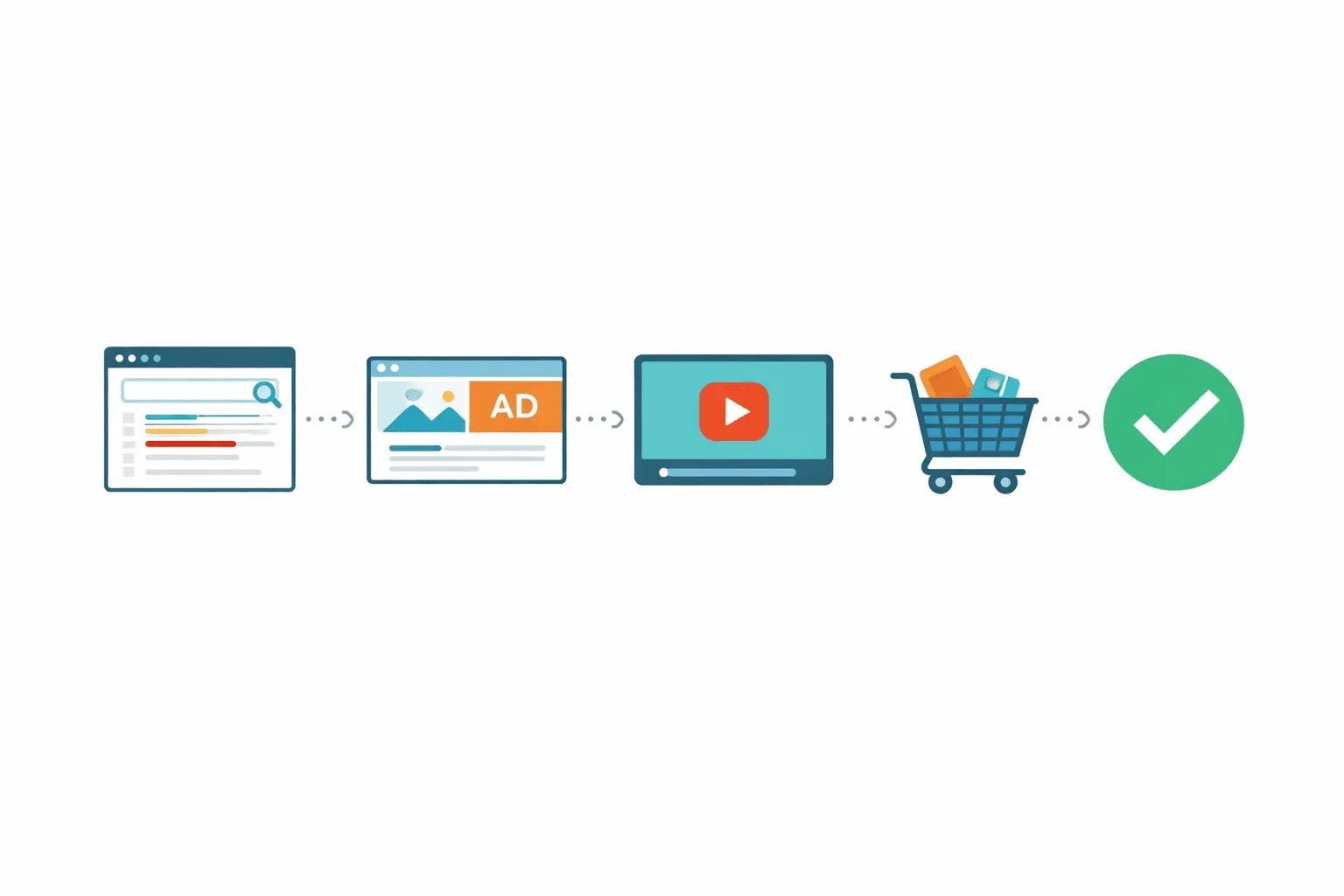
Most Amazon sellers look at ACOS and ask one question: did this campaign pay for itself? It is a reasonable question, but it is also incomplete. A customer who converts after seeing a Sponsored Brands ad on Monday, a Sponsored Display retargeting unit on Thursday, and finally clicking a Sponsored Products result on Saturday does not show up cleanly in any single campaign report. Last-click attribution flatters Sponsored Products and systematically undersells everything else in your advertising stack. Amazon's Conversion Path Report changes that. Since going fully live worldwide in late 2025 and reaching all managed-service DSP accounts in early 2026, it now surfaces the complete 30-day sequence of ad touchpoints that preceded every sale — which Sponsored Products, Sponsored Brands, Sponsored Display, Sponsored TV, and DSP impressions contributed, and in what order. For sellers who know how to read it, it is the clearest view yet into what is actually driving purchases. Most are not using it. This guide explains how to change that.

What the Amazon Conversion Path Report Actually Shows
Before diving into tactics, it helps to understand exactly what the report does and does not capture, because its boundaries shape how you should interpret the data.
The 30-Day Attribution Window and the Top-5 Paths View
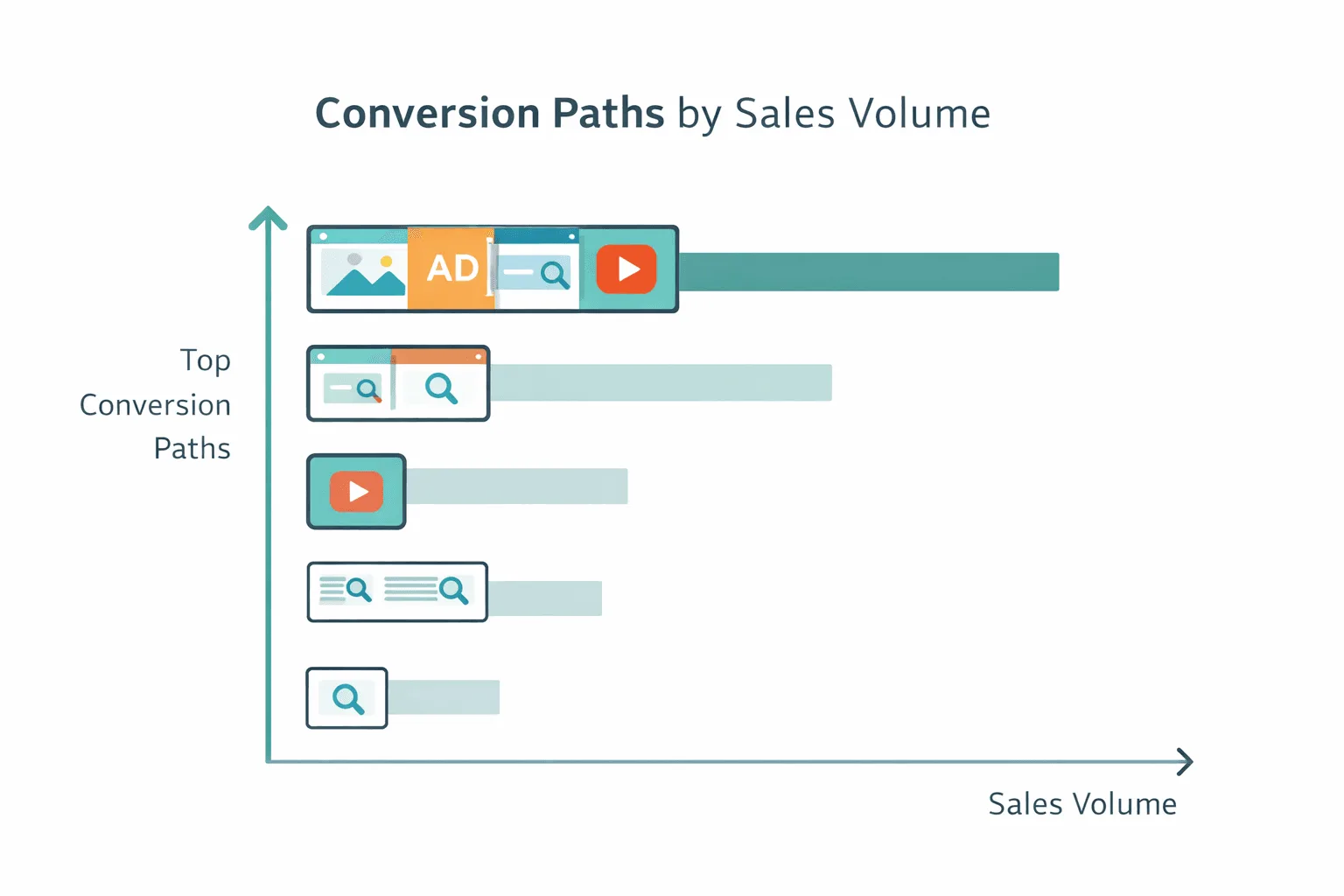
The Conversion Path Report displays the top five customer conversion paths within a 30-day window prior to purchase. For each path, you see the ordered sequence of ad interactions — the specific ad types the customer encountered — ranked by total sales volume attributed to that path pattern. Think of it as Amazon's answer to the question: "What does the typical journey to a purchase actually look like, in terms of how people interact with my ads?"
Paths are visualised at the ad-type level rather than the campaign or keyword level. So you will see a path like "Sponsored Brands → Sponsored Products → Sponsored Products" rather than something tied to individual search terms or targeting groups. This is both a feature and a limitation, which we will address later.
The report covers five ad formats: Sponsored Products, Sponsored Brands, Sponsored Display, Sponsored TV, and Amazon DSP. Historical data is available from September 2025 onward. Access is through the Ad Console reporting section, the Amazon DSP interface, and the Amazon Ads API for programmatic reporting.
The Attribution Gap This Closes
Traditional last-click attribution — still the default for most campaign-level reporting — credits the final ad touchpoint before purchase and ignores every interaction that came before it. For sellers running only Sponsored Products, this is largely fine. But for sellers who have expanded into Sponsored Brands video, Sponsored Display audience targeting, or upper-funnel DSP, last-click data creates a dangerous blind spot: it makes those upper-funnel investments appear to generate zero direct return, which leads to budget cuts that damage the very pipeline feeding your lower-funnel conversions.
The Conversion Path Report makes that pipeline visible. When you see that 38% of your highest-value conversion paths started with a Sponsored Brands video impression, you have a concrete data-backed case for maintaining — or increasing — that spend, even if the Sponsored Brands campaign's own ACOS looks weak in isolation.
The 3 Most Common Conversion Path Patterns (and What Each One Tells You)
Sellers who review their top conversion paths regularly tend to encounter a few recurring structures. Understanding what each pattern signals shapes how you should respond.
Pattern 1: Single-Touch Sponsored Products Paths
The most common path for new sellers and narrowly-focused SKUs is a single Sponsored Products touchpoint — the customer searched, clicked, and bought in one session. If this dominates your top five paths, your advertising mix is either very efficient for high-intent shoppers or, more likely, heavily skewed toward bottom-of-funnel capture. You are reaching buyers who already know what they want. The risk is that you are not doing enough to build awareness among buyers who do not yet know your product exists.
This is useful information for brand investment decisions, not necessarily a problem to fix immediately, but it tells you that your current spend is working in a very narrow, conversion-focused window.
Pattern 2: Upper-Funnel Entry, Lower-Funnel Close
The more commercially interesting pattern is a multi-touch path that starts with an upper-funnel format — Sponsored Brands, Sponsored Display, or Sponsored TV — and closes through Sponsored Products. This is evidence that your awareness spend is genuinely influencing downstream purchase decisions, even when the individual Sponsored Brands or Display campaign reports look disappointing on last-click metrics.
Sellers who see this pattern frequently should treat it as a signal to protect their Sponsored Brands and Display budgets more aggressively. Cutting them to hit a short-term ACOS target often costs you the entry point that was generating high-quality prospects for your Sponsored Products campaigns.
Pattern 3: Sponsored Brands as Both Discovery and Close
A smaller but high-value subset of paths shows Sponsored Brands appearing multiple times, or as both the entry and the closing touchpoint. This tends to correlate with brand-name queries and repeat-purchase categories. If you see this pattern, your Sponsored Brands campaigns are doing more work than their ACOS suggests — they are building the brand familiarity that drives both first-touch discovery and the final search that converts.
How to Act on Conversion Path Data: A Practical Framework
Understanding the data is only useful if it changes how you allocate spend and set bids. Here is a structured approach to translating conversion path insights into campaign decisions.
Identify Which Ad Formats Are Missing From Your Top Paths
Start by asking a simple diagnostic question: which ad formats appear in your top five conversion paths, and which are absent? If Sponsored Display never appears, either you are not running it or it is not contributing meaningfully to conversions. If Sponsored Brands appears in every path, but your Sponsored Brands budget is capped below its delivery potential, you have a clear priority for reallocation.
This is also where you spot imbalances. A seller spending 90% of their ad budget on Sponsored Products but seeing that 60% of conversion paths include a Sponsored Brands touchpoint has a structural budget misalignment that last-click reporting would never reveal.
Rebalance Budgets Based on Path Frequency, Not Just Campaign ACOS
The most direct action is to shift budget away from campaigns that appear only in low-frequency paths — or that never appear in the top five at all — toward the ad types that anchor the highest-volume paths. If your top path by sales volume is "Sponsored Brands → Sponsored Products," increasing the Sponsored Brands budget by 20% may be more impactful than reducing CPCs on an already-efficient Sponsored Products campaign.
Use Path Data to Justify Longer Attribution Windows in Reporting
Sellers who review performance on a 7-day attribution window are structurally blind to the multi-session journeys that conversion path data makes visible. If your top conversion paths show customers taking 8-14 days from first ad touch to purchase, your standard weekly reports are systematically undercounting revenue from upper-funnel activity. Adjusting your reporting timeframes to align with actual purchase cycle length improves the accuracy of every ROAS and ACOS calculation you make.
Where AI Automation Beats Manual Analysis
The practical limitation of conversion path review is that it requires regular manual attention. Most sellers check it once, draw a few conclusions, adjust budgets, and then forget to revisit it as seasonal patterns and competitive dynamics shift. Path composition changes — what worked in Q4 may look completely different in Q2. An AI-powered platform like Autron continuously ingests performance signals across all your ad types, including the halo effects that conversion path data makes visible, and adjusts bids and budgets in real time rather than waiting for a monthly or quarterly review cycle to surface the insight.
This matters most when you are scaling. Manual path analysis is tractable for a seller running 50 campaigns. It becomes unworkable at 500 campaigns across multiple ASINs and markets.
The Honest Limits of Conversion Path Reporting (And How to Work Around Them)
No attribution tool is perfect, and conversion path reporting has constraints that are worth understanding before you make significant budget decisions based solely on it.
The Top-5 Cap Hides Long-Tail Path Diversity
Amazon surfaces only the five most common paths by sales volume. This is useful for understanding your dominant conversion patterns, but it obscures the diversity of how customers actually interact with your ads. For high-SKU sellers or those in fragmented categories, the top five paths may represent a small fraction of total conversion events, with hundreds of less-common paths making up the majority. The absence of a format from the top five does not mean it is not contributing — it may simply mean its contribution is spread across too many variants to surface in a five-path view.
The 30-Day Window Has Category-Specific Blind Spots
The 30-day attribution window is long enough to capture most considered purchases but still misses genuinely long buying cycles — home improvement, B2B supplies, and high-ticket consumables where research spans 60-90 days. If your category has an unusually long purchase consideration period, conversion path data will undercount the contribution of early-funnel touchpoints.
The practical workaround is to use conversion path data directionally rather than as a precise accounting of every ad dollar's contribution. Treat it as evidence for or against rebalancing decisions, not as a definitive revenue attribution system.
Conclusion: Stop Optimising With One Eye Closed
Amazon's Conversion Path Report is not a minor reporting update. It is a structural shift in how sellers can understand the relationship between their ad formats and their actual revenue. Used correctly, it prevents the common mistake of cutting upper-funnel spend because it appears not to convert, when in reality it is generating the first touchpoints that make every lower-funnel conversion possible.
The sellers who build conversion path review into their weekly workflow — and pair it with automated bid management that acts on multi-signal performance data continuously — will have a measurable advantage over those still optimising by last-click ACOS alone.
If you want an AI platform that does this automatically, Autron is built for exactly this: goal-based bid optimisation that accounts for the full performance picture across your entire ad stack, not just the final click. Try Autron for free at https://autron.ai.